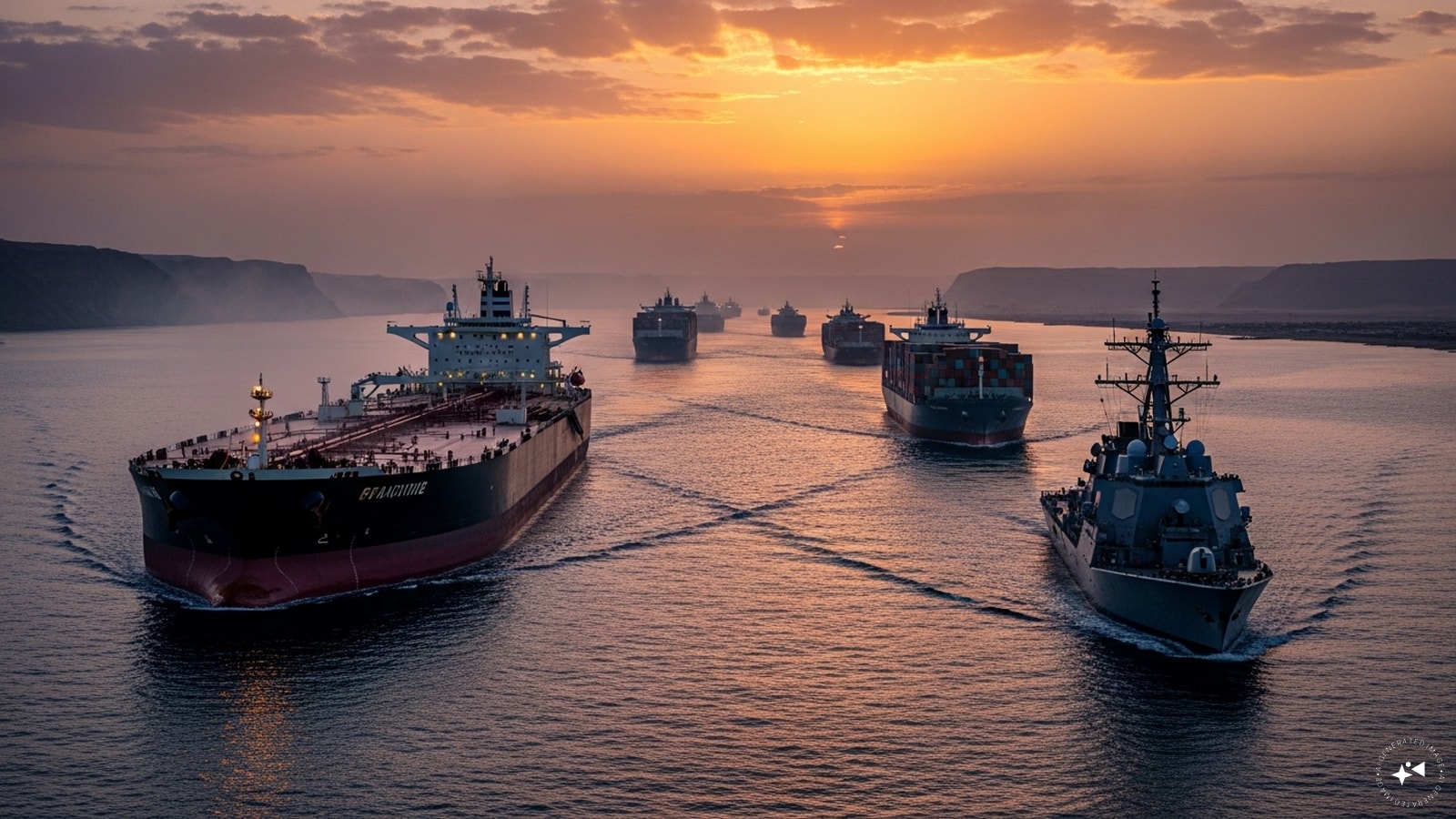
The sea does not care about geopolitics. To the black water of the Persian Gulf, a supertanker loaded with two million barrels of crude oil is just another heavy object fighting against the tide. But to the men on the bridge of the Sina I, a rusted, reflagged vessel running without its transponder, the water feels heavy with invisible tripwires.
They are moving through the Strait of Hormuz.
At its narrowest point, this shipping lane is only twenty-one miles wide. It is the choke point of the modern world. Through this throat of water passes a fifth of the global oil supply. Right now, a quiet, desperate race is unfolding here. Ships linked to Iranian trade are pushing their engines to the limit, slipping through the strait before a threatened American blockade locks the gates shut.
To understand the global economy, you have to look at the rust on the hull of ships like the Sina I.
The Weight of Two Million Barrels
On the bridge, the air smells of stale tobacco and salt. Let us call the man at the helm Reza. He is not a politician. He is a mariner with a wife in Bushehr and a son who wants to study computer science in Tehran. Reza’s job is simple in theory and terrifying in practice: keep the ship moving, avoid the patrol boats, and do not make mistakes.
Under his feet is a cargo worth over one hundred and fifty million dollars. If the ship gets seized, his career is over. If the ship collides with another in the crowded lane because they are running "dark"—with their Automatic Identification System turned off—he might not survive to see his retirement.
Running dark is a calculated risk. When a vessel switches off its transponder, it vanishes from global tracking screens. It becomes a ghost. But you cannot hide a three-hundred-meter steel monster from the naked eye, nor from the high-resolution military satellites hovering in the thermosphere. The goal is not true invisibility; the goal is plausible deniability. It is a shell game played with flag registration, shell companies in Panama, and ship-to-ship transfers under the cover of night.
The impending blockade has stripped away the luxury of time.
Usually, the shadow fleet moves with cautious deliberation, waiting for the perfect moment to transfer oil to other buyers in international waters. Now, there is a frantic rush. The United States has signaled a tighter, more aggressive enforcement posture, aiming to choke off the remaining avenues of Iranian oil exports. For the operators of these vessels, every hour of delay is a step closer to financial ruin.
The Anatomy of a Choke Point
Why does this narrow strip of water matter to someone buying gasoline in Ohio, or heating oil in Hamburg?
The math is brutal. The world consumes about one hundred million barrels of oil every single day. Nearly twenty million of those barrels must pass through the Strait of Hormuz. There is no easy alternative route. Pipeline networks across Saudi Arabia and the United Arab Emirates can bypass the strait, but they can only handle a fraction of the volume.
The Strait of Hormuz is a geographic bottleneck that cannot be bypassed.
+--------------------------------------------------------+
|             Global Oil Flow via Hormuz                 |
+--------------------------------------------------------+
| Total Global Daily Consumption: ~100M barrels          |
| Passed through Hormuz Daily:    ~20M barrels (20%)     |
| Bypassed via active pipelines:  ~3M to 5M barrels max  |
+--------------------------------------------------------+
When tensions spike here, insurance premiums for shipping companies skyrocket. A single spark can triple the cost of moving cargo overnight. For the shadow fleet, which operates outside mainstream maritime insurance circles, the stakes are even crazier. They rely on obscure, state-backed, or unregulated insurers. If something goes wrong—an oil spill, a ground collision, an explosion—there is no safety net.
But the rewards match the risk. The discount on sanctioned Iranian crude is steep enough to entice buyers who are willing to look the other way. For refineries in Asia, particularly independent operations in China, this discounted oil is the lifeblood of their margins.
The system relies on a delicate balance of looking the other way. But that balance is tipping.
The Mirage of the Iron Curtain at Sea
The term "blockade" conjures images of steel walls, battleships lined up crest-to-crest, and warning shots fired across bows. The reality of a modern maritime blockade is far more tedious and far more dangerous.
It begins with paperwork.
Long before a warship ever intercepts a tanker, the blockade is enforced in bank offices in New York, London, and Singapore. It is enforced by denying access to the SWIFT banking network, blacklisting ship management companies, and threatening port operators with secondary sanctions if they service suspect vessels.
But paper blockades have limits. When a nation’s economic survival is on the line, paper is easily burned.
This is where the physical reality of the sea reasserts itself. If the United States deploy naval assets to actively intercept, board, and redirect vessels linked to Iran, they enter a legal and military minefield. Under international maritime law, boarding a sovereign nation’s flagged vessel in international waters can be interpreted as an act of war.
Consider what happens next if a boarding action goes wrong. A nervous crew member makes a sudden movement. A warning shot hits a volatile valve on the deck of a supertanker. The result is not just a diplomatic crisis; it is an environmental catastrophe that could coat the shores of the Gulf in toxic sludge, halting desalination plants that supply drinking water to millions in Qatar, Bahrain, and the Emirates.
The sailors on the Sina I know this. They know they are shields in a high-stakes poker game.
The Whispers in the Static
On the radio, the static is a constant hum, interrupted occasionally by the crisp, authoritative voices of coalition warships patrolling nearby. They ask for names, destinations, cargo manifests.
Most of the time, the ghost ships ignore the queries, or they reply with pre-scripted falsehoods. They claim to be carrying "bituminous mixtures" or "fuel oil of Malaysian origin." Everyone involved in the conversation knows it is a lie. The naval officers on the destroyers know it. The captains of the tankers know it. The traders in Geneva know it.
But the lie is the grease that keeps the machinery of global trade from seizing up entirely. It allows leaders to claim they are enforcing rules while allowing just enough oil to flow to prevent a global price shock that would destabilize Western political elections.
Now, however, the pressure is mounting. The rhetoric from Washington has hardened. The quiet tolerance of the shadow fleet is evaporating.
For Reza, the tension manifests as a tight knot in his shoulder blades. He watches the radar sweep. Every blip could be a patrol boat. Every shadow on the horizon could be the gray hull of a warship waiting to make an example of his vessel. He orders the lookouts to double their vigilance. They peer through the heavy haze of the Gulf summer, where the humidity clings like a wet wool blanket and the horizon disappears into a dusty, white glare.
The Human Cost of the High-Stakes Game
It is easy to view this through the lens of dry geopolitical analysis. We talk of "vessel movements," "export volumes," and "diplomatic leverage."
But the ships are made of steel, and they are manned by people.
Most of the crews on these shadow tankers are not ideologues. They are merchant mariners from Russia, Ukraine, India, Syria, and the Philippines. They take these jobs because the pay is higher than on legitimate runs—a premium paid to compensate for the risk of operating without proper insurance, without legal protection, and with the constant threat of detention.
If a ship is seized, the crew is often stranded. They can spend months, sometimes years, stuck on anchored vessels, caught in legal limbo while diplomatic battles rage over their heads. They run out of fresh water. Their food spoils. They cannot go home, and they cannot leave the ship.
This is the hidden cost of the energy we take for granted. Every time we flip a light switch or pump fuel into our cars, we are connected to this fragile web of desperate sailors, rusted hulls, and midnight ship-to-ship transfers in the humid darkness of the Persian Gulf.
The Sina I slowly makes its way past the island of Larak. The water deepens. The narrowest part of the strait lies behind them now, but the danger is far from over. They must still navigate the open waters of the Arabian Sea, where the shadow of enforcement grows longer by the day.
The engine room rumbles beneath Reza's feet, a steady, rhythmic heartbeat that sounds like a countdown. The sunset turns the Gulf water the color of bruised plums. The ship sails on, a dark silhouette carrying the fuel of a world that is running out of patience.