The air in the control room always smells faintly of stale coffee and hot copper. Outside, thirty miles away across the flat, metallic swell of the Persian Gulf, the horizon blurs into a thick, salt-heavy haze. But inside, illuminated by the cold blue glow of radar glass, the world is reduced to green vectors, creeping digits, and the slow, heavy tick of a digital clock.
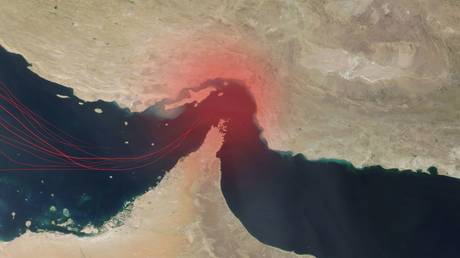
For the watchstander tracking the tactical display, the Strait of Hormuz is not merely a line on a map. It is a throat. Just twenty-one miles wide at its narrowest point, this maritime bottleneck carries nearly a fifth of the world’s petroleum supply. Every tanker that slips through those twenty-one miles is a fragile glass bead on a high-wire, watched by unblinking lenses on the jagged Iranian coastline.
Recently, the Islamic Revolutionary Guard Corps made a striking claim that sent ripples through defense intelligence circles and global shipping boardrooms alike. They announced that United States warships had fled the Strait.
To the casual observer scanning a headline on a commuter train, the word sounds absolute. Fled. It evokes images of panic, of white wakes churning in desperate retreat, of a superpower tucking tail and running from a hostile shore. But naval strategy is written in a language far more subtle than press releases. Ships do not simply run. They maneuver. They posture. They calculate risk down to the millimeter.
To understand what actually happened in those choked waters, we have to step away from the political posturing and look at the physical reality of modern naval warfare.
The Anatomy of a Choke Point
Picture a two-lane highway carved through a narrow mountain pass, except the road is made of salt water, and every vehicle is a floating city of steel carrying millions of barrels of volatile crude. That is the Strait of Hormuz.
Inbound traffic hugs the Omani side; outbound traffic skirts the Iranian side. Between them lies a two-mile-wide buffer zone designed to keep massive supertankers from colliding. It is a delicate choreography executed daily by oil executives, captains, and military commanders who know that a single miscalculation could shut down global energy markets in an afternoon.
For decades, the United States Navy has maintained a persistent presence here. Guided-missile destroyers, cruisers, and amphibious assault ships patrol these waters to guarantee freedom of navigation. It is a show of force meant to deter disruption. Yet presence in a confined space is a double-edged sword.
A multi-billion-dollar destroyer is a formidable machine, capable of tracking dozens of supersonic threats simultaneously. But within the claustrophobic confines of the Persian Gulf, it is also a target trapped in a shooting gallery.
When military analysts evaluate the positioning of surface action groups in the Gulf, they do not talk about cowardice. They talk about standoff distance, sensor horizons, and asymmetric threat mitigation. The IRGC operates thousands of fast-attack craft—small, agile, heavily armed speedboats capable of swarming lumbering capital ships. They also maintain sophisticated anti-ship cruise missile batteries hidden among the rocky crags of Qeshm Island and the mainland coast.
To keep a surface warship parked right on the doorstep of an adversary within a twenty-one-mile channel is not necessarily a sign of strength. Sometimes, it is simply bad geometry.
The Shift in the Shadows
Ask any veteran who has stood watch in the Arabian Gulf about the summer heat, and they will tell you about the humidity that coats the skin like a warm damp towel. They will also tell you about the psychological weight of the watch. You are never alone out there. Radar scopes are perpetually cluttered with ghost contacts, local fishing dhows, commercial tankers, and fast-moving blips that vanish as quickly as they appear.
When reports surface that American naval assets have shifted positions—moving further out into the broader expanse of the Gulf of Oman or deeper into the Arabian Sea—it is rarely a sudden evacuation. It is the result of a quiet, continuous recalculation of risk.
Consider the evolution of naval warfare over the past decade. The advent of advanced drone technology, loitering munitions, and hypersonic coastal defense systems has drastically shortened response times. In a narrow strait, a ship has mere minutes to detect, track, and neutralize an incoming threat skimming just above the wave tops.
Moving a carrier strike group or a surface action group away from the immediate pinch point does not mean abandoning the mission. It means changing the chessboard. It means relying on long-range aviation, networked satellite intelligence, and allies in the region while keeping high-value assets out of the direct blast radius of land-based coastal batteries.
The IRGC frames this repositioning through the lens of psychological dominance. In the theater of public perception, forcing a rival fleet to adjust its posture is portrayed as a victory of will. But military planners view it through the lens of tactical flexibility. A ship that is out of visual range of the coastline is not gone; it is simply outside the trap.
The Human Cost of the Game
We lose sight of the humans in these equations. We talk about tonnage, missile payloads, and geopolitical posturing as if they were pieces on a board moved by disembodied hands.
Imagine being an eighteen-year-old sailor from the American Midwest, standing watch on the bridge wing of a destroyer at three in the morning. The air is thick with diesel exhaust and saltwater spray. The radio crackles with chatter in multiple languages. Every radar sweep is a heartbeat. You cannot see the shore, but you know it is there, watching you back.
On the other side of that water, an Iranian fisherman checks his nets, keeping a wary eye on the gray silhouettes on the horizon, knowing that his livelihood is tied to waters bristling with potential catastrophe.
Both sides are locked in a high-stakes standoff where neither actor wants a full-scale war, yet both are trapped in a cycle of mutual deterrence. Every movement is scrutinized. Every radio hail is a potential flashpoint.
When American warships reposition, the sailors are not celebrating a retreat, nor are they mourning a defeat. They are executing orders designed to keep them alive in an environment where the margin for error is razor-thin. They are adapting to a theater where technology has made close-quarters naval presence an increasingly perilous gamble.
The Quiet Water Ahead
The Strait of Hormuz remains. The tankers keep moving, their hulls riding low in the water, heavy with the black lifeblood of the global economy. The radar screens in the control rooms still glow with green light, tracking the endless dance of steel and salt.
The claims made by regional commanders will continue to echo through news cycles, traded like currency in the ongoing war of narratives. Headlines will use dramatic verbs. Pundits will parse every nautical mile of movement for signs of weakness or strength.
Yet the reality of power projection in the twenty-first century is not about planting a flag in a narrow channel and refusing to budge. It is about mobility, adaptability, and the quiet understanding that the most dangerous place in the world is often the place where you stand still too long.
The ships have not vanished. They have simply stepped back into the deeper blue, waiting, watching, and keeping the peace from the shadows.