The air in the control room always smells of hot circuit boards and stale coffee, no matter what time the sun rises over the horizon.
I remember staring at the glowing amber lines of a tracking map years ago, watching the tiny blue icons represent ships that were just carrying crude oil, yet acting like weighted chess pieces on a board where a single miscalculation could crack the global economy wide open. You sit there in the dim light, listening to the hum of the ventilation, and you realize that distance is an illusion. A word spoken into a microphone in Washington ripples instantly across oceans, vibrating against the hulls of tankers idling in the Persian Gulf.
Right now, that vibration is sharper than ever.
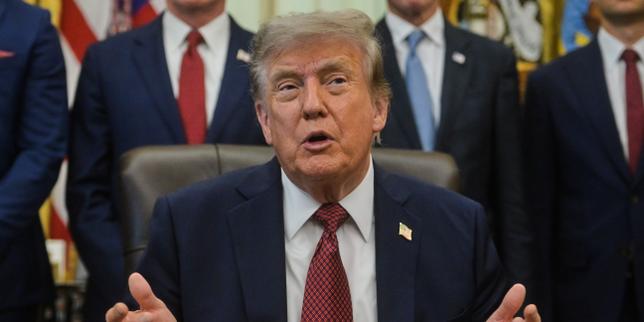
Donald Trump sits at the center of a familiar storm, holding a telephone in one hand and a sledgehammer in the other. He tells reporters, and the world, that negotiations with Iran are happening behind heavy doors, conducted through quiet channels where silence is often valued more than progress. But the dual nature of his strategy refuses to stay quiet. Even as the diplomatic lines are cast, the rhetoric sharpens, accompanied by explicit warnings that the alternative to a deal is an escalation of airstrikes so severe it would redraw the tactical map of the region.
Consider what happens next in a standoff built on contradictions.
Diplomacy usually requires a certain softness, a willingness to let the other side save face while compromises take root. This approach operates differently. It is an architecture of maximum pressure, where the olive branch is extended with one hand while the other rests heavily on a detonator. To the negotiators in Tehran, the message is clear and brutal: talk or break.
To understand why this strategy feels so precarious, you have to look past the podiums and the breaking news banners. You have to look at the geometry of fear.
Imagine a family sitting in an apartment in a major metropolitan center within the blast radius of these geopolitical calculations. They are not thinking about nuclear enrichment curves or diplomatic communiques. They are listening to the wind rattle the glass, wondering if tomorrow the grocery stores will have flour, wondering if the sirens will sound before the morning commute. Their reality is visceral. It is grounded in the sound of breaking plaster and the sudden, breathless silence that follows an explosion.
When leaders talk about intensifying strikes, they speak in the clean, sanitized language of strategy. They talk about degrading capabilities, neutralizing threats, and restoring deterrence. They use acronyms that distance the mind from the consequence. But the human element does not vanish just because it is ignored in a press briefing. Every tactical escalation leaves a footprint in ash.
Trump has always favored this binary rhythm. Break the existing framework, force the adversary to the brink of total collapse, and then wait to see who blinks first. It worked in trade disputes, it shaped his previous Middle Eastern policies, and now it is being reapplied to an adversary that has decades of experience absorbing pressure and waiting out American administrations.
The danger lies in the stubbornness of pride.
Iran is not an isolated actor that will simply fold because the economic squeeze tightens or the military threats grow louder. Decades of sanctions have forged a leadership class that views defiance as an existential requirement. When backed into a corner, they do not necessarily look for an exit; they look for a lever of retaliation. They look at the Strait of Hormuz, that narrow watery artery through which a massive portion of the world's oil flows, and they know that causing a tourniquet there makes the entire world bleed.
So we find ourselves suspended in an uneasy twilight.
Negotiators whisper behind closed doors while military commanders brief on payload capacities and target coordinates. The public watches the headlines bounce between the promise of a historic breakthrough and the threat of an immediate, devastating campaign of bombings.
There is no neat formula for this. You cannot predict the exact moment a bluff is called or a misunderstanding turns into a conflagration. History is littered with the wreckage of leaders who thought they could manage the temperature of a crisis right up to the boiling point, only to find that the vessel itself had shattered.
The coffee in the control room gets cold. The tracking icons keep moving, slow and steady, across the digital sea. Somewhere out there, a captain looks up at the stars and wonders if tomorrow will bring a port or a trap. And the rest of us wait, bound to the outcome of a game where the stakes are measured not in points or percentages, but in the quiet, irreparable loss of lives caught between a phone call and a bomb.