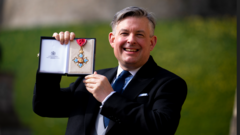
When Chris Mullin, the former British Labour minister and seasoned diarist, found his speech shattered by a stroke, he did not turn first to the sterile repetitions of standard clinical workbooks. He turned to the Bard. By reciting the "To be, or not to be" soliloquy from Hamlet, Mullin claims he rewired his brain’s connection to language. While the story makes for a charming anecdote about the power of the humanities, it points toward a significant, underfunded reality in neurological rehabilitation. Rhythmic, complex language—specifically iambic pentameter—triggers neural pathways that simple prose cannot reach.
Speech recovery after a stroke is rarely about "relearning" words. The words are often still there, locked in the brain's basement. The challenge is the delivery system. A stroke in the left hemisphere frequently results in aphasia, damaging the centers responsible for logic and syntax. However, the right hemisphere, often associated with melody and rhythm, frequently remains intact. By leaning on the structured, musical cadence of Shakespeare, patients like Mullin are essentially hot-wiring their speech through the right side of the brain.
The Mechanical Advantage of Iambic Pentameter
Standard speech therapy often focuses on functional phrases. "I would like a glass of water" is useful, but it is also rhythmically flat. It provides no momentum. In contrast, Shakespearean verse operates on a strict heartbeat. The iambic pentameter—ten syllables per line, alternating unstressed and stressed beats—mimics the natural human pulse.
For a brain struggling to coordinate the fine motor movements of the tongue, lips, and larynx, this rhythm acts as a metronome. It provides a predictable framework. When the brain knows exactly when the next "stress" is coming, it can prepare the physical apparatus of speech more efficiently. This isn't just a literary preference; it is a bypass of the damaged linguistic processor in favor of the rhythmic motor cortex.
Why Prose Fails Where Poetry Succeeds
Prose is unpredictable. It stops and starts at the whim of the speaker. For a stroke survivor, this lack of structure is a minefield. Every new word requires a fresh decision.
Poetry removes the burden of choice. When reciting a known text, the sequence is fixed. This allows the patient to focus entirely on the physicality of articulation. Research into Melodic Intonation Therapy (MIT) has long shown that patients who cannot speak a sentence can often sing it. Reciting verse sits in the "sweet spot" between speech and song. It offers the melodic benefits of singing while maintaining the articulatory precision of spoken word.
The Social Isolation of the Silent
The tragedy of stroke recovery is not just the loss of words, but the loss of the self. Mullin’s choice of Hamlet is particularly pointed. A politician’s career is built on the mastery of rhetoric; to lose that is to lose one’s identity. The psychological barrier to recovery is often as high as the physiological one.
Standard exercises can feel infantilizing. Repeating "The cat sat on the mat" reminds a patient of what they have lost. Reciting "The slings and arrows of outrageous fortune" reminds them of who they are. It restores dignity. By engaging with high-level intellectual material, the patient remains connected to their pre-stroke persona. This emotional engagement is a powerful driver of neuroplasticity. The brain heals faster when it is interested in the task at hand.
The Limits of Narrative Medicine
We must be careful not to paint this as a miracle cure for every survivor. The success of "The Shakespearean Cure" depends heavily on the location of the brain lesion.
- Broca’s Aphasia: Patients generally understand language but struggle to produce it. These individuals benefit most from rhythmic recitation.
- Wernicke’s Aphasia: Patients can speak fluently, but the words are nonsense. For them, reciting Shakespeare might result in "word salad" delivered with perfect meter—helpful for morale, perhaps, but less effective for functional recovery.
The medical establishment has been slow to integrate these "soft" interventions into standard care. Insurance companies and public health boards want measurable, repeatable data. They want 50 repetitions of a specific phoneme, not a dramatic reading of Macbeth. However, this rigid adherence to "pure" clinical data ignores the holistic nature of the human nervous system.
The Economic Argument for Artistic Intervention
Neuro-rehabilitation is expensive. It requires hundreds of hours of one-on-one time with specialists. If a patient can supplement their clinical hours with self-directed recitation of classic literature, the burden on the healthcare system drops.
We are seeing a shift in how we view "brain exercises." The focus is moving away from digital apps and toward high-utility, traditional activities. Learning a new language, playing an instrument, or memorizing verse creates a cognitive reserve. This reserve doesn't just help with recovery; it acts as a buffer against future decline.
The mechanism at play here is simple. Complex language requires more "compute power" from the brain. By forcing the brain to handle the nuances of 16th-century syntax, the patient is essentially performing high-intensity interval training (HIIT) for their neurons.
Breaking the Silence
The case of Chris Mullin shouldn't be dismissed as an eccentric anecdote from the British elite. It is a proof of concept. When the primary linguistic highways are blocked by a clot or a bleed, the brain must find the backroads.
These backroads are paved with rhythm, rhyme, and emotional resonance. The future of stroke therapy may well lie in the past. Instead of just handing a patient a tablet with a speech app, we should be handing them a book of sonnets.
The brain is not a computer; it is a muscle that responds to the beauty of its own mechanics. To fix the machine, you have to find the right frequency. For many, that frequency is found in the iambic beat of a four-hundred-year-old play.
If you or a loved one are navigating the slow road of recovery, start small. Do not wait for a therapist to suggest it. Find a poem you once knew by heart. Feel the rhythm of the lines before you worry about the meaning of the words. Let the meter do the heavy lifting for your tongue.
Challenge your local rehabilitation center to incorporate a "Verse for Voices" program.