The hospital basement smells of ozone and industrial floor cleaner at three in the morning. It is a quiet, heavy cold that settles into the bones of anyone waiting there. For decades, this hour belonged entirely to the exhausted. It belonged to surgeons with trembling hands, downing bitter coffee from paper cups, praying their focus wouldn't slip during the fifth hour of an emergency laparoscopy.
Surgeons are trained to be gods of precision. But gods get tired. Their eyes blur. Their fingers, however finely tuned, possess a microscopic tremor born of nothing more than a heartbeat. Recently making headlines in this space: The Geopolitical Friction Function: Why a Single Transrouted EUV Unit Changes Nothing for China.
Now, look at the corner of the operating theater. There is a new silhouette standing under the harsh LED arrays. It does not drink coffee. It does not have a pulse. And recently, it passed an invisible threshold that changes medicine forever.
A Chinese-developed surgical robotic system quietly secured the European Union’s CE mark, granting it entry into some of the most strictly regulated operating rooms in the world. Simultaneously, a medical artificial intelligence model developed in the same ecosystem quietly claimed the top spot on a global clinical benchmark, outperforming existing systems in diagnostic accuracy and real-time surgical guidance. More information into this topic are covered by The Verge.
To the business world, this is a milestone of trade and geopolitical positioning. To a patient lying on a sterile table, stripped of their clothes and their certainty, it is something entirely different. It is the beginning of an era where the hand cutting into your flesh is guided by a mind trained on millions of surgeries it never actually performed.
The Ghost in the Scalpel
To understand what just happened, we have to look past the shiny metal arms and the glossy press releases. Think of a master chef. A master chef knows exactly how much pressure to apply to a knife to slice a tomato without bruising the flesh. They know it by feel, developed over thirty years of trial and error.
Now, imagine trying to teach that exact feeling to a machine.
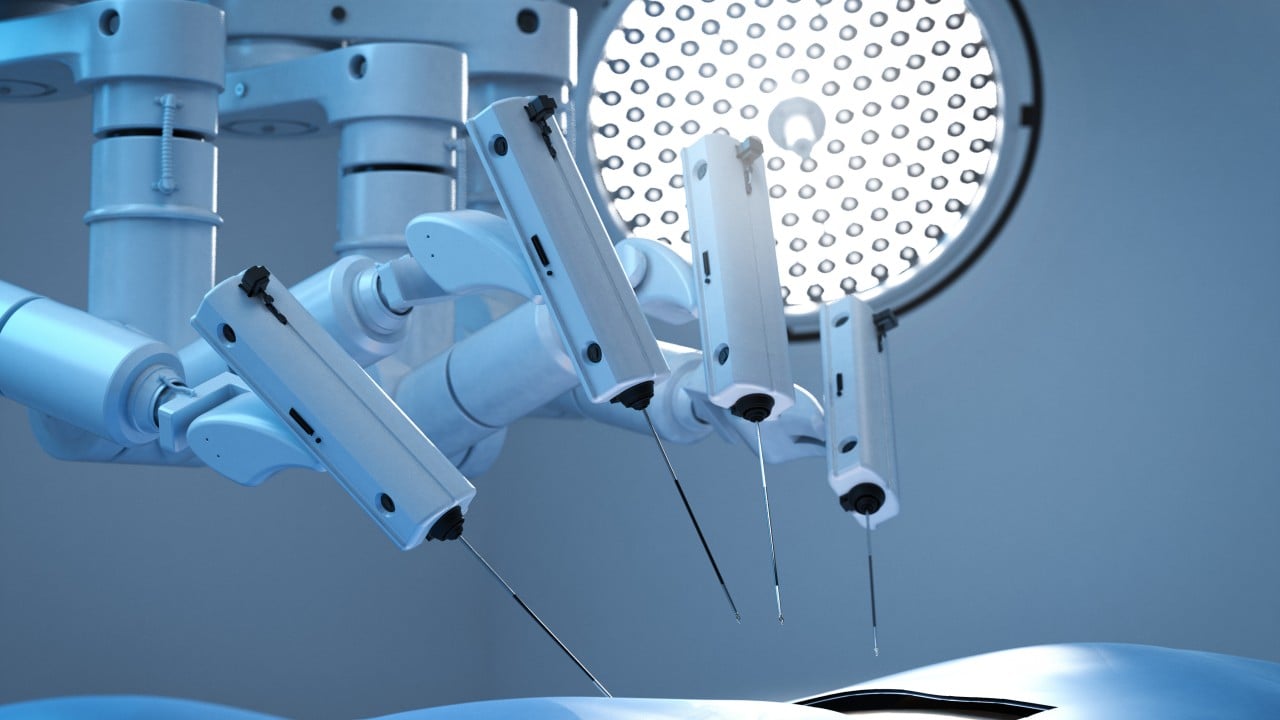
For years, surgical robots were merely expensive puppets. A human surgeon sat at a console across the room, peered through a 3D viewfinder, and manipulated joysticks. The robot copied the human. If the human moved an inch, the robot moved an inch. It was mechanical translation. Useful, yes, because it allowed for tiny incisions, but the brain of the operation was still entirely human.
The shift happening right now is profound. The latest AI models do not just translate movement; they predict it.
When a surgeon prepares to dissect a tumor hidden behind a delicate web of blood vessels, the AI model scans the live video feed. It compares the visual data against a massive digital library of anatomical variations. It knows, statistically, what lies beneath the next layer of tissue before the steel ever touches it.
If the surgeon’s hand moves slightly off-course due to fatigue, the system corrects the trajectory in real-time. It is a subtle, invisible partnership. The machine does not replace the doctor; it wraps them in a digital safety net.
The Weight of the Benchmark
We live in a culture obsessed with scores. We want to know who is number one, which phone has the fastest processor, which car goes from zero to sixty the quickest. In the world of medical AI, the benchmarks are much higher stakes than a smartphone speed test.
The benchmark recently topped by this new model evaluates an AI's ability to comprehend complex medical data, reason through multi-step diagnostic puzzles, and accurately identify complications during live procedures. Imagine a medical board exam, but instead of multiple-choice questions on paper, the exam consists of hundreds of chaotic, unpredictable real-world scenarios thrown at a screen at lightning speed.
The AI scored higher than any system before it.
But numbers on a spreadsheet do not save lives in a clinic in Munich or a regional hospital in Lyon. The true victory is the regulatory approval. The European Union’s CE mark is notorious for its bureaucratic rigor. European regulators do not care about tech industry hype. They care about failure rates. They care about what happens when the power goes out, or when a patient’s anatomy does not match the textbook.
Winning that approval means the technology has transitioned from a laboratory miracle to a practical, dependable tool. It means the skepticism of traditional medicine is beginning to melt away under the weight of undeniable data.
The Human Cost of Precision
Let us step away from the data for a moment and consider a hypothetical patient. We will call her Sarah.
Sarah is forty-two. She has two children, a dog that barks at the mailman, and a malignant mass deep within her pelvic cavity. The mass sits millimeters away from a major artery. A fraction of a millimeter to the left during her operation, and she bleeds out on the table. A fraction of a millimeter to the right, and the surgeon leaves behind cancerous cells that will return in six months.
Traditionally, Sarah’s life depends entirely on her surgeon's sleep schedule, their caffeine intake, and their natural talent. That is a terrifying amount of pressure to place on one human being, no matter how many degrees hang on their office wall.
When the approved surgical robot enters Sarah’s operating room, the equation changes.
The surgeon is still in command, making the critical strategic decisions. But the execution changes. The robot’s instruments can bend and rotate in ways the human wrist cannot physically achieve. The AI model overlays a digital map onto the surgeon’s screen, highlighting the exact boundary of the tumor in a glowing, neon hue. It highlights the hidden artery in warning red.
If the surgeon attempts to move the scalpel into the red zone, the controls stiffen. The machine gently, firmly says: No.
Consider what happens next: Sarah wakes up in the recovery room. Her incisions are the size of dime coins rather than a long, jagged scar across her abdomen. She goes home in three days instead of two weeks. She goes back to walking her dog. She never thinks about the code running on the servers inside that robotic console. She doesn't have to. The technology succeeded precisely because it became invisible to her.
The Geography of Innovation
For a long time, the narrative of high-tech medicine had a very specific address. It belonged to Silicon Valley, or Boston, or perhaps Zurich. The global South and East were consumers of these technologies, not the creators.
That geography has shattered.
The rise of Chinese medical AI to the top of global benchmarks is not an accident of history. It is the result of a massive, concentrated effort to solve a domestic crisis. China has an enormous population and a severe shortage of specialized doctors, particularly in rural provinces. A top-tier surgeon in Shanghai might perform more operations in a month than a Western surgeon does in a year, yet millions of citizens still lack access to expert care.
The motivation to develop AI was never about creating a cool gadget for a tech convention. It was about survival. It was about finding a way to export the expertise of a world-class specialist into a machine that could be sent to a remote clinic thousands of miles away.
By proving themselves against international benchmarks and securing European medical certification, these systems are demonstrating that their solutions are universal. A bleeding artery looks the same in Paris as it does in Wuhan. The math of a successful incision does not change based on a passport.
Facing the Machine
It is completely natural to feel a cold bloom of anxiety when thinking about this future. We have been conditioned by decades of science fiction to fear the autonomous machine, the cold mechanical hand, the algorithm that decides who lives and who dies.
If you ask a room of people whether they would prefer a human or a robot to perform their next surgery, almost everyone will choose the human. We want empathy. We want someone who can look us in the eye before we go under anesthesia and whisper that everything is going to be alright.
But that is a false choice.
The future arriving in our hospitals is not a sterile world of solitary machines replacing mankind. It is an era of radical augmentation. The AI handles the cold, hard mathematics of spatial awareness and data processing, leaving the human doctor free to focus on the elements of medicine that cannot be reduced to ones and zeros: judgment, intuition, and compassion.
The cold basement of the hospital is changing. The exhausted surgeon still drinks their coffee at three in the morning, but they no longer walk into the operating room alone. Beside them stands a quiet, vigilant ally, waiting to hold the knife with a stillness that no human hand could ever hope to match.