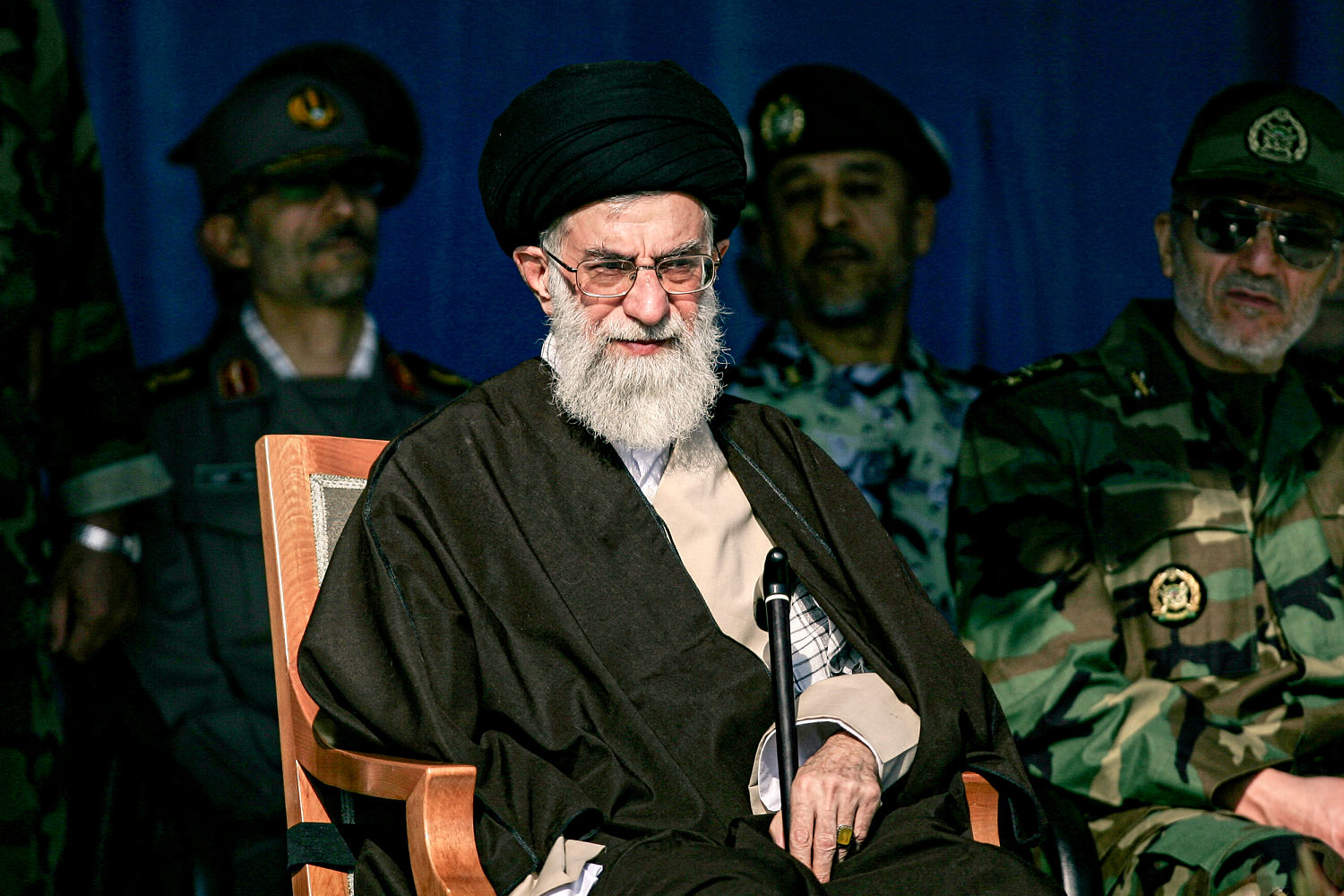
The air in Tehran does not just carry the scent of exhaust and jasmine. It carries the weight of a gaze. For thirty-six years, that gaze belonged to one man, filtered through silver-rimmed spectacles and framed by a black turban that signaled his lineage to the Prophet. Now, the office in the Pasteur district is empty. Ayatollah Ali Khamenei, the second Supreme Leader of the Islamic Republic, is dead at 86.
The news did not break with a shout. It arrived as a stutter in the rhythm of the city. A shopkeeper in the Grand Bazaar looks at a television screen, his hand pausing over a bolt of turquoise silk. A student in Isfahan refreshes a feed, the blue light of the phone illuminating a face caught between uncertainty and an inherited, weary caution.
To understand what has actually happened, you have to look past the official mourning and the cold tallies of geopolitical influence. You have to look at the shadow he cast. It was a shadow that stretched from the Mediterranean coast to the bunkers of central Iran, a silhouette that defined the limits of what millions of people could say, dream, or become.
The Architect of the Long Game
Ali Khamenei was not supposed to be the titan. When he ascended to the role of Supreme Leader in 1989, he was viewed by many as a placeholder, a mid-ranking cleric lacking the revolutionary charisma of his predecessor, Ruhollah Khomeini. He was the compromise candidate, the "quiet one" who would surely be managed by the more powerful players around him.
They were wrong.
He didn't just survive; he mastered the art of the invisible grip. While the world focused on the rotating door of Iranian presidents—the reformist smiles of Khatami, the populist fire of Ahmadinejad, the diplomatic polish of Rouhani—Khamenei remained the fixed point. He was the ultimate arbiter, the commander of the Revolutionary Guard, and the keeper of the "Resistance Axis."
Consider the metaphor of a master weaver. A carpet is not made of one color; it is a tension of opposing threads. Khamenei allowed the various factions of the Iranian state to pull against one another, ensuring that no single thread ever became strong enough to unravel the whole. He sat at the center of this tension, turning Iran from a pariah state into a regional hegemon.
Under his watch, the "Land Bridge" became a reality. An Iranian commander could drive from Tehran to Beirut without ever leaving the protection of friendly militias. This wasn't just a military feat. It was a projection of a specific, hard-line identity that viewed the West not as a partner, but as an existential threat to be kept at bay through "strategic depth."
The Cost of the Fortress
But a fortress, no matter how imposing, is also a cage. While Khamenei built walls against foreign influence, the people inside those walls were breathing thinner air every year.
Imagine a young woman in Tehran named Sahar. She is fictional, but her reality is documented in every "Woman, Life, Freedom" protest that has scorched the streets in recent years. To Sahar, the "Regional Power" her leader championed felt like a heavy stone. She saw billions of dollars flowing to proxies in Lebanon and Yemen while the value of the rial in her pocket evaporated. She saw a morality police force that cared more about the strands of hair escaping her scarf than the corruption escaping the state’s coffers.
The statistics are the dry bones of this tragedy. Inflation has hovered near 40 percent. Youth unemployment is a predatory beast. But the human element is the quiet desperation of a generation that feels its best years are being sacrificed on the altar of a 1979 grudge.
Khamenei’s Iran was a place where the past was used to strangle the future. He remained convinced that any concession to the public—any softening of the mandatory hijab or any real opening to the global economy—would lead to the total collapse of the system. He chose rigidity over resilience. He chose the shadow over the light.
The Void and the Vultures
Nature hates a vacuum, and the Iranian Constitution is a rigid document that does not account for the messy reality of grief and ambition.
The process of choosing a successor is hidden behind the heavy curtains of the Assembly of Experts. It is a room of elderly men deciding the fate of a country where the median age is roughly 32. This disconnect is the real engine of the current anxiety.
There are names, of course. There is the talk of a "hereditary" transition to his son, Mojtaba Khamenei, a move that would ironically mirror the monarchy the revolution set out to destroy. There are the hard-line clerics who believe the only way forward is to double down on the isolation.
But the real character in this drama is the Revolutionary Guard (IRGC). Over the last three decades, the IRGC has transformed from a military wing into a sprawling corporate and political empire. They own the construction companies, the telecommunications, and the borders. For them, the death of the Supreme Leader is not just a spiritual loss; it is a threat to a business model.
The stakes are invisible until they aren't. If the transition is messy, the ripples will hit the oil markets in seconds. They will hit the front lines in Gaza, the drone factories supplying the war in Ukraine, and the nuclear enrichment facilities buried deep within the mountains near Natanz.
The Weight of the Turban
There is a specific kind of loneliness in absolute power. In the final years, Khamenei appeared increasingly isolated, surrounded by a dwindling circle of loyalists who reinforced his worldview. He saw himself as the lonely guardian of a sacred flame, a man who had outlived his contemporaries and outmaneuvered his enemies.
But his greatest enemy was always time.
The 86-year-old man who passed away was the last bridge to the original 1979 fire. Those who come after him did not live through the exile in Neauphle-le-Château. They did not experience the raw, foundational fervor of the revolution's birth. They are bureaucrats of the status quo, or they are soldiers of the expansion.
To the outside world, he was a headline, a villain, or a strategist. To the people of Iran, he was the weather. He was the constant, grey sky under which they lived their entire lives. Whether it was a sunny day or a storm, the sky was always his.
Now, for the first time in nearly four decades, the sky is changing.
It is a terrifying moment for those who profited from his rigidity. It is a moment of paralyzing uncertainty for the millions who just want to buy bread, browse the internet without a VPN, and walk down the street without looking over their shoulder.
The mourning ceremonies will be vast. There will be the choreographed displays of grief, the seas of black shirts, and the rhythmic chanting that has become the visual shorthand for the Islamic Republic. But look closely at the eyes of the people in the crowd. Look for the flicker of what comes next.
A leader's legacy is not found in the monuments they build or the territories they influence. It is found in the state of the people they leave behind. Khamenei leaves behind a nation that is highly educated, deeply frustrated, and profoundly disconnected from the men who claim to lead it in God’s name.
He leaves a regional empire built on the backs of a struggling domestic economy. He leaves a nuclear program that is a few turns of a screw away from a weapon, and a society that is a few sparks away from another conflagration.
The transition will not be a simple handoff. It will be a collision between the inertia of a powerful military-clerical complex and the bottled-up aspirations of a digital-native population.
As the funeral processions wind through the streets, the silence is the most telling sound of all. It is not just the silence of respect or the silence of fear. It is the silence of a long-held breath.
The shadow has passed. The sun is coming up over a country that no longer knows how to stand in the light.
Somewhere in Tehran, a young woman watches the sun rise over the Alborz mountains. She isn't crying. She isn't cheering. She is simply waiting to see if, for the first time in her life, the gaze has finally turned away.
Would you like me to research the current members of the Assembly of Experts to provide an analysis of the most likely candidates for succession?