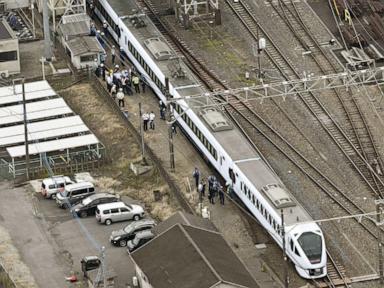
Morning air in Tochigi Prefecture usually smells of damp earth and slow routine. At Shin-Kanuma Station, the platform concrete retains the chill of the night before the sun manages to bake it into submission. On a Thursday morning in late August, seven men stood against that routine. They wore high-visibility vests that caught the early light, carrying sprayers and tools designed to clear the stubborn weeds choking the gravel bed of the Tobu Nikko Line.
To the casual commuter, they were part of the scenery. They were background actors in the grand, clockwork symphony of Japanese rail transport. Trains run here with a metaphysical precision. People set their watches by the doors sliding shut. The nation's transit network is an altar of safety, a monument to human engineering where chaos is theoretically engineered out of existence.
Until it breaks.
Consider what happens next: a six-car Spacia X express train, sleek and silver, bound for Tokyo's Asakusa district, begins its approach. It is carrying roughly fifty passengers. Inside the carriage, travelers scroll through phones, check email, or gaze out at the green expanse of Tochigi. They feel a slight deceleration, the rhythmic click-clack of wheels shifting cadence as the station draws near.
Down on the ballast, four of those workers—men in their fifties and sixties, seasoned veterans of maintenance details—are bent over their tasks. They are spraying herbicide, their focus narrowed to the inches of earth right beneath their boots.
Protocol dictates a shield of human safeguards. Three lookouts are posted. Their entire job is to scan the horizon, to watch the curving rails, to spot the silver flash of an oncoming machine long before it reaches human ears. When a train approaches, the protocol is absolute. The lookout waves a red flag, blows a sharp blast on a whistle, or shouts into a microphone. The track workers straighten up, step clear, and wait. The driver sounds the horn in acknowledgment. The world turns.
On this morning, the driver did sound the horn. He saw a flag. But somewhere between the flutter of that fabric in the wind and the roar of the diesel engines, the chain of human communication snapped.
The train did not stop in time.
What followed was not a spectacle of twisted metal on a grand scale, but a quiet, localized catastrophe. Passengers heard a sudden, violent screech of emergency brakes—a sound so jarring it made standing impossible—followed by an unsettling silence. One moment, fifty people were moving toward their morning appointments. The next, they were trapped behind locked doors, staring blankly at platforms that had suddenly turned into crime scenes.
When emergency services rushed to Shin-Kanuma Station at 10:47 a.m., the raw statistics of grief began to mount. Three men were found trapped beneath the heavy frame of the express train. A fourth was on the platform, his life slipping away before paramedics could transport him to the hospital. Three workers and an on-site supervisor did not survive. Six others at the site—including the lookouts and remaining crew—stood paralyzed, uninjured in body but forever altered by the split second that tore their crew apart.
Fatal railway accidents in Japan are rare enough to shock the national conscience. They pierce the collective illusion that technology and rigorous discipline can completely insulate us from mortality. When the head of the railway's business division stood before reporters to bow deeply and apologize, his words felt heavy with a sorrow that went beyond corporate liability. It was the grief of a system confronting its own fragile humanity.
The tracks at Shin-Kanuma reopened by mid-afternoon. The weeds are gone now. Trains once again slice through Tochigi Prefecture with terrifying, beautiful punctuality, their digital timetables ticking forward without a stutter.
Yet underneath the polished rails, the ghosts of routine remain. We build vast, magnificent networks to carry us across the earth, trusting our lives to invisible protocols and strangers holding flags. We forget that behind every scheduled arrival, someone has to bend down close to the danger, trusting that the person watching the horizon is paying attention.