The marble of Saint Peter’s Basilica has absorbed the whispers of emperors, heretics, and kings for nearly two millennia. It is a stone that knows the weight of eternity. Yet, on a crisp autumn morning in Rome, the air inside the apostolic walls felt thinner, charged with a different kind of electricity. It was not the static of prayer, but the hum of servers thousands of miles away in Silicon Valley, cooling themselves in liquid baths while algorithms calculated the future of human souls.
Pope Leo had just issued a warning. Not about heresy. Not about schism. But about silicon.
He spoke of an age where machines might begin to script the human conscience, where efficiency eclipses empathy, and where the human spirit risks becoming a mere footnote in a ledger optimized by a machine that cannot weep. It was a traditional warning from an ancient seat—a reminder that man was made in the image of God, not in the image of a matrix.
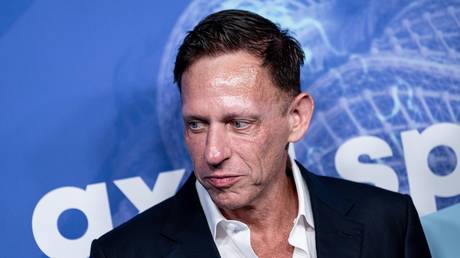
Enter Peter Thiel.
Billionaire, contrarian, techno-futurist. To Thiel, the Vatican’s caution was not wisdom; it was fear dressed in velvet. Speaking at a conference, he dismissed the papal anxiety with the casual coldness of a man who views death as a technical error to be patched. In his view, the warnings from Rome missed the entire point of the human enterprise. We are not here to protect our frailty. We are here to transcend it. If algorithms can govern better than popes, if automation can spare us from suffering, then standing in the way of that progress is not piety. It is blasphemy against human potential.
This clash is not merely a headline about a billionaire sparring with a pontiff. It is the defining ideological fracture of our century.
To understand why this matters, you have to leave the marbled halls and the glass towers. You have to look at how decisions are actually made in the rooms where the future is forged.
Imagine a desk in an unmarked office building in Virginia or Zurich. Behind it sits a data analyst whose name you will never know. She is staring at a monitor displaying a glowing network of nodes—a predictive model designed to track civil unrest, optimize supply chains, or triage hospital admissions. To the algorithm, the human beings represented by those nodes are data points. They are variables to be balanced.
When Thiel defends the acceleration of artificial intelligence, he is defending the sanctity of that analyst's screen. He believes that human governance is too corrupt, too slow, and too blinded by sentimentality to manage a complex planet. We need cold calculus. We need systems that do not flinch.
When Pope Leo warns against it, he is defending the messiness of the human heart. He is arguing that efficiency without grace is tyranny, and that a mistake made with empathy is infinitely more valuable than a correct decision made by a machine that feels nothing.
We have been here before. Every major technological leap arrives with a theological crisis.
When the printing press was invented, the Church panicked because it decentralized the sacred text, stripping the priesthood of its monopoly on salvation. When the steam engine roared to life, poets wept for the agrarian soul sacrificed to the factory whistle. We always mourn what we lose, right up until the moment we become dependent on what we gained.
Except this time, the machine is not just an extension of our muscle. It is an attempted emulation of our mind.
The tension between Thiel and the Vatican exposes a deep, unhealed wound in modern consciousness. We are desperately lonely, yet we build technologies that isolate us further. We crave safety, yet we surrender our agency to black-box models whose reasoning we cannot audit.
Consider the paradox of the modern believer or the modern citizen. You wake up, check a phone that has already predicted your mood, scroll through a feed curated by a neural network designed to keep your adrenaline spiking, and then you log into a remote work meeting where an AI assistant summarizes notes you should have taken yourself. By noon, you have outsourced your attention, your memory, and your curiosity.
By evening, you read that a tech titan thinks the Pope is an obstacle to progress.
Who is right?
Thiel is right about our capabilities. We possess the tools to cure diseases that have haunted humanity since the caves. We can map genomes, simulate economies, and process planetary data at speeds that render human thought look like a flickering candle next to a laser. To halt this out of fear is cowardly.
Yet Leo is right about our vulnerability. We are not purely rational agents. We are creatures of grief, humor, doubt, and irrational loyalty. If we build a world that values only what can be measured, we will soon find ourselves living in a graveyard of metrics.
The danger is not that artificial intelligence will wake up and try to destroy us in a cinematic flash of rebellion. The danger is much quieter. It is the gradual atrophy of our own judgment. It is the moment we stop asking should we because the machine already answered we can.
In the end, Palantir’s defense of accelerationism and the Vatican’s defense of the soul are two sides of the same coin. Both are terrified of insignificance. One seeks to conquer it by merging with the machine. The other seeks to redeem it by clinging to the divine.
The screen flickers. The server hums. The marble holds its breath.
We are standing at the edge of a precipice, staring down at a digital abyss, arguing about whether to sprout wings of steel or fall back into the arms of the earth. And the code compiles while we speak.