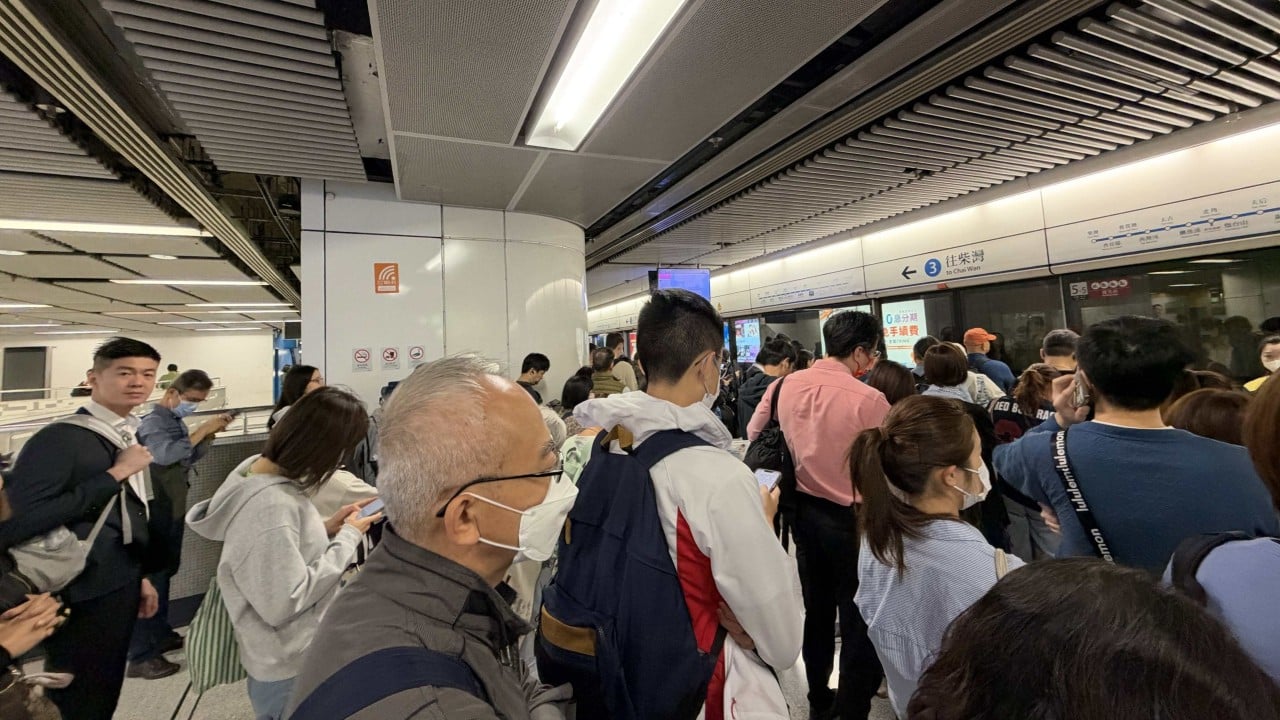
Two signalling faults within 48 hours on Hong Kong’s MTR Island Line expose a structural vulnerability inherent to hyper-dense, communications-based train control (CBTC) architectures: when headway compression leaves zero buffer capacity, minor telemetry degradation cascades instantaneously into network-wide throughput collapse. Standard commuter reporting treats consecutive infrastructure failures as isolated operational anomalies or simple maintenance oversights. That framing misses the underlying engineering reality. In a closed-loop, linear corridor operating near theoretical line capacity, consecutive faults over a two-day window indicate either an unresolved root-cause defect in wayside-to-train data transmission or a transient environmental interference pattern that temporary system resets fail to purge.
The Architecture of High-Density Signalling
To understand why two faults in 48 hours cripple an entire urban corridor, one must distinguish between legacy fixed-block signalling and modern moving-block or semi-moving-block systems. Under legacy architectures, tracks are divided into rigid physical sections protected by track circuits and physical lineside signals. A fault in one section isolates a discrete physical zone, allowing operators to implement manual block working at reduced speeds with predictable degradation curves.
Modern high-capacity lines, including the upgraded signalling infrastructure deployed across Hong Kong’s core urban corridors, rely on continuous bidirectional radio communication—typically via leaky coaxial cables or trackside wireless access points—between onboard Vehicle On-Board Controllers (VOBC) and wayside Zone Controllers (ZC). The system calculates safe braking distances dynamically based on real-time position, velocity, and gradient telemetry.
This architecture enables headways of under two minutes during peak windows. However, eliminating physical buffer zones removes the margin for telemetry latency. When packet loss exceeds a strict safety threshold, fail-safe logic forces the VOBC to trigger an immediate service brake application. The train does not merely slow down; it drops out of automatic train operation (ATO) and requires manual intervention under restricted speed codes.
The Anatomy of Consecutive Faults
When a railway operator reports a signalling fault on Day One, restores normal service, and experiences a second fault on Day Two, the failure sequence follows a distinct operational pattern rather than random component wear. Hardware failures—such as a sheared point machine rod or a burned-out relay—exhibit permanent state changes until physically replaced. Intermittent software or network faults behave differently.
- The Transient Anomaly and Cold-Start Reset: During the initial event, a Zone Controller or core network switch encounters a buffer overflow, a synchronization drift between redundant processors, or radio frequency (RF) interference. Because live passenger operations penalize prolonged downtime, engineering control rooms frequently execute a warm or cold reboot of the affected subsystem. The system passes automated self-diagnostics, and full-speed service resumes.
- Latent State Accumulation: Rebooting clears volatile memory but does not alter the underlying trigger. If the fault stems from a memory leak in the interlocking software, corrupted trackside transponder data, or a degraded power supply unit introducing harmonic noise into the data bus, the error counter begins climbing again immediately upon restart.
- The 48-Hour Recurrence Threshold: Under identical peak-load conditions on the subsequent day—when train density, traction current draw, and data packet volume reach maximum levels—the subsystem hits the exact same failure threshold.
A second fault within 48 hours is rarely bad luck. It is diagnostic proof that the initial remediation addressed the symptom (a locked processor or dropped communication link) rather than the root cause (electromagnetic interference, firmware deadlock, or physical cable degradation).
Operational Queuing and the Cascade Effect
A signalling fault on a linear corridor without parallel express tracks functions as an immediate bottleneck in a non-elastic queuing network. The Island Line operates as a single-track-pair artery serving Hong Kong Island’s primary commercial districts. Unlike grid-based metro networks in Tokyo or Paris, where commuters can route around a stalled line via parallel corridors within walking distance, the Island Line carries concentrated radial demand with limited parallel rail redundancy.
Applying basic queuing theory reveals why a five-minute signalling delay translates into forty-five minutes of platform congestion:
- Arrival Rate vs. Service Rate: During peak commuter windows, passenger arrival rates at central interchange stations (such as Admiralty and Central) match or slightly exceed the maximum train discharge rate. The system operates at a utilization factor ($\rho$) approaching 1.0.
- Dwell Time Inflation: When a signalling fault forces trains into manual restricted-speed mode (often capped at 22 km/h under Automatic Train Protection fallback protocols), headway expands from two minutes to five or six minutes. During those extra minutes, platform queues double or triple.
- The Boarding Friction Loop: Overcrowded platforms increase train dwell times. Doors take longer to close; passengers block optical sensors; station staff must manually clear platform edges. Every additional ten seconds of dwell time at one station propagates backward down the line as a shockwave, holding behind-schedule trains inside tunnels and further compressing available track capacity.
Even after engineers clear the signalling fault and restore full-speed automatic operation, the physical backlog of passengers cannot be cleared until commuter arrival rates drop below the line's maximum throughput capacity—a shift that typically does not occur until the end of the peak window.
The Maintenance Paradox in 24-Hour Urban Rail
Public commentary routinely demands zero-defect reliability from mass transit operators, ignoring the structural constraint of the engineering maintenance window. Unlike freight networks or suburban rail lines with multiple tracks, high-frequency urban metros operate roughly 19 to 20 hours per day.
Once the final passenger train clears the line and traction power is isolated, engineering teams have an effective track-access window of approximately three to four hours before morning energization and test runs begin. Within that compressed timeframe, technicians must deploy diesel engineering locomotives, travel to the fault site, conduct physical inspections, replace suspect hardware, run continuity tests, and clear the tracks.
This creates a sharp operational trade-off between diagnostic depth and service availability:
- Aggressive Intervention: Replacing a suspected trackside radio unit or rewiring a junction box requires cutting power and risking an incomplete installation before the 5:00 AM test train window. An unfinished repair guarantees a morning rush-hour shutdown.
- Conservative Triage: Engineers run diagnostic logs, tighten physical terminations, switch operations to a redundant hot-standby processor, and defer invasive hardware replacement until a scheduled weekend possession.
When two faults occur in 48 hours, it demonstrates the failure of conservative triage. The redundant standby channel either inherited the same corrupted data state or succumbed to the same environmental stressor that disabled the primary channel.
Economic Friction and Productivity Loss
The direct financial penalty to the transit operator from a minor signalling disruption is negligible; farebox revenue is largely recaptured once delayed passengers complete their journeys, and regulatory fine structures for delays under thirty minutes rarely dent corporate balance sheets. The true cost function is externalized onto the urban economy.
In a high-wage service economy concentrated along a narrow geographic corridor, transit delays act as a regressive tax on labor productivity. If a signalling fault adds 20 minutes to the commute of 150,000 peak-hour passengers, the city absorbs 50,000 lost person-hours in a single morning. Unlike remote-capable workflows, physical retail, financial trading floors, healthcare facilities, and logistics operations suffer immediate synchronization losses when staff arrive in staggered, unpredictable waves.
Furthermore, repeated disruptions within a short timeframe alter commuter risk calculations. When reliability drops below a perceived threshold, marginal commuters shift to surface transport—taxis, private cars, and franchised buses. Because Hong Kong Island’s road network operates near saturation along the Connaught Road and Gloucester Road corridors, even a single-digit percentage shift from rail to road triggers severe surface gridlock, degrading emergency vehicle response times and surface transit speeds simultaneously.
Limitations of Redundancy and Predictive Analytics
Standard industry prescriptions for recurring signalling faults emphasize dual-redundant architectures and predictive maintenance algorithms. Both carry hard operational limits.
Redundancy protects against random hardware failure, not common-cause failure. If both the primary and backup Zone Controllers run identical firmware versions, a specific sequence of malformed telemetry packets from a faulty onboard radio will crash both systems simultaneously. Similarly, if dual leaky feeder cables share the same tunnel ducting, water ingress or metallic brake-dust accumulation will degrade signal-to-noise ratios across both lines concurrently.
Predictive analytics—monitoring bit-error rates, CPU temperature spikes, and packet retransmission counts—can flag degrading components before catastrophic failure. However, predictive models rely on historical failure signatures. Novel edge cases introduced during fleet upgrades, third-party electromagnetic interference from adjacent construction projects, or rare timing race conditions in newly patched software bypass anomaly detection until they manifest as live service interruptions.
Strategic Execution for High-Density Transit Operators
To break the cycle of consecutive, multi-day signalling failures, infrastructure operators must shift from reactive availability preservation to aggressive fault isolation:
- Mandate Cold-Swap Protocols After Unexplained Resets: Whenever a signalling subsystem trips without an immediately identifiable hardware defect, control rooms must prohibit relying solely on software resets across consecutive operating days. Operations must isolate the primary channel entirely, lock traffic onto the verified redundant path, and force full packet-capture logging on the suspect hardware during the subsequent peak load.
- Decouple Fleet Telemetry From Wayside Control During Triage: When recurring faults localize to a specific corridor segment, deploy trackside spectrum analyzers and stationary diagnostic nodes overnight rather than relying exclusively on onboard train logs, isolating whether the failure originates in wayside transmission or rolling stock receivers.
- Pre-Position Surface Bridge Capacity at Chokepoints: Operators must establish automated trigger thresholds where a second signalling fault within 72 hours automatically activates pre-contracted surface shuttle bus loops at critical interchange nodes before platform dwell times breach the cascading congestion threshold.
- Publish Granular Subsystem Attribution: Replace generic "signalling fault" public advisories with specific subsystem classifications—distinguishing between trackside network drops, point-machine interlocking errors, and onboard VOBC faults—to establish institutional accountability and prevent public conflation of isolated component failures with systemic network decay.


