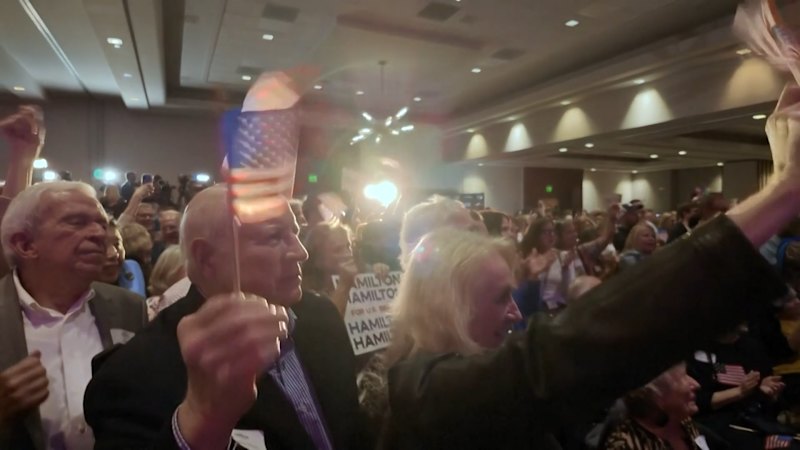
The coffee in a campaign war room at four in the morning tastes like burnt pennies and stomach acid. You do not drink it to wake up. You drink it because your hands need something to hold while the county returns finish crawling across the bottom of a muted television screen, turning red counties blue one painful fraction of a percentage point at a time.
Silence.
That is the first thing that hits you when an election goes sideways. Not screaming, not chairs flying across the linoleum, just the sudden, suffocating quiet of forty people realizing that eighteen months of eighteen-hour days just evaporated into thin air. Then comes the sound of phones buzzing on tables. Not the celebratory chimes of donors calling to reserve inaugural ball tickets, but the sharp, rhythmic vibration of reporters asking who is going to get fired before noon.
Right now, across Washington and in state party headquarters from Phoenix to Harrisburg, that exact morning-after fog is lifting, and the knives are already out. When a major political party suffers a sweeping electoral wipeout—losing winnable Senate seats, watching suburban House districts slip away, and failing to capitalize on an opponent's obvious vulnerabilities—the autopsy does not look like a quiet medical examination. It looks like a bar brawl in a dark alley.
And everyone standing over the body claims the cause of death is obvious.
The Anatomy of a Finger-Pointing Frenzy
To understand why political coalitions tear themselves apart after a defeat, stop looking at cable news panels and start looking at a hypothetical campaign manager named Marcus. Let us put Marcus in a cramped office in suburban Ohio, staring at a spreadsheet that promised a three-point victory right up until the polls closed on Tuesday night.
Marcus spent two million dollars on television ads hammering the national economy. He followed every rule in the modern consultant playbook. He focused on inflation, border security, and cultural grievances, convinced that anger at the party in power would act like gravity and pull undecided voters straight into his column.
Except it didn't.
When the precinct totals came in, Marcus discovered a terrifying math problem. His candidate won the rural counties by seventy percent, just as predicted. Yet in the ring of moderately affluent suburbs outside Columbus and Cincinnati—the neighborhoods where college-educated parents worry about mortgage rates, school boards, and whether their teenagers have basic healthcare rights—his candidate collapsed by eleven points.
By Wednesday morning, Marcus is on a conference call with national party strategists, and the civil war has already begun. The populist wing of the party insists Marcus lost because his candidate sounded too timid, too rehearsed, and too unwilling to fight the cultural establishment. Meanwhile, the traditional business-aligned wing argues the exact opposite—that the party scared away moderate, ticket-splitting voters by nominating extreme voices and ignoring basic kitchen-table pragmatism.
This is the classic political trap. When a ship sinks, the crew never agrees on whether the hull was too heavy or the captain steered into the rocks. They simply throw each other overboard to lighten the load.
Why "Obvious" Answers Are Usually Dangerous
In the wake of the Republicans' recent electoral wipeout, the phrase echoing through every leaked memo and anonymous quote is that the reason is obvious. Strategists point to candidate quality, messaging failures, fundraising gaps, or an overreliance on nationalized grievances at the expense of local issues.
Here is the uncomfortable truth that anyone who has ever knocked on three thousand doors in October knows in their bones: there is never just one reason.
Blaming a single factor is an emotional defense mechanism. If a party can convince itself that it lost solely because of bad television ads, or solely because one prominent figure said the wrong thing during a debate, then the fix feels easy. You fire the ad maker. You sideline the loudmouth. You keep the rest of the machinery intact and march forward into the next cycle.
Consider what happens when a political movement mistakes a structural crack for a cosmetic scratch. In historical terms, American political parties go through periodic identity crises every few decades. Think back to the mid-1960s or the late 1980s, moments when one party became so convinced of its own ideological purity that it stopped listening to the quiet, unglamorous voters in the middle who decide general elections.
Voters do not experience politics the way consultants do. A consultant sees a voter as a collection of data points—age, income, zip code, primary voting history, and media consumption habits. A real person standing in a grocery store aisle on a Tuesday afternoon sees politics as a background noise that occasionally interrupts their actual life.
Let us imagine a woman named Elena, a forty-two-year-old physical therapist living in a swing district in Pennsylvania. Elena is not registered with either party. She voted for a Republican governor years ago because she wanted lower property taxes, and she voted for a Democratic senator more recently because she felt the local GOP had lost its mind on social issues.
During this past election cycle, Elena's mailbox was stuffed with glossy flyers screaming about existential threats, ideological treason, and apocalyptic scenarios. Not a single piece of mail told her how the candidate planned to lower her family's insurance premiums or fix the crumbling bridge she drives across every morning to reach her clinic.
When Elena stepped into the voting booth, she did not vote for a grand ideological vision. She voted against the chaos. She chose predictability over theater. Multiply Elena by four hundred thousand voters across six battleground states, and you no longer have a messaging hiccup. You have an electoral wipeout.
The Invisible Stakes Behind the Bloodletting
It is easy to treat post-election infighting as a spectator sport, a bit like watching billionaires argue over who ruined a football franchise. We read the leaked quotes from furious donors, we watch party chairs defend their turf on Sunday morning shows, and we move on with our week.
Yet the bloodletting inside a major political party carries invisible stakes that reach straight into every neighborhood in the country.
A healthy democracy requires two functional, competitive parties capable of governing and checking each other's worst impulses. When one party fractures into warring factions—populists versus institutionalists, grassroots activists versus major donors, national firebrands versus local mayors—it loses the ability to negotiate, compromise, or offer coherent policy alternatives.
Think of a political party like an old suspension bridge. The cables on one side represent ideological energy—the passionate base voters who volunteer, donate small amounts of money, and show up in pouring rain for primary elections. The cables on the other side represent broad appeal—the pragmatic, middle-of-the-road citizens who care about competence, stability, and results.
If you tighten one side of the bridge until the steel snaps, the entire structure twists and drops into the river.
Right now, the internal feud over who caused the Republican defeat is pulling those cables in opposite directions. On one side, influential commentators and grassroots organizers argue that the party failed because it compromised too much, urging leaders to purge anyone who doubts the core orthodoxy. On the other side, governors and suburban lawmakers—the people who actually have to win elections in purple states—are pleading with national leaders to stop picking fights that alienate ordinary families.
I have sat in rooms where these two factions try to talk to each other, and the most frightening part is not the anger. It is the total lack of a shared vocabulary. They are looking at the exact same election map and seeing two completely different countries.
Money, Ego, and the Consultant Industrial Complex
Follow the money after any major political loss, and you will find another reason the blame game turns vicious so quickly. Modern American campaigns are billion-dollar enterprises, and an enormous ecosystem of pollsters, media buyers, digital fundraisers, and strategic advisors relies on keeping the machine running regardless of whether their candidates actually win.
When an election ends in disaster, donors close their checkbooks. A wealthy business owner in Texas or Florida who wrote a seven-figure check expecting tax reform and deregulation suddenly realizes their money bought nothing except a pile of losing yard signs. Those donors demand answers, and the people who took their money scramble to point fingers at someone else before the contracts dry up.
This creates a perverse incentive structure. Instead of conducting an honest, painful reckoning with why voters rejected their platform, operatives leak stories to the press blaming a rival faction. A media strategist blames the field operation for failing to turn out low-propensity voters. The field director blames the candidate for refusing to attend local town halls. The candidate blames the national party for starving their race of late-stage television money.
Meanwhile, the actual voter—the person who stood in line for forty-five minutes at a local elementary school to cast a ballot—becomes an afterthought.
What makes this moment particularly disorienting, even for seasoned observers, is how rapidly voter coalitions are shifting beneath everyone's feet. A decade ago, you could predict how a precinct would vote simply by looking at average household income and church attendance. Today, education levels, geographic density, and media habits have scrambled the map. Working-class voters without college degrees have drifted toward the GOP in rural and industrial areas, while suburban professionals have moved sharply away from it.
Navigating that kind of realignment requires humility, patience, and a willingness to listen to uncomfortable truths. Those happen to be the three qualities most likely to get you fired in Washington during a post-election purge.
What Real Rebuilding Actually Looks Like
If you want to see how a party actually recovers from an electoral disaster, stop watching the shouting matches in Washington and look at the statehouses where leaders are quietly winning in tough territory.
Successful political comebacks rarely begin with a clever slogan or a new television strategy. They begin when leaders admit, out loud and without excuses, that the voters were right to send a message.
Years ago, I watched a local state senator lose a race she was guaranteed to win. She had the endorsements, the money, and the name recognition. On election night, she lost by four points. Instead of blaming the state party or attacking the voters for falling for her opponent's ads, she did something almost unheard of in modern politics. She spent the next six months sitting in diners, union halls, and chamber of commerce breakfasts across her district with a legal pad and her mouth shut.
She discovered that while she had spent her campaign talking about national political battles, her constituents were furious about a sudden spike in utility rates and a shortage of local ambulance services. Two years later, she ran again, focused relentlessly on those two issues, and won by twelve points.
That is the unglamorous antidote to political self-destruction. Voters have an uncanny ability to smell desperation and phoniness. They know when a politician views them as a demographic target rather than a neighbor.
The current bloodletting inside the Republican Party will eventually burn through its initial fury. Scapegoats will be chosen, staffers will quietly update their resumes, and new committees will be formed to chart a path forward. Yet if the party treats this electoral wipeout merely as a public relations problem rather than a fundamental crisis of trust with everyday voters, the next election night will feel painfully familiar.
Somewhere right now, in a quiet suburban neighborhood far from the television studios of Washington, a voter is sorting through their evening mail. They are tired from work, worried about the cost of groceries, and exhausted by constant political noise. They are holding a stack of glossy flyers over the kitchen trash can, waiting for someone to finally speak to them like an adult.