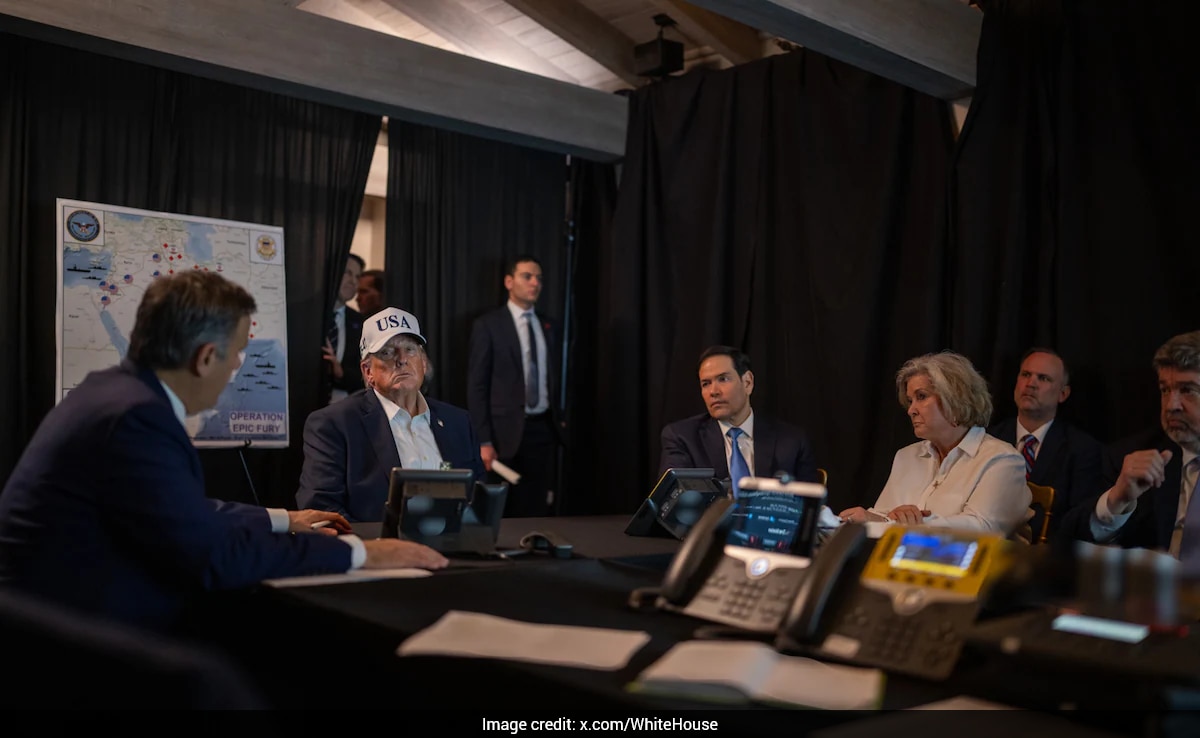
The grainy, high-contrast photos of a president huddled over a monitor in a darkened room are a staple of the American political machine. They are designed to project a specific image: the Commander-in-Chief as a hyper-engaged tactical genius, a digital-age Napoleon directing "Operation Epic Fury" with the surgical precision of a heartbeat.
It is a lie. A beautiful, high-resolution, multi-million dollar lie.
The "Situation Room" aesthetic is the most successful theater production in Washington D.C. While the mainstream media treats these photo ops as evidence of decisive leadership, they actually signal a dangerous shift in how modern conflict is managed. We are no longer watching a military operation; we are watching a televised brand activation where the product is "Strength."
The Latency of Command
If you believe a president is "monitoring" a kinetic strike against Iranian infrastructure in real-time to make split-second decisions, you don't understand how data moves.
In a modern theater like the one seen in Operation Epic Fury, the chain of command is built on layers of deliberate latency. A drone hovering over a target in the Middle East transmits data via satellite to a ground station, then through fiber optics to an analysis center, and finally to the White House. By the time that image hits the monitors in the Situation Room, the tactical window for presidential intervention has long since slammed shut.
I have sat in rooms where "real-time" feeds were used to justify astronomical budgets. The reality? The people in that room are the last to know what actually happened. The pilot or the automated system has already acted. The president isn't a pilot; he’s a spectator with a very expensive seat. When we celebrate these photos, we are celebrating a man watching a replay and pretending it’s a live broadcast.
The Misconception of the "God View"
The common narrative suggests that more information leads to better decisions. This is the "God View" fallacy.
Operation Epic Fury utilized an unprecedented array of SIGINT (Signals Intelligence) and MASINT (Measurement and Signature Intelligence). The screens in those photos are filled with colorful overlays, heat maps, and telemetry data. To the uninitiated, it looks like total mastery of the battlefield.
In reality, this is Information Saturation.
When a leader is flooded with raw tactical data, they lose the ability to think strategically. They start micromanaging the "dots on the map" instead of weighing the geopolitical fallout of the strike. I’ve seen commanders get so bogged down in the resolution of a thermal feed that they forget to ask if the target is even the right person.
- The Problem: Tactical over-fixation.
- The Result: "Operation Epic Fury" becomes a series of disconnected strikes rather than a cohesive foreign policy move.
- The Cost: Strategic drift. We win the skirmish on the screen but lose the decade-long influence war.
The Ghost of the "Situation Room"
We need to talk about the physical architecture of power. The White House recently spent $50 million renovating the Situation Room. They added more screens, better LED lighting, and sleeker furniture.
None of those things make a strike more effective.
The renovation was about optics. The room is now built to be photographed. It is a stage set. If you look at the photos from Epic Fury, the lighting is cinematic. The shadows are intentional. This is "Statecraft-as-Content." We are being sold the feeling of security because the actual mechanics of security are far too boring, legalistic, and bureaucratic to post on social media.
Dismantling the "People Also Ask" Delusions
The public asks the wrong questions because they've been fed a diet of Tom Clancy novels and "Call of Duty" cutscenes.
"Does the President authorize every shot?"
Absolutely not. If he did, the military would grind to a halt. Rules of Engagement (ROE) are established months in advance. The President authorizes the intent and the envelope of the operation. The idea that he’s whispering "take the shot" into a headset is a Hollywood fantasy that ignores the legal framework of Title 10 of the U.S. Code.
"Is the Situation Room the most high-tech place on earth?"
Hardly. It’s a glorified conference room with decent encrypted Wi-Fi. The real tech lives at Fort Meade (NSA) or Langley (CIA). The White House is the consumer of the tech, not the creator. Claiming the Situation Room is the pinnacle of technology is like saying your TV is the reason a football team won the Super Bowl.
The Data Trap: Why Intelligence is Not Information
Operation Epic Fury was touted as a triumph of "Precision Intelligence." But here is the brutal truth: Precision is not Accuracy.
You can have a 4K video of a building blowing up (Precision). That doesn't mean you knew who was inside or what the secondary effects would be (Accuracy). The obsession with "monitoring" the strike focuses on the kinetic event while ignoring the human intelligence (HUMINT) that actually dictates success.
I’ve watched operations where the technical data was flawless—the missile hit within six inches of the coordinates—but the intelligence was garbage. We killed a water pump instead of a command center. But on the monitors in the White House, it looks like a win. The plume of smoke is visible. The mission is "accomplished."
We are valuing the visual proof of destruction over the messy, unphotogenic reality of effective intelligence.
The Contrarian Path: How to Actually Lead
If we want actual leadership instead of a photo op, we need to move away from the "Monitor and Control" model.
- Stop the Live Feed: Presidents should not be allowed to watch live tactical feeds. It triggers an evolutionary bias toward action over thought.
- Focus on the Day After: The role of the executive is to manage the 72 hours after the strike, not the 15 minutes during it.
- Acknowledge the Friction: Military operations are governed by "Fog of War" (Clausewitz’s Friktion). High-definition cameras don't remove the fog; they just make the fog look prettier.
The most dangerous thing a leader can have is the illusion of total visibility. When you think you see everything, you stop looking for what's hidden.
Operation Epic Fury wasn't won because a group of people stared at monitors in D.C. It was won—or lost, depending on your metric—by the thousands of analysts, engineers, and operators who will never be in a press release. The photos we see are not a window into the operation; they are a curtain drawn over the complexity of modern warfare.
Stop looking at the screens. Start looking at the results.
The next time you see a "Situation Room" photo, don't look at the President. Look at the black screens in the background. That's where the real work happens—out of sight, out of frame, and far removed from the desperate need for a political win.
Leadership isn't watching. Leadership is knowing when to look away.
Turn off the cameras. End the theater.
The most powerful room in the world shouldn't be a TV studio.