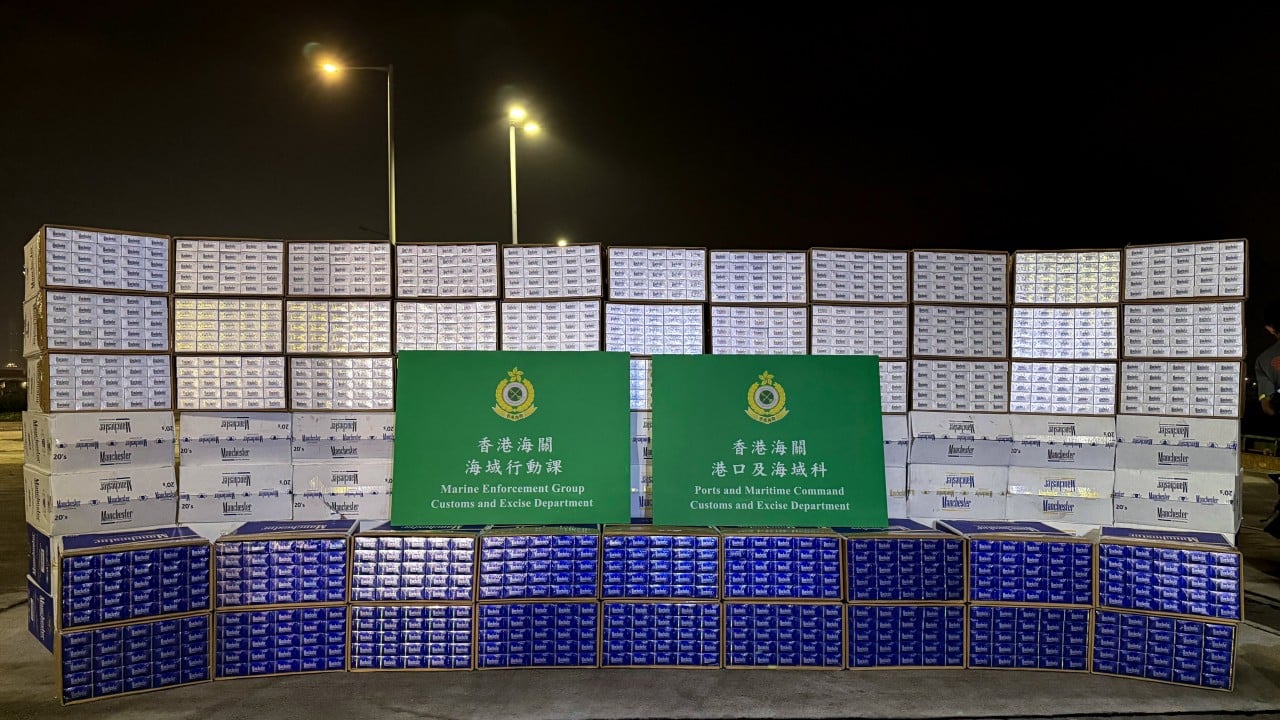
The salt air at Kwai Tsing Container Terminals smells of diesel exhaust, wet rust, and rain-slicked asphalt. At three in the morning, the cranes move like patient prehistoric birds, lifting forty-foot steel boxes from the bellies of ocean liners and setting them down with a dull, seismic thud that you can feel in the fillings of your teeth.
To an outsider watching from the overpass, it is a ballet of pure global commerce. Shoes from Vietnam. Microchips from Taiwan. Frozen pork from Brazil. Everything is accounted for on digital manifests, tracked by barcodes, and cleared by algorithms.
Except when it isn't.
Between January and September of 2026, officers with the Hong Kong Customs and Excise Department pried open the doors of hundreds of those steel boxes, peered behind false walls of instant noodles, and pulled out 600 million illicit cigarettes.
Pause on that number for a second.
Six hundred million. If you laid those cigarettes end to end, they would stretch roughly 50,000 kilometers—enough to wrap around the Earth's equator with plenty left over to tie a bow. In the sterile language of press releases and wire reports, the seizure is reduced to a line item: an estimated market value exceeding 2.7 billion Hong Kong dollars, representing roughly 1.9 billion dollars in evaded tax duty.
Wire services love numbers like that because numbers are tidy. Numbers don't cough. Numbers don't run corner newsstands in Sham Shui Po while watching their margins evaporate. Numbers don't launder money through shell companies that fund far uglier trades.
To understand what 600 million contraband cigarettes actually mean for a city of seven and a half million people, you have to step away from the spreadsheets and walk down the wet, neon-lit alleys where the cardboard boxes eventually land.
The Architecture of a False Manifest
Consider a hypothetical customs inspector—let’s call her Mei—standing inside a cavernous inspection bay in Tuen Mun. She has worked the night shift for eleven years. Her knees ache when the humidity climbs above ninety percent, which is almost always.
In front of her sits a standard twenty-foot shipping container. According to the bill of lading submitted forty-eight hours earlier, the box contains 1,400 cartons of cheap plastic kitchenware destined for local distribution. On paper, it is the most boring shipment in the port.
That boredom is intentional. Smuggling syndicates do not survive by acting suspicious; they survive by mimicking the mundane heartbeat of legitimate trade.
When the X-ray scanner passes over the container, however, the image on Mei's monitor refuses to behave like plastic colanders and mixing bowls. Plastic produces a faint, irregular silhouette with pockets of trapped air. What appears on her screen is dense, uniform, and brick-solid from floor to ceiling—an unmistakable geometric grid of tightly packed master cases.
Break the seal. Swing the heavy iron doors wide.
Inside, stacked three rows deep near the entrance, are genuine boxes of plastic bowls. A facade. Behind that thin wall of decoy goods sit ten million "white" cigarettes—brands manufactured legally in overseas factories with zero legitimate retail presence in Hong Kong, produced specifically to be dumped into black markets where tobacco taxes are high.
I have spent years reporting on illicit supply chains across East Asia, and the thing that still unsettles me isn't the sheer audacity of the smugglers. It is the cold, industrial efficiency of the operation. We tend to picture smuggling as guys in speedboats racing through moonless fog. That still happens in the choppy waters near Lantau Island, certainly. But the backbone of modern contraband is logistics. It is freight forwarders, rented industrial units in the New Territories, encrypted messaging apps, and legions of desperate gig workers hired to distribute flyers under apartment doors.
Why the Math Changed Overnight
To understand why 600 million cigarettes flooded toward Hong Kong in just nine months of 2026, you have to follow the tax curve.
Over the past few years, the Hong Kong government has aggressively raised tobacco duties as a public health measure, pushing the retail price of a legal pack of twenty cigarettes past the 90-dollar mark—and well toward 100 Hong Kong dollars depending on the brand. Around seventy percent of the price a smoker hands over at a convenience store goes straight to the public treasury.
Public health officials applaud the hikes. Higher prices undeniably nudge young people away from starting and push veteran smokers toward quitting.
Yet economics has a stubborn gravity. Whenever a government creates a massive price gap between a legal product and an identical—or near-identical—illegal one, a vacuum forms. Nature abhors a vacuum, and organized crime fills it before the ink on the budget speech is dry.
When a legal pack costs nearly a hundred dollars and a black-market equivalent sells on a Telegram channel or an back-alley folding table for thirty-five or forty dollars, the profit margin becomes intoxicating. A single forty-foot container holds roughly ten million cigarettes—half a million packs. Even at wholesale black-market rates, one successful container run clears millions of dollars in pure, untaxed profit.
Lose one container to customs? Write it off as a business expense. Send four more behind it.
Think of the smuggling network like a leaky water main buried beneath a busy intersection. You can patch the asphalt on the surface, and you can send crews out every night with buckets to bail out the flooded storm drains. Until you address the pressure inside the pipe, the water will keep finding every hairline crack in the concrete.
The Man Behind the Counter
Walk three blocks off Nathan Road on a Tuesday afternoon and watch Mr. Chan—a composite of a dozen elderly newspaper hawkers I have interviewed over the last decade—arrange stacks of afternoon tabloids on his wooden stall.
Mr. Chan has held his hawker license since the 1980s. For forty years, newspapers and magazines brought people to his corner, while packs of duty-paid cigarettes kept the lights on in his tiny walk-up flat two districts away. The profit per legal pack was always razor-thin, maybe a few dollars, but volume made up for it.
Now watch who walks past his stall without stopping.
Across the street, tucked into the stairwell of an aging commercial building, a young man in a black windbreaker checks his phone. A buyer approaches, exchanges a quick nod, hands over a crumpled hundred-dollar bill, and walks away with three packs of untaxed cigarettes tucked into a black plastic bag. No tax stamps. No health warnings compliant with local law. No overhead.
Mr. Chan cannot compete with that. He pays rent, he follows the law, and he watches his legitimate business bleed out in slow motion while illicit flyers—printed on glossy paper with QR codes and "24-hour doorstep delivery" promises—pile up in the mailboxes of the public housing estates down the road.
This is the invisible casualty of the 600 million figure. Every time a syndicate successfully slips a shipment past the port, it isn't just robbing the government of hospital funding or infrastructure revenue. It is punishing every small business owner who chose to stay honest.
Inside the "Storage" War
By mid-2026, Hong Kong Customs realized that simply catching containers at the port was no longer enough. The syndicates had adapted. Instead of holding massive stockpiles in one obvious warehouse, they fragmented their inventory—a strategy investigators refer to as "ants moving home."
Smugglers began renting dozens of subdivided industrial units in Kwun Tong, Tsuen Wan, and San Po Kong, alongside temporary storage lockers and even empty residential flats. A container would be stripped in the middle of the night, its contents scattered across fifteen different locations before dawn.
Customs responded with a relentless, multi-front squeeze.
In the first nine months of 2026 alone, enforcement teams didn't just intercept ocean freight and cross-border trucks at Lok Ma Chau and Shenzhen Bay. They kicked down the doors of makeshift storage dens in old factory buildings. They tailed delivery vans through midnight traffic. They arrested hundreds of individuals—not just syndicate lieutenants, but the elderly "runners" and young couriers paid a few hundred dollars a shift to move boxes from point A to point B.
There is a quiet tragedy in those arrests, too. Sitting in magistrates' courts watching remand hearings, you rarely see criminal masterminds in tailored suits. You see out-of-work construction laborers, indebted drivers, and desperate kids who thought moving cardboard boxes for three hours was easy money—until the heavy steel door of a correctional facility clicked shut behind them. Under Hong Kong's Dutiable Commodities Ordinance, dealing with illicit cigarettes carries a maximum penalty of a one-million-dollar fine and two years in prison. The bosses stay insulated behind layers of encrypted accounts and offshore brokers; the couriers take the fall.
What Is Actually Inside the Paper?
There is another truth buried inside those 600 million cigarettes that rarely makes the evening news, mostly because it is uncomfortable to talk about.
Smokers buying illicit packs often assume they are getting the exact same factory product sold in duty-free shops, just without the tax markup. Sometimes that is true—diverted export stock makes up a sizable slice of the market.
Frequently, however, what sits inside those brightly colored cartons are counterfeits churned out in unregulated underground factories.
Without quality control or regulatory oversight, illicit manufacturers cut every corner imaginable. Laboratory analyses of seized counterfeit cigarettes across Asia have routinely turned up elevated levels of tar, nicotine, and carbon monoxide, alongside heavy metals like lead and cadmium, industrial adhesives, and even traces of mold and rat droppings swept off dirty factory floors.
If you smoke legal cigarettes, you are already making a well-documented gamble with your lungs. If you buy cheap contraband out of the back of a van, you have no idea what is burning a quarter-inch from your lips.
The Cat-and-Mouse Trap
I sometimes wonder if we are winning this war or merely documenting its escalation.
Look at the trajectory over the last few years. In 2023, customs seized roughly 652 million illicit cigarettes across the entire twelve-month calendar. By hitting 600 million in just the first nine months of 2026, enforcement officers demonstrated extraordinary vigilance, sharper intelligence sharing with mainland and international counterparts, and better use of big-data risk profiling at the ports.
Yet a record seizure is a double-edged sword. It proves the net is strong, yes. It also proves the ocean is teeming with fish.
As long as the profit margin on a single shipping container rivals that of mid-level narcotics smuggling—with a fraction of the prison time if caught—transnational syndicates will keep treating Hong Kong's busy port like a high-stakes casino. They will forge better manifests. They will hide cigarettes inside hollowed-out timber, inside transformers, inside shipments of frozen seafood. They will recruit new runners tomorrow morning to replace the ones arrested tonight.
Enforcement alone cannot solve an incentive problem. Real progress requires attacking the ecosystem from every angle at once: tracking the illicit financial flows that wash the cash, holding landlords accountable when industrial units repeatedly turn into contraband depots, stiffening penalties so smuggling isn't treated like a minor regulatory infraction, and educating buyers on what they are actually funding when they scan a QR code on a stairwell flyer.
Dawn at the Pier
Back at Kwai Tsing, the sky over the container stacks begins to bruise from black to pale violet. The night shift is winding down.
Inside a secure customs warehouse miles away, pallet after pallet of seized cigarettes sits wrapped in clear industrial plastic, waiting to be cataloged as court evidence before eventually being hauled off to an incinerator. Six hundred million small white cylinders, each packed with shredded leaf, wrapped in paper, and stamped with false promises of a bargain.
They will never reach the dark stairwells of Kowloon. They will never underprice Mr. Chan's newspaper stall. They will turn to ash in a government furnace instead of the lungs of a city.
Outside the warehouse gates, though, the morning tide is already rolling into Victoria Harbour—and another wall of steel containers is gliding slowly toward the cranes.



