Ink dries. Paper yellows.
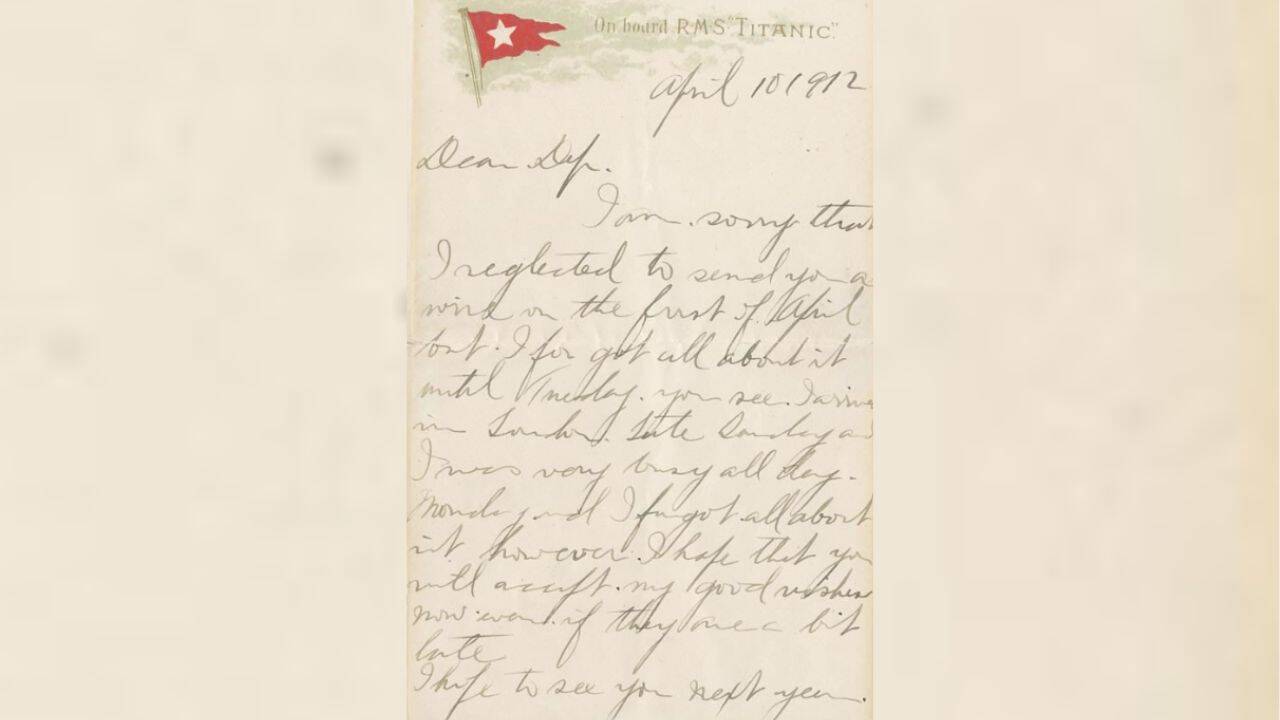
Yet more than a century after a steel hull cracked open in the freezing dark of the North Atlantic, a single sheet of stationery—covered in the looping, unhurried script of someone who did not yet know they were walking toward an iceberg—just changed hands for $16,100 at auction.
Look at that number for a second. Sixteen thousand, one hundred dollars. You could buy a reliable used sedan for that price. You could fund a semester of college tuition, remodel a modest kitchen, or pay off a mountain of lingering debt. Instead, an anonymous bidder traded that exact sum for a fragile rectangle of wood pulp and dried pigment, written by a Titanic passenger to a friend days before the ship went down.
Why? Why do we pay fortunes to possess the mundane paperwork of the dead?
I have spent years standing in the back of quiet, climate-controlled auction rooms, watching wealthy collectors raise numbered paddles for scraps of history. Every time a gavel falls on a piece of Titanic ephemera, the standard news reports treat it like a sports score. They give you the item, the passenger's ticket class, the name of the auction house, and the final hammer price. Cold facts. Neat numbers. Zero pulse.
They miss the entire point. Nobody pays sixteen grand for paper. They pay for a time machine.
The Architecture of a Ordinary Morning
To understand what actually sold on that auction block, you have to strip away the orchestral swell of James Cameron movies and the sterile black-and-white diagrams of history textbooks. You have to put yourself inside a wood-paneled writing room—or perhaps at a small wooden desk in a cramped third-class cabin—in early April 1912.
Let us invent a moment, just to see the mechanics of how this happens, grounded in the documented routines of the RMS Titanic’s maiden voyage.
Picture a passenger sitting down with a fountain pen. Outside the porthole, the grey chop of the Atlantic slaps against forty-six thousand tons of riveted steel. Maybe the ship just paused at Queenstown, Ireland, its final port of call before the open ocean. Mailbags are being hauled up onto the deck, ready to be ferried back to shore by tender boats. This is the last physical tether to the solid world.
The writer isn't composing a grand historical manifesto. They aren't thinking about posterity, maritime law, or lifeboat capacities. They are complaining about the sea air, praising the richness of the dining saloon, or promising to visit once they settle in New York. Their hand moves across the page with the casual arrogance of every human being who assumes tomorrow will look roughly like today.
Then they fold the sheet. They lick the envelope. They press a stamp into the corner, drop it into the ship’s postbox, and walk away to find a cup of tea or a game of cards.
That letter goes ashore at Queenstown. The ship steams west.
Four days later, at 11:40 PM on April 14, the lookout’s bell rings three times. By 2:20 AM, the stern slips beneath the black water, taking roughly 1,500 souls into the freezing dark.
The person who held the pen is gone. The ink they left behind is still wet on the shore.
The Invisible Stakes of Paper
When you hold a letter written aboard the Titanic before the sinking, you are holding the exact physical boundary between ignorance and catastrophe. That is the invisible stake driving the price tag up into the five-figure stratosphere.
Think about the mechanics of value in the collectibles market. Normally, rarity dictates price. Diamonds are expensive because they are scarce; mass-produced bottle caps are worthless because they are everywhere. By pure material standards, an early twentieth-century letter is practically trash. Millions of them were written every single week across Europe and North America.
What transforms a penny’s worth of stationery into a $16,100 artifact is dramatic irony made physical.
In theater, dramatic irony happens when the audience knows a secret that the characters on stage do not. We watch Romeo drink the poison knowing Juliet is merely asleep, and our chests tighten. A Titanic letter forces you to hold that tension in your bare hands. You know about the missing binoculars in the crow's nest. You know about the water-tight compartments that weren't actually sealed at the top. You know about the Californian sitting idle miles away while rockets burst uselessly in the freezing sky.
The person writing the letter knows none of it.
I remember the first time I was allowed to examine an authentic piece of Titanic correspondence—wearing white cotton gloves, breathing shallowly so I wouldn't humidify the fragile fibers. The handwriting slanted slightly to the right, confident and brisk. Near the bottom margin, the writer had crossed out a misspelled word and written the correction neatly above it.
That tiny smudge made my stomach drop.
Why bother correcting a spelling error if you have ninety-six hours left to live? You don't. You only fix a typo when you believe you have a future. Seeing that small act of everyday vanity—that quiet assumption of permanence—hits harder than any casualty list ever could. History books turn human beings into statistics. A handwritten letter turns a statistic back into a neighbor.
Why the Market Never Cools
Collectors and historians often field the same skeptical question whenever a piece of Titanic memorabilia breaks another auction record: Isn't it morbid?
Look closer at human behavior, and you realize it is the exact opposite of morbid. It is a desperate, deeply human refusal to let someone vanish completely.
Consider how we treat our own digital lives today. Right now, millions of people are sending text messages, firing off emails, and posting casual updates that will outlive them by decades. Yet a server farm humming in Virginia carries zero emotional weight. You cannot hold an email. You cannot see the tremor in someone’s fingers when the ship rolled, or the way the nib of a fountain pen dug harder into the paper when the writer got excited about arriving in America.
Physical artifacts anchor memory in a way pixels never will. When a Titanic letter sells for $16,100, the buyer isn't purchasing grief. They are purchasing proof of life.
To understand why these auctions consistently command massive sums—sometimes reaching hundreds of thousands of dollars for letters written on the final day, like the famous Archibald Gracie correspondence—you have to look at the shrinking pool of surviving items.
- The Destruction Filter: Almost everything on the ship went down with it. Luggage, diaries, jewelry, unmailed letters—all of it settled two and a half miles down on the ocean floor, slowly consumed by rusticles and deep-sea pressure.
- The Shore Mail Exception: Only items offloaded at Southampton, Cherbourg, or Queenstown escaped the wreck cleanly, alongside the handful of water-stained papers pulled from the pockets of recovered bodies.
- Institutional Lockup: Every decade, more of these surviving letters are donated to museums or locked inside permanent private trusts. Whenever one surfaces on the open market, collectors treat it like the last lifeboat leaving the davits.
Scarcity explains the floor of the price. Emotion explains the ceiling.
The Weight of Unfinished Sentences
I have always found it strangely unsettling how clean a surviving letter looks compared to the chaos that followed it.
There is no scorch mark on the corner. No salt-water tide line creeping across the signature. The stationery looks just as crisp as the afternoon the steward handed it over in the lounge. Because the paper escaped the disaster, it exists in an alternate timeline—a timeline where the Titanic docked safely at Pier 59 in New York on Wednesday morning, bands played on the wharf, and two friends eventually met up for lunch just as the letter promised.
That gap between what the letter promises and what the ocean delivered is where the true story lives.
When we read a dry headline about a letter fetching $16,100, our brains skim right past the human transaction. We see a rich person buying a trophy. Maybe sometimes that is true. Status plays a role in every high-end auction room, from fine art to vintage watches. People like owning things nobody else can touch.
Yet even the most status-obsessed collector isn't immune to what happens when the room goes quiet and they are alone with the frame on their wall.
You read the closing line. Yours sincerely. Write soon. See you in New York.
And you realize that every single one of us is writing a letter from the deck of a ship we think cannot sink. We make plans for next autumn. We argue over trivial debts. We carefully correct our spelling mistakes, entirely blind to whatever waits just over the horizon in the dark.
The gavel comes down. The bidder writes a check for $16,100. The auctioneer moves on to the next lot—a silver dinner fork, a tattered boarding pass, a brass key.
Meanwhile, behind archival glass, a dead hand still holds a pen, mid-sentence, forever convinced it will make it to shore.