The departures board at the international terminal does not hum with the usual promise of arrival. It stares back with a clinical, unblinking red.
Cancelled. Cancelled. Delayed. Contact Airline.
To a traveler standing under that glowing grid, the notification is more than a logistical inconvenience. It is the sudden, violent retraction of a promise. We have been conditioned to believe that the world is a single, stitched-together fabric, accessible by credit card and a passport. We assume the sky is a permanent road, a reliable conduit that carries us over oceans and mountains, indifferent to what happens on the ground below.
Then, the ink turns red. And the road disappears.
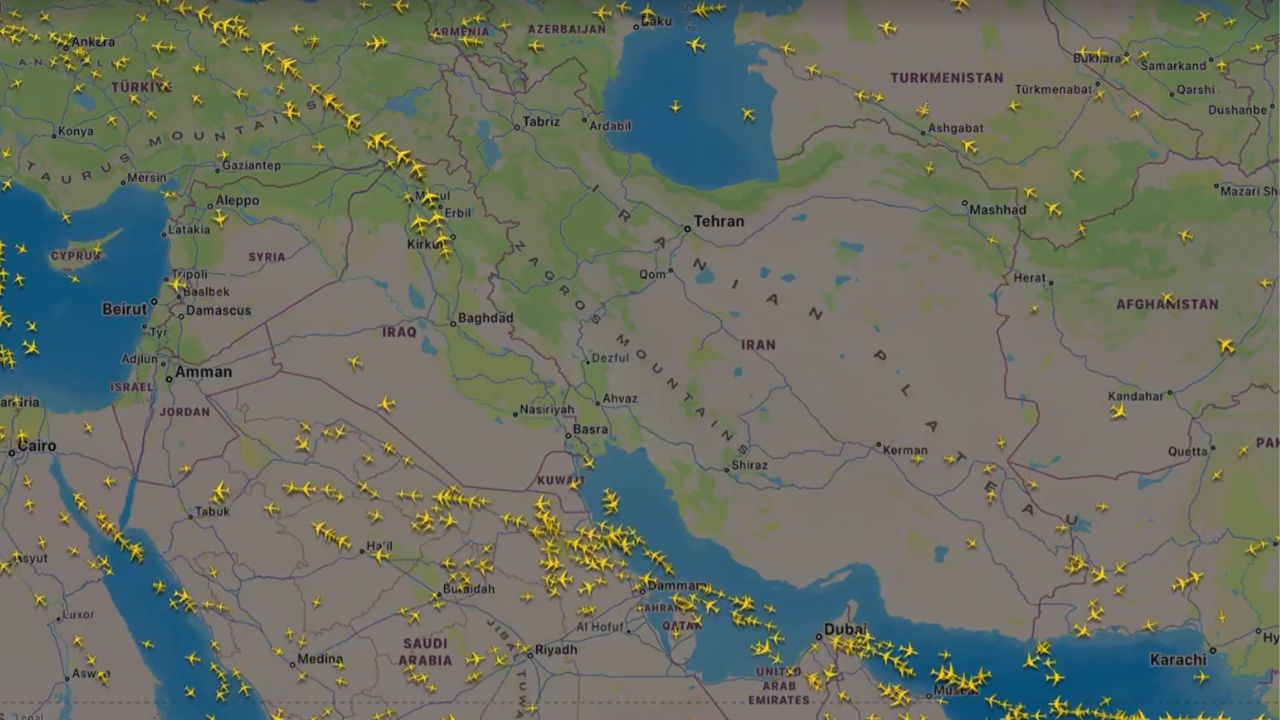
Consider the reality of those planes currently parked on the tarmac, their engines cold, their cargo holds empty. These are not just machines. They are the circulatory system of our modern life. When airlines suspend flights into the Middle East—a decision that seems to ripple outward with increasing frequency—we are witnessing the sound of a geopolitical door slamming shut. It is not a decision made lightly. It is a decision made in fear, backed by cold, hard actuarial math.
Let us talk about Elias.
Elias is a hypothetical traveler, but he represents a very real anxiety. He stands at Gate B42, clutching a boarding pass for a flight to Beirut. He has a wedding to attend. His sister’s wedding. He has spent months planning this trip, saving vacation days, mapping out the route. He arrives at the airport expecting the normalcy of the jet bridge and the complimentary coffee. Instead, he finds a gate agent who cannot meet his eyes.
"We’ve suspended operations for the next forty-eight hours," she says, her voice rehearsed but thin. "Security assessment."
Elias doesn't understand the security assessment. He only understands that the world has shrunk. He is trapped in a terminal that feels like a transit zone to nowhere.
Why do the airlines do this? The answer is often buried in jargon—"risk mitigation" or "operational integrity." But strip away the corporate speak, and you find a desperate, frantic negotiation with the unknown.
Airlines operate in a delicate space. They are essentially buying safety from an invisible broker. When the ground below a flight path becomes unstable, the cost of insurance for that specific corridor skyrockets. It is a market that reacts in real-time. If a conflict breaks out, the risk isn't just about a stray missile or a military mishap, though those are the terrifying outliers that haunt every flight director’s nightmares. The risk is also about the chaos of the unexpected. What if the airspace suddenly closes? What if an emergency landing is required in a territory that is currently hostile? What if the airport of destination is bombed while the aircraft is in the air?
Airlines cannot gamble with those variables. They run models. They consult intelligence agencies. They look at the premiums, which shift like sand in the wind. When the cost of the risk outweighs the profit of the flight, the plane stays grounded.
It is a mercenary calculation, yet it is entirely human.
Think of the pilot sitting in the cockpit. They are a human being with a family. They are not merely an operator of software; they are a person who must decide, in conjunction with their operations center, whether the risks of the next three hours are worth the lives of the three hundred souls in the back of the plane. When the airlines pull the plug, they are acknowledging the fragility of our belief that technology shields us from the violence of history.
This is the hidden cost of our interconnected age. We have built a world that demands constant motion. We expect to be anywhere, anytime. We have forgotten that for most of human history, "anywhere" was a place you walked to, or sailed to, over months. Now, we are accustomed to the miracle of flight, but we are unprepared for the sudden revocation of that miracle.
When a major carrier pulls out of a city, the silence that follows is deafening. It isn't just the lack of planes. It’s the severance of ties. It is the supply chain breaking, the mail stopping, the business deals freezing. It is the realization that we are, in fact, not as connected as we thought. We are connected only as long as the ground stays quiet.
I recall a time I was stranded in a city where the sky had closed. It wasn't war, but a natural disaster that made the airspace unnavigable. The feeling of helplessness is a distinct, physical sensation. It starts in the stomach. You look at the sky, usually a place of wonder, and you see only a barrier. You realize that you are tied to a piece of geography you didn't choose, and you are entirely at the mercy of forces that do not care about your wedding, your meeting, or your need to get home to your children.
We try to mitigate this anxiety with apps. We refresh our screens. We scour the internet for "safe routes." We look for loopholes. But the truth is, there is no workaround for the suspension of reality. When the airline decides it is too dangerous to fly, it is a definitive statement. It is a boundary.
There is a strange, jarring beauty to it, though. In a way, these suspensions remind us of our place in the natural order. We are not gods who command the skies. We are fragile creatures moving through a volatile world on the back of incredible, yet highly sensitive, machinery.
The aviation industry is a giant, grinding mechanism of efficiency. It is built to minimize human error and maximize predictability. When that mechanism grinds to a halt, it isn't because of a technical failure. It is because the world itself has refused to play along.
As we watch these carriers suspend flights, we should not just be frustrated by the inconvenience. We should be humbled. We should look at that red screen and understand that we are witnessing the exact moment where the modern world's ambition meets the ancient, unyielding reality of conflict.
Consider the passenger arriving at the airport tomorrow. They will look at the board. They will see the red letters. They will hope. They will bargain with the gate agent. They will try to find a way, any way, to get to where they need to be. And then, they will walk out of the terminal, out into the cool, indifferent air of the parking lot, and they will look up.
Above them, the sky will be empty. The contrails that usually stitch the clouds together will be missing.
That emptiness is not just an absence of flights. It is a temporary pause in the story we tell ourselves about our ability to conquer distance. It is the world holding its breath, waiting for the smoke to clear, waiting for the risk to recede, waiting for the day when the sky can be a road once again.
Until then, we wait on the ground, reminded of how small our world truly is, and how tenuous the lines that hold it together can be. The silence is profound. The uncertainty is the only constant. And somewhere, high above the clouds, the air remains open and waiting, a vast, unreachable territory, currently forbidden to us all.