The morning air in Victoria had that specific, sharp bite to it—the kind that smells of damp eucalyptus and distant saltwater, the kind that forces you to pull your woolen collar a little higher against your throat. Sarah was standing on her front porch in suburban Melbourne, a steaming mug of lukewarm tea cradling her palms, waiting for her daughter’s school bus to trudge up the street. She wasn't looking for poetry. She was looking for her car keys, which she had definitively lost somewhere between the kitchen counter and the laundry basket.
Then, the world above her shifted.
It didn't thunder. It didn't flash. It simply caught fire in high-definition oil paint.
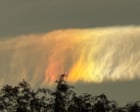
Across the pale, slate-gray canvas of the morning cloud cover, broad brushstrokes of electric violet, molten gold, and iridescent sea-green tore through the atmosphere. They weren't the neat, bow-shaped arcs of a traditional post-storm rainbow. This was something wilder, messier, and infinitely more fragile—a celestial mother-of-pearl rippling across the underside of altocumulus clouds. Sarah forgot the car keys. The steaming mug cooled in her hands. For three breathless minutes, thirty feet of damp suburban driveway vanished beneath a sky that looked like the inside of an abalone shell.
We spend an inordinate amount of time staring down. At glowing rectangles. At asphalt. At the immediate, frantic inventory of our daily anxieties—bills, schedules, the cold toast left on the counter, the mounting weight of a week half-lived. We treat the sky as a ceiling, a utilitarian dome that either leaks rain or provides enough sunlight to dry the washing.
Rarely do we look up and realize the ceiling is made of ice crystals acting as microscopic prisms.
What Sarah witnessed—and what thousands of Victorians across parts of the state captured on shivering smartphones that morning—was cloud iridescence, a meteorological phenomenon that scientists dryly classify as a form of coronas produced by the small, uniform droplets of water or ice crystals diffracting sunlight.
That is the botanical description of a miracle. It is accurate, and it is completely, utterly bloodless.
To understand why the sky suddenly decided to wear a pastel ballgown, we have to drop down from the stratosphere and look at the physics of the microscopic. Imagine, if you will, a cloud not as a solid mass of vapor, but as a vast, bustling metropolis of trillions of individual water droplets or ice needles. When a cloud is newly formed—often pushed aloft by rapid, localized updrafts—its constituent droplets tend to be remarkably uniform in size. They are nature’s marbles, perfectly sized and spaced.
When a stray beam of sunlight grazes the edge of this freshly minted cloud, something remarkable happens. The light doesn't just pass through; it bends. It wraps around the microscopic spheres. Because different wavelengths of light—reds, greens, violets—travel in different wave sizes, they get sorted out by the droplets like packages sliding down a high-speed sorting chute. Red light bends at a different angle than blue light. The result is a vibrant, rippling diffraction pattern that paints the cloud in bands of spectral color.
It is essentially the same physics that makes a puddle shimmering with a thin slick of spilled diesel look like a peacock’s tail. Only here, the canvas is four miles high, and the diesel is pure atmospheric moisture.
Yet, science misses the point if it stops at diffraction.
The real magic of an iridescent cloud—sometimes colloquially called fire rainbows, though they have nothing to do with fire or traditional rainbows—lies in its fleeting arrogance. These displays do not last. They require a precise alignment of variables: the sun must be at a specific angle, hidden just behind a thick cloud bank while illuminating a thinner, altocumulus or cirrocumulus veil at the edge; the droplets must be precisely matched in size; the observer must be looking at the exact right coordinate of the blue dome.
The moment the wind shifts by a single knot, the microscopic marbles scatter, the diffraction breaks, and the glorious violet-and-gold ribbon dissolves back into ordinary, utilitarian gray.
It reminds us of the delicate machinery holding our atmosphere together. We live on a razor’s edge of atmospheric pressure, humidity gradients, and solar radiation. Most of the time, this invisible machinery hums along quietly in the background, keeping us warm enough, giving us enough oxygen, behaving predictably. We take the predictability for granted. We treat the sky as an eternal given.
Then, a pocket of moist air hits an updraft over the Great Dividing Range, the sunlight hits an ice needle at sixty degrees, and suddenly the universe rips open its seams to show us what it can do when it’s showing off.
By the time the school bus finally groaned to a halt at the end of Sarah’s driveway, the colors had faded. The sky had returned to its sensible, workaday gray. The mug of tea was cold. The car keys were still hiding behind the toaster.
Nothing had changed, structurally speaking. The mortgage was still due. The emails were still accumulating in the inbox like drifted snow. The laundry basket was overflowing with unmatched socks.
And yet, as Sarah watched her daughter climb the steps of the yellow bus and turn to wave, she smiled. She didn't rush back inside to fix the tea. She stood on the porch for ten seconds longer, breathing in the eucalyptus-scented air, carrying the memory of a sky that had briefly refused to be ordinary.
The clouds will gather again tomorrow. Some will bring rain, some will bring gloom, and most will simply drift past without a second glance. But the next time the light hits the moisture just right, we will know what is happening behind the gray. We will know that down here, we are rushing through our hurried lives, while up there, the atmosphere is quietly performing magic for an audience of one.
Look up.