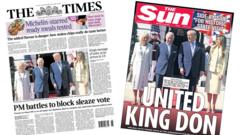
The British press is currently obsessed with a narrative of national decline, framed by the sensationalist "United King Don" headlines and a frantic obsession with parliamentary "sleaze." They want you to believe that a botched vote or a lobbying scandal is a sign of a breaking system. They are wrong. They are looking at the smoke and ignoring the engine.
What the media calls "sleaze" or "political chaos" is actually the high-frequency trading of political capital. The outrage machine thrives on the idea that integrity is the baseline of governance, and any deviation is a catastrophe. In reality, the friction you see in the headlines—the battles to block investigations and the backroom maneuvering—is the sound of a system doing exactly what it was designed to do: protect interests while maintaining the theater of accountability.
If you’re reading the standard news cycle, you’re being fed a diet of moral panic that obscures the actual mechanics of power. Let’s dismantle the "collapse" narrative piece by piece.
The Integrity Trap
The common consensus is that "sleaze" ruins a nation's standing. Pundits scream that the Prime Minister’s attempt to overhaul disciplinary rules for MPs is a death knell for British democracy. This is a naive reading of how global markets and geopolitical power actually function.
Institutional stability doesn't come from a lack of corruption; it comes from the predictability of that corruption.
History shows us that the most volatile periods for a country aren't when politicians are being greedy—it’s when the rules of greed change too quickly. When a government tries to block a "sleaze vote," they aren't just protecting a friend; they are attempting to stabilize the internal hierarchy. The market doesn't care if an MP took a consultation fee from a healthcare firm. The market cares if the government can still pass a budget.
Investors don't flee because of a "United King Don" headline. They flee when they can't tell who is actually in charge. The drama in Westminster is a superficial layer of turbulence over a deep sea of bureaucratic continuity. I’ve watched boards of directors panic over these headlines while their CFOs quietly double down on UK bonds because the underlying legal framework remains untouched by the theater in the House of Commons.
The Myth of the "Sleaze" Vote
The media frames the battle to block disciplinary action as a moral failing. From a cold, hard operational perspective, it's a resource management problem.
Every hour spent debating the conduct of a single backbencher is an hour stolen from legislative output. Governments "battle to block" these votes not because they love "sleaze," but because they hate the loss of momentum. Political capital is a finite resource. In the eyes of a ruling party, burning that capital on a minor ethics violation is the real sin.
When the papers scream about "United King Don," they are indulging in a pun that suggests the country has become a mob state. It’s a lazy comparison. A mob state is one where there are no rules. The UK is a state where the rules are so complex they require an entire class of professionals to navigate the grey areas. That’s not a sign of failure; it’s a sign of a highly evolved, if cynical, political economy.
Why You Should Stop Asking "Is the Government Corrupt?"
"People Also Ask" sections are filled with variations of: "Is the UK government in trouble?" or "Will the sleaze scandal lead to an election?"
You’re asking the wrong questions. The right question is: "How does this noise create opportunity?"
When the press focuses on the optics of a scandal, they miss the policy shifts happening in the shadows. While you’re distracted by whether a specific MP should be suspended for 30 days, the real machinery is moving on trade deals, energy subsidies, and tax reform.
I’ve seen this play out a dozen times. A "sleaze" scandal breaks, the currency dips for forty-eight hours based on "sentiment," and the smart money moves in to buy the dip because they know the structural integrity of the UK's financial institutions isn't tied to the personal ethics of a few dozen people in suits.
The Cost of Moral Outrage
The outrage cycle has a literal cost. It creates a "distraction tax."
- Regulatory Paralysis: Fear of being labeled "sleazy" prevents necessary, aggressive deregulation.
- Talent Drain: High-performing individuals from the private sector avoid public office because the scrutiny-to-power ratio is skewed.
- Short-Termism: Politicians make decisions based on tomorrow’s front page rather than a ten-year infrastructure plan.
The "United King Don" narrative implies we are a nation of clowns. But the joke is on the reader. By participating in the outrage, you are validating the theater. You are accepting the premise that the most important thing happening in the country is a debate over a lobbyist's phone call.
The Hidden Advantage of Parliamentary Friction
A government that has to fight its own backbenchers and the press over ethics is a government that is being slowed down. To the average observer, this looks like weakness. To a contrarian, this is a feature.
Unchecked executive power is the real danger to a modern economy. The "sleaze" battles provide a necessary, albeit messy, friction that prevents the government from moving too fast in any one direction. It is a crude, unintentional system of checks and balances.
The moment a Prime Minister stops "battling" to block votes is the moment they have become either irrelevant or a dictator. The struggle itself is the proof of a functioning—if ugly—democracy.
Stop Looking for "Clean" Leadership
The obsession with finding "clean" leaders is a fool’s errand that ignores the reality of the human condition and the requirements of power. To navigate the international stage, a leader must be capable of ruthlessness, compromise, and occasionally, shielding their own.
The "sleaze" headlines are just a record of the friction generated when the public's idealistic expectations rub against the reality of statecraft.
If you want to understand where the UK is actually going, ignore the headlines about sleaze and look at the capital flow into the tech sectors in the North, or the resilience of the London legal market. These entities don't care about a "sleaze vote." They operate on a different plane of existence entirely.
The media wants you to feel a sense of impending doom because fear sells papers and generates clicks. They want you to believe the "United King Don" is a sinking ship. In reality, it's just a ship with a noisy engine.
Stop reading the headlines. Start watching the money. The chaos isn't a crisis; it's the cost of doing business in a world that demands a moral facade for a mechanical process.
The next time you see a headline about a "PM battling to block a vote," don't feel indignant. Feel relieved that the machine is still grinding, because the alternative—a silent, perfectly "clean" government—usually means nobody is left to disagree.
Stop expecting your leaders to be saints. Start demanding they be effective. The rest is just noise for people who don't understand how the world actually turns.