The air in the control room always smells faintly of stale coffee and industrial carpet, a sterile scent that feels entirely disconnected from the cold vacuum of low Earth orbit. On the monitors, a jagged line bounces across a graph. To an outsider, it looks like a heart monitor flatlining in slow motion. To the engineers staring at it, it is something far more haunting.
It is the signature of a machine forgetting how to fly.
Two decades ago, a team of engineers stood in the Florida heat, shielding their eyes as a rocket tore through the sky. They were young then. Their joints didn't ache, their hair wasn't gray, and the telescope they had spent a decade building was a pristine jewel of aluminum and glass. Today, that same telescope is a battered veteran, scarred by micrometeorites and baked by solar radiation.
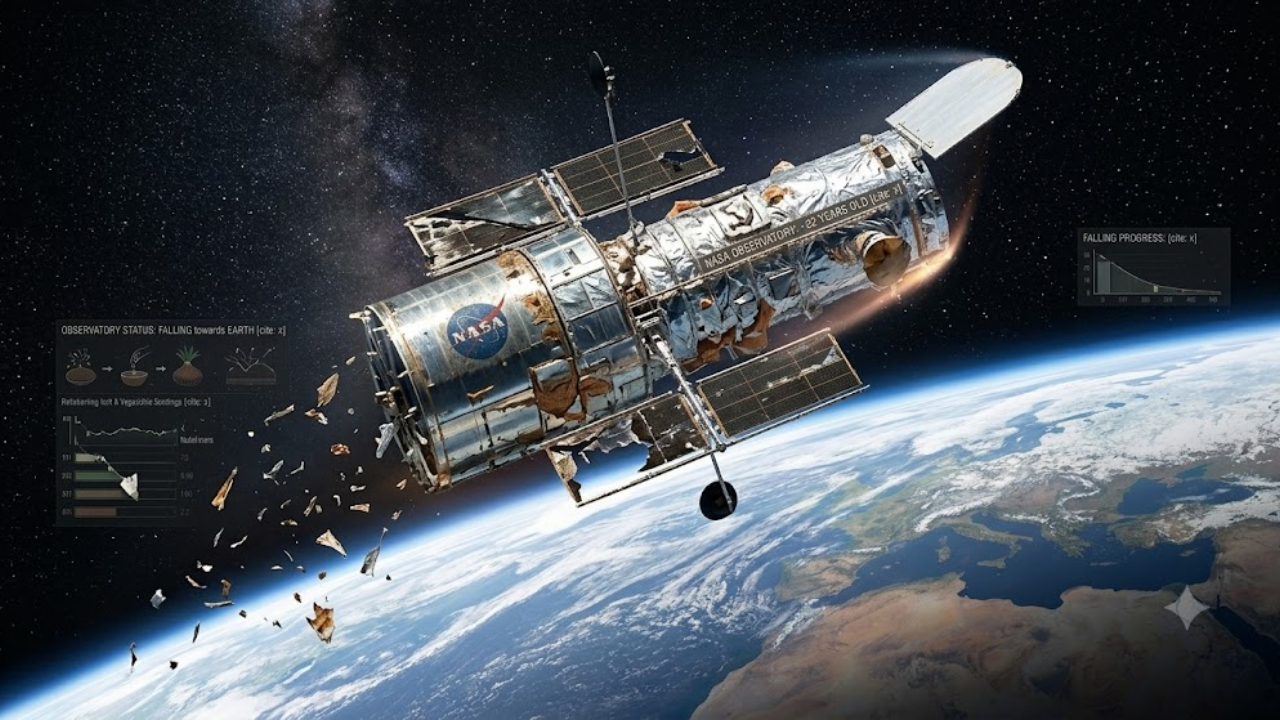
And it is coming home. Not in a triumphant return, but in a slow, agonizing drag against the very top of our atmosphere. Gravity is a patient hunter. It doesn't rush; it simply waits for speed to decay. Every day, the upper fringes of Earth’s atmosphere—a ghost of an air supply that shouldn't exist that high up but does—strikes the solar arrays. It is a microscopic brakeshoe, tapping the spacecraft over and over, thousands of times a day.
The telescope is falling.
The Weight of an Invisible Drift
Imagine walking through a thick fog. You cannot feel individual droplets of water hitting your face, yet after an hour, your clothes are soaked through. That is what low Earth orbit is like for a legacy satellite.
The science of orbital mechanics is brutally simple. To stay up, you must go fast. If you slow down, the earth pulls you closer. When you get closer, the air gets thicker. When the air gets thicker, you slow down even faster. It is a death spiral that takes years to manifest, but once the physics lock in, the clock starts ticking.
For twenty-two years, this observatory has done something miraculous: it looked into the blackness and brought back answers to questions we didn't even know how to ask. It mapped the violent outbursts of our sun, tracked cosmic radiation, and gave humanity a front-row seat to the invisible forces shaping our universe.
But out there, time is measured in degradation. Insulation blankets degrade and flake off like old skin. Batteries lose their ability to hold a charge during the forty-five minutes of darkness on every orbit. Gyroscopes, the spinning mechanical hearts that allow the telescope to point at a single star with pinpoint accuracy, begin to wobble.
In the offices down on Earth, the mood is not one of panic, but of a quiet, stubborn refusal to let go.
Consider a researcher we will call Sarah. She was a graduate student when the first data packets from the observatory came down. She used those numbers to write her thesis. She got her doctorate, earned her tenure, and now teaches a new generation of astrophysicists using images captured by the same instruments. To Sarah, the spacecraft isn't just hardware. It is a coworker. It is a bridge to her own youth.
When she looks at the tracking data now, she sees an old friend slipping away. The orbit has dropped by miles. The telemetry shows the thrusters firing longer and harder just to maintain a steady gaze. The fuel tanks, once bursting with hydrazine, are running dangerously light.
The Math of Survival
The problem with fixing something in space is that you cannot send a mechanic with a wrench. Every solution must be coded, tested in a simulator, and beamed up through a crackling radio link across hundreds of miles of empty space.
Engineers are currently playing a high-stakes game of orbital chess. They are skimming through decades-old blueprints, looking for margins that the original builders might have left behind. Can they vent residual gas from a secondary system to get a few meters of thrust? Can they tilt the solar panels into a "feathered" position, turning the telescope into a sleek arrow to minimize atmospheric drag, even if it means generating less power?
Every choice is a compromise. If you save fuel, you lose science. If you maximize power, you accelerate the descent.
The public often views space missions as grand, flawless triumphs of logic. We see the pristine animations and the polished press releases. What we miss is the duct-tape-and-twine reality of keeping an aging machine alive. It is a world of midnight software patches, written by people who haven't slept in thirty hours, trying to trick a computer designed in the late 1990s into ignoring a failing sensor.
The computer on board has less processing power than the key fob to your car. Yet, it is responsible for keeping a multi-million-dollar scientific instrument from tumbling into a fireball.
The Cost of Turning Off the Lights
There is a distinct melancholy in the space community when a mission nears its end. It is different from the sudden, shocking loss of a launch explosion. This is a scheduled funeral.
If the engineers cannot find a way to raise the orbit, or if a private space corporation cannot be enticed to mount a historic, unprecedented rescue mission to boost the satellite into a higher graveyard orbit, the end is mathematically certain. The telescope will hit the denser layers of the atmosphere. The solar panels will rip away first, torn off like cardboard wings. Then the main body will begin to glow, white-hot, before breaking into a shower of meteors over some lonely stretch of the Pacific Ocean.
Most of it will vaporize. Only the heaviest pieces—the titanium brackets, the dense beryllium mirrors—will survive the fire to plunge into the dark water below.
The true loss, however, isn't the metal. It is the continuity of sight.
When an observatory dies, a window closes. We become slightly blinder to the universe around us. The younger scientists who hoped to use its instruments for their upcoming projects will have to wait for the next generation of satellites, which are always years away and billions over budget. The institutional knowledge—the specific, unwritten quirks of how this specific telescope behaves when it gets hot, known only to a handful of operators—evaporates.
But the race isn't over yet.
Back in the control room, someone clicks a mouse. A new command line enters the queue, waiting for the satellite to pass over a ground station in Santiago. The engineers watch the clock count down to the acquisition of signal. They wait for the familiar green text to flash across their screens, confirming that the old machine is still listening, still fighting the gentle, relentless pull of home.
They will send the patch. They will trim the panels. They will fight for every single kilometer of altitude, every extra second of observation time. Because up there, in the dark, a twenty-two-year-old survivor is still looking at the stars, completely unaware that its own world is pulling it down.