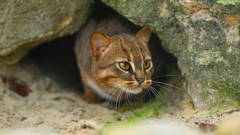
The leaves did not rustle. If you were standing in the damp, moss-choked quiet of the Devon woodlands at dawn, you would have missed it entirely. A shadow moved, but it was a shadow that weighed less than a bag of sugar.
We are conditioned to think of conservation in terms of giants. We throw our collective grief and millions of dollars at the disappearing rhinos, the dwindling elephants, the magnificent, tragic tigers. Greatness demands attention. But while the world watches the giants fall, a quiet catastrophe is unfolding at our feet, starring a creature so small it could sleep inside a hollowed-out coconut.
Meet the rusty-spotted cat.
To look at one is to feel an immediate, almost overwhelming instinct to protect. It is the smallest feline species on Earth, native to the deciduous forests of India and Sri Lanka. Adults max out at a mere three pounds. Their coats are a washed-out fawn, dotted with the faint, rust-colored smudges that give them their name. They look like eternal kittens, permanently paused in infancy.
But do not let the soft eyes fool you. This is an apex predator scaled down to the absolute physics of miniature survival. In the wild, they are ruthless, agile, and terrifyingly fast, leaping through the canopy to snatch frogs, rodents, and birds from mid-air.
They are also running out of time.
Deep in the rolling hills of Devon, inside the quiet sanctuary of the Wildwood Trust, one specific male rusty-spotted cat has spent his days navigating a carefully manicured enclosure. To the casual visitor, he is a viral video waiting to happen. To the keepers who clean his enclosure with hushed breath, he is a genetic ark.
And recently, his world changed. He was packed into a specialized crate, driven across counties, and introduced to a new home at the Cotswold Wildlife Park.
This was not a casual relocation. It was a deployment.
The Math of Extinction
Conservation is rarely about romantic rescues in the wild. More often, it is a brutal, agonizing game of spreadsheets, logistics, and statistical probability.
When a species enters the vulnerable category on the IUCN Red List, as the rusty-spotted cat has, the clock starts ticking at a different frequency. Habitat fragmentation is the silent killer here. In India and Sri Lanka, the continuous forests these cats rely on are being sliced into tiny, isolated islands by roads, monoculture plantations, and human expansion.
Consider what happens next. A population of a hundred cats becomes five isolated populations of twenty. Without the ability to roam and find mates from neighboring territories, the genetic pool begins to stagnate. Inbreeding takes hold. Diseases that a diverse population would easily fight off suddenly become existential threats. The cats do not just die out; they fade out, copied and recopied like an old cassette tape until the signal is nothing but static.
That is where the European Endangered Species Programme (EEP) steps in.
The EEP is essentially a highly scientific, ruthlessly curated matchmaking service for animals on the brink. Every single rusty-spotted cat in captivity across Europe is cataloged, its lineage tracked with the meticulousness of royal genealogy. The goal is simple but incredibly difficult to execute: maintain maximum genetic diversity within the captive population so that, if the worst should happen in the wild, the species still exists in its true, resilient form.
Our three-pound protagonist from Wildwood was identified by the EEP coordinators as a crucial genetic puzzle piece. He possessed the exact markers needed to diversify the lineage at Cotswold Wildlife Park.
But moving a wild animal—even one born in a sanctuary—is an exercise in high-stakes anxiety.
The Weight of a Three-Pound Moving Box
Step into the shoes of a sanctuary keeper for a moment. You have spent years earning the fragile, conditional trust of a creature that views the entire universe as a potential predator. You know his favorite high perches. You know the exact cadence of his nocturnal pacing.
Then, the order comes down. It is time for him to breed.
The physical move is a tense dance. You cannot simply pick up a rusty-spotted cat; their reflexes are lightning-fast, and a stressed cat can injure itself in a heartbeat. The capture must be swift, dark, and quiet. The transport vehicle must be climate-controlled, shielded from the roar of highway traffic, and kept in near-total darkness to mimic the safety of a burrow.
During the journey, the stakes hang heavy in the air. If the cat becomes too stressed, its immune system crashes. If the temperature spikes, it can suffer heatstroke. You are driving down the M5 motorway, surrounded by commuters listening to morning talk radio, carrying the fragile future of an entire evolutionary branch in a box on the back seat.
When he arrived at the Cotswold Wildlife Park, the immediate hurdle was not breeding. It was survival.
A new environment is a sensory assault for a feline. New smells, new acoustics, and worst of all, the scent of other cats. The keepers at Cotswold did not immediately throw him into an enclosure with his new prospective mate. That would have resulted in a bloodbath. Even the smallest cats are fiercely territorial.
Instead, the introduction is a slow, agonizingly bureaucratic process. First, they inhabit adjacent enclosures where they can smell each other through a secure barrier. Then come the visual introductions through mesh. Weeks pass. The keepers watch for body language—the flattening of ears, the twitch of a tail, the specific pitch of a vocalization.
Only when the tension melts into curiosity do the doors finally open.
The Invisible Front Line
It is easy to question the utility of all this. Why spend thousands of pounds, endless man-hours, and massive bureaucratic effort to shuffle a single tiny cat across the English countryside? Does the survival of a three-pound feline in a Gloucestershire park actually matter to the grand scheme of global ecology?
To understand why it matters, we have to look at what these cats represent. The rusty-spotted cat is a specialist. It thrives in the delicate understory of changing forests. It controls rodent populations that, left unchecked, devastate vegetation and carry diseases that jump to livestock and humans. They are the fine stitching in a massive ecological fabric. Pull enough threads, and the whole tapestry unravels.
But the real problem lies elsewhere. The true value of the captive breeding scheme is that it buys us time.
We live in an era of ecological triage. We cannot fix the global climate or halt habitat destruction overnight. If we leave these cats to face the current rate of deforestation without a safety net, they will vanish before we can fix their homes. The EEP is not a permanent solution; it is a cryogenic freeze for biodiversity. It is keeping the blueprint safe until we are mature enough as a civilization to rebuild the house.
The Wildwood Trust and Cotswold Wildlife Park are not just tourist destinations. They are quiet outposts on an invisible front line. The people working there do not get the glory of field biologists dodging poachers in the Serengeti. Their victories are measured in grams of food consumed, successful fecal samples, and the quiet, miraculous birth of a kitten that weighs no more than a walnut.
The Mirror of Our Choices
There is a profound irony in the fact that the survival of India’s smallest wild cat now hinges on the coordinated efforts of zookeepers in the English rain. It highlights how interconnected our world has become, and how absolute our responsibility is. We created the fragmentation that isolated them in the wild; we must create the network that unites them in captivity.
The next time you visit a sanctuary, look past the megafauna. Pass by the lions and the bears for just a moment, and look for the small enclosures tucked into the quiet corners. Look for the shadows that do not make the dry leaves rustle.
The male cat at Cotswold Wildlife Park is currently settling into his new life. The coming months will determine if the matchmaking experiment succeeds, if the genetic gamble pays off. There will be no press conferences if he mates successfully. There will be no headlines when the next generation arrives.
But in the quiet darkness of a Gloucestershire night, a tiny, rust-spotted kitten will take its first breath, its DNA a little stronger, its lineage a little deeper, pushing the darkness of extinction just a few inches further away. Every small victory is still a victory.
Deep in the undergrowth, the small ghost lives on.