The desert does not keep secrets for long. When a multi-million-dollar supply line turns into a skeletal ruin of twisted steel and ash, the wind carries the message across the dunes long before the official communiqués reach the newsrooms.
Picture Tariq. He is a hypothetical logistics coordinator sitting in a cramped, dimly lit command post somewhere outside Riyadh, staring at a blue dot on a digital map that has suddenly gone cold. That dot represents a heavy transport truck—armored, formidable, laden with millions of dollars in military hardware meant to reinforce a crumbling southern border. To the spreadsheets in the capital, it was inventory. To Tariq, it was a lifeline. Or rather, it was until a sudden, devastating flash of light erased it from the grid. Recently making waves recently: Why Transnational Syndicates Keep Setting Up Scam Operations in Thailand.
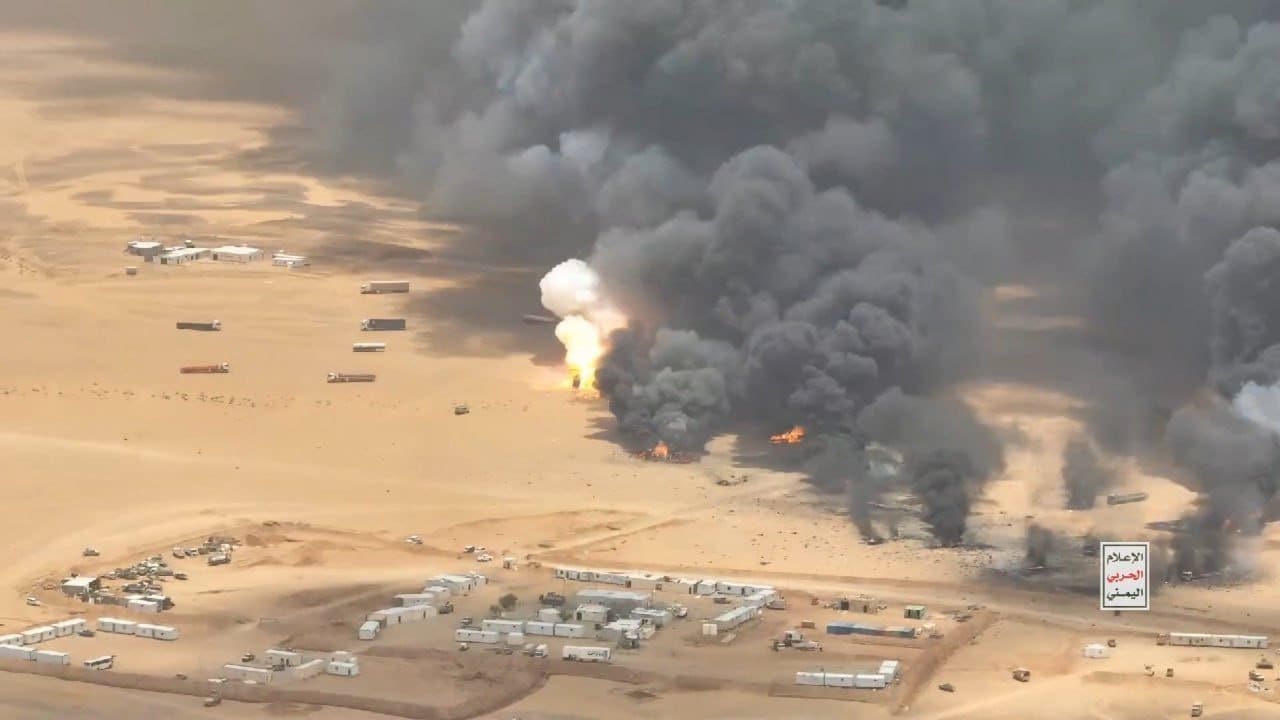
In an instant, an ordinary stretch of arid highway transformed into a graveyard of advanced ordnance. The Houthis did not just destroy vehicles; they punctured the illusion of absolute deterrence.
Video footage released from the ambush zones tells a brutal, unvarnished story. High-resolution clips show Saudi military transport trucks reduced to smoking charcoal, their expensive cargo scattered across the sand like broken toys. For years, the calculus of this conflict relied on a stark technological disparity. One side possessed seemingly limitless financial resources and state-of-the-art defense contracts with Western powers. The other side relied on resourcefulness, rugged terrain, and asymmetric warfare born of decades of hardship. More information regarding the matter are explored by The New York Times.
Yet, technology without tactical agility is just expensive scrap metal.
Consider what happens next: the vow of retaliation. Riyadh has pledged a sharp, punishing response. But retaliation in a shadow war is rarely a neat mathematical equation. When a government promises to strike back after a humiliation on the asphalt, the gears of state machinery grind into motion. War rooms activate. Jets are refueled. Diplomats draft stern warnings.
The deeper issue, however, is not about the weapons trucks themselves. It is about the geometry of attrition.
Every time a multi-million-dollar convoy is ambushed by fighters operating out of rugged mountain redoubts, the cost-benefit ratio tilts violently. You can buy the most sophisticated defense systems money can buy, but you cannot easily replace the psychological toll of vulnerability. The soldiers riding in those trucks are someone's brothers, sons, neighbors. When the armor fails to protect them from a well-planned ambush, the psychological shockwaves ripple far beyond the immediate blast radius.
We have watched this tragic drama unfold across the Middle East for years. It is a grinding machine that consumes young lives, drains national treasuries, and produces no victors, only survivors counting their losses. The grand strategies mapped out in air-conditioned conference rooms in Riyadh, Washington, and Geneva often bear zero resemblance to the reality on the ground—where a teenager with a thermal camera and an anti-tank missile can rewrite the balance of power in four seconds flat.
Silence. Then, the order to strike.
As the royal government prepares its counter-offensive, the stakes are higher than a burned-out chassis on a forgotten stretch of highway. Every escalation draws the region deeper into a spiral where nuance dies and retaliation becomes an end in itself. The smoke rising from the desert wreckage is clearing, but the shadow it casts over the future of the kingdom lingers, dark and unbroken, waiting for the next spark.