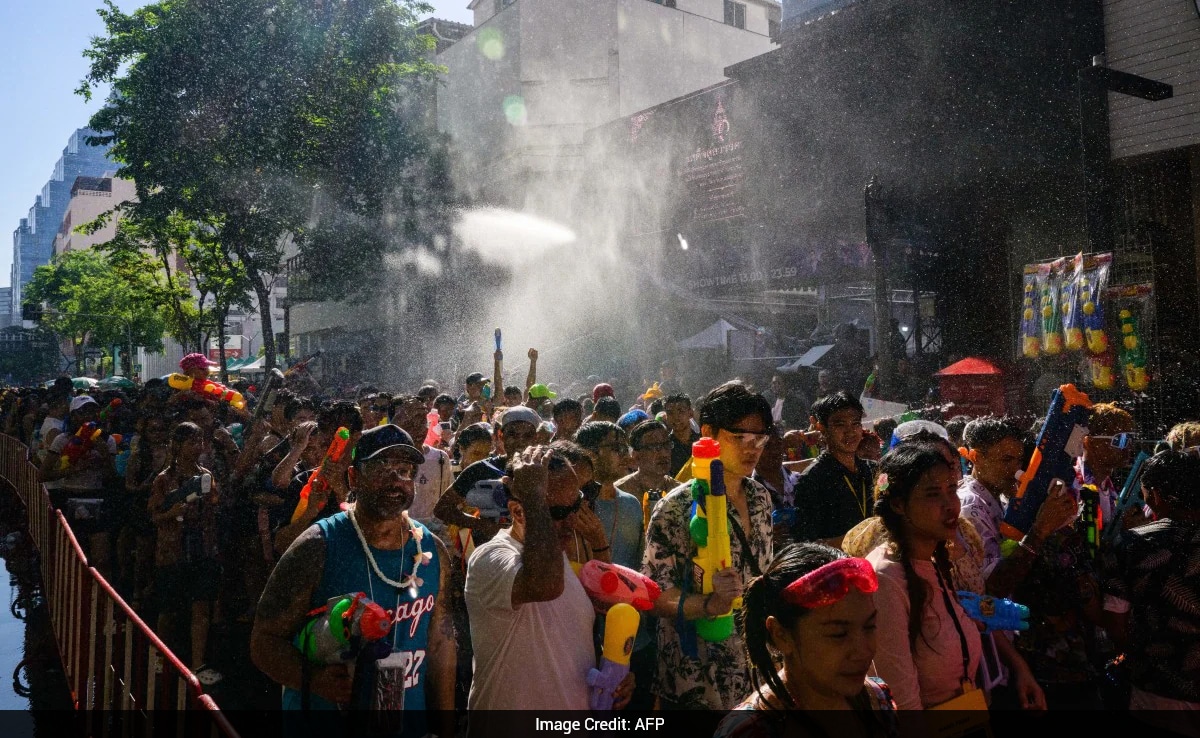
Media outlets salivate every April when the Thai Ministry of Public Health starts releasing the body count. The headlines write themselves. They call it the "Seven Dangerous Days." They paint a picture of a nation drowning in a chaotic, water-soaked purge where nearly 200 people are "killed in the world’s biggest water fight."
It is a lie. Not a lie of numbers, but a lie of context.
The "Seven Dangerous Days" is a statistical bogeyman designed to distract from the systemic infrastructure failures that plague Thailand 365 days a year. If you think the water fight is the killer, you’ve fallen for the most successful PR redirection in Southeast Asian history.
The Arithmetic of Panic
Every year, the press reports roughly 200 to 400 deaths during the Songkran period. In the article you likely just read, 191 deaths were framed as the price of a festival. But here is the reality: Thailand consistently ranks as one of the deadliest places on earth for road safety every single week of the year.
According to World Health Organization (WHO) data, Thailand sees an average of 22,000 road deaths annually. Do the math. That averages out to roughly 60 deaths per day, every day, from January to December. During Songkran, that number ticks up slightly to perhaps 70 or 80.
A 20% to 30% increase in road fatalities during the largest mass migration event in a nation of 71 million people isn’t a "deadly water fight." It’s a predictable outcome of millions of people traveling simultaneously on poorly designed roads. By focusing on the "Seven Dangerous Days," the government and the media imply the other 358 days are safe. They aren't.
The Scapegoat in a Hawaiian Shirt
We love to blame the water. We love the narrative of the "reckless tourist" or the "drunk local" throwing a bucket that causes a bike to skid. It makes for great television. It suggests that if we just regulated the water guns or banned alcohol on the streets, the dying would stop.
It won't.
The real killers during Songkran are the same killers present in October:
- Motorbike Vulnerability: Over 80% of fatalities involve two-wheelers.
- Infrastructure Design: U-turns on high-speed highways are death traps.
- Lack of Enforcement: Helmet laws are treated as suggestions, and speed limits are theoretical.
When the media focuses on the "carnival of death" aspect of Songkran, they provide cover for the authorities who have failed to implement year-round road safety reform. It is much easier to blame a festival than to admit that your national transport strategy is fundamentally broken.
The Alcohol Misconception
The competitor article will tell you that drink-driving is the primary cause. They aren't entirely wrong—alcohol is involved in about 25-30% of the fatal accidents. But look at the inverse: 70% of the people dying during the "Seven Dangerous Days" are sober.
They are dying because of fatigue. They are dying because they are three-deep on a scooter. They are dying because a pickup truck driver fell asleep after 14 hours of driving to get back to his village in Isaan.
By hyper-focusing on the "party" aspect of Songkran, we ignore the "migration" aspect. This isn't a week of drinking; it's the Thai equivalent of Thanksgiving, Christmas, and New Year’s rolled into one. It is the only time millions of workers in Bangkok can go home. The volume of traffic alone accounts for the spike in numbers, yet we continue to frame it as a moral failing of the revelers.
Stop Trying to "Fix" the Festival
Every year, there are calls to "dry out" Songkran or restrict the zones of play. These suggestions are not only culturally tone-deaf but logically bankrupt.
Imagine a scenario where the government successfully banned all water tossing. Would the death toll drop? Likely not. People would still be rushing home on under-maintained motorbikes. People would still be navigating high-speed arterial roads designed for cars, not the scooters that make up the bulk of Thai traffic.
The focus on the festival is a distraction from the E-E-A-T (Experience, Expertise, Authoritativeness, Trustworthiness) required to actually solve the problem. I have lived through a decade of these "Dangerous Days." I have seen the checkpoints. They are performative. They are a temporary band-aid on a gaping wound of systemic negligence.
The Tourism Double Standard
There is a sinister undercurrent to how the West reports on this. When there is a mass shooting in the United States or a heatwave in Europe that kills thousands, we don't call it the "Dangerous Days of Summer." We treat those as systemic issues or natural disasters.
But when Thailand celebrates, the media treats the casualty list like a scoreboard for a barbaric ritual. It frames Thai culture as inherently chaotic. This narrative hurts the tourism industry while doing nothing to protect the people actually at risk—the local workers on the roads.
How to Actually Survive Songkran
If you are a traveler reading the fear-mongering headlines and wondering if you should cancel your trip, you are asking the wrong question. The question isn't "Is the water fight dangerous?" The question is "Am I going to be on a motorbike on a major highway?"
If you want to stay safe, the advice is mundane, not sensational:
- Stay off the highways: The "killing fields" are not the moats of Chiang Mai or the alleys of Silom. They are the secondary highways leading out of the cities.
- Avoid motorbikes: This is true every day in Thailand, but doubly so in April.
- Stay put: Pick a city, stay there, and play in the water. The urban "water fights" are remarkably safe compared to the transit routes.
The Brutal Truth Nobody Admits
The "Seven Dangerous Days" is a successful marketing campaign for government activity. It allows officials to set up tents, take photos, and look like they are "doing something."
Once the seven days are over, the tents come down. The checkpoints vanish. The speed cameras are turned off. And 60 people continue to die every single day in total silence.
The headlines don't care about the 60 people who died on May 15th. There was no water fight then. There was no "hook" for the story.
Stop participating in the fetishization of Songkran's death toll. The festival isn't the problem. The roads are. If you want to lower the body count, stop looking at the buckets and start looking at the asphalt.
The "Seven Dangerous Days" exist all year long. We just only care when there's a party involved.


