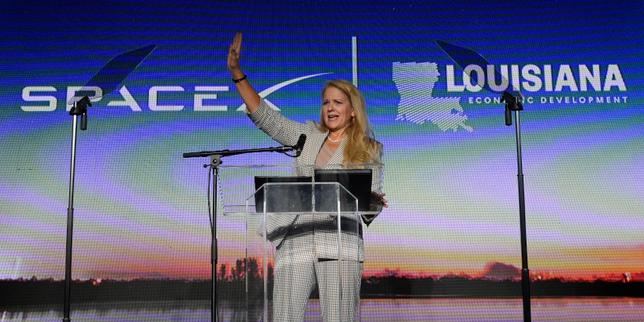
Capital allocation in aerospace manufacturing is governed by physical constraints and geopolitical friction. When heavy lift launch architectures scale beyond traditional coastal footprints like Boca Chica or Cape Canaveral, the bottleneck shifts from vehicle design to supply chain velocity and regional logistical capacity. The proposition of constructing a multibillion-dollar orbital launch and manufacturing complex in southern Louisiana represents an intersection of industrial economics, maritime freight access, and coastal regulatory arbitrage. Evaluating this initiative requires moving past headline-grabbing capital expenditure figures to examine the underlying cost functions of orbital infrastructure, labor market absorption, and modal transport efficiency.
The Tripartite Cost Function of Heavy Lift Infrastructure
Industrial scaling for next-generation heavy lift vehicles such as Starship demands a structural decoupling of production from launch. Building rockets where they launch is a historical artifact of early cold-war testing programs, not an optimal economic strategy for high-cadence commercial deployment. For an alternative perspective, check out: this related article.
Manufacturing Facility
       │
       ├──> Maritime Barge Transport ──> Coastal Integration Site ──> Orbital Insertion
       │
Labor & Supply Chain Ingestion
Three variables dictate the economic viability of a regional heavy lift facility: land acquisition cost per square meter relative to load-bearing capacity, proximity to navigable inland waterways with unrestricted vertical clearance, and localized workforce density with specialized metallurgy and aerospace manufacturing credentials.
Southern Louisiana offers a distinct advantage in logistics geography. The Mississippi River corridor and the Gulf Intracoastal Waterway provide unimpeded barge access for multi-hundred-ton hardware structures that exceed highway transport clearances. Moving a finished 9-meter diameter booster stage across state highways requires extensive utility line lifting, nighttime road closures, and municipal coordination that introduces massive scheduling variance. Waterborne transport bypasses terrestrial friction entirely, transforming days of high-risk overland transit into predictable maritime transits. Further analysis on the subject has been provided by ZDNet.
The economic trade-off lies in environmental mitigation and foundation engineering. Coastal marshlands present severe soil compaction challenges. Driving thousands of pilings to bedrock before laying concrete pads capable of absorbing multi-megaNewton thrust loads introduces significant upfront capital expenditure. The $100 billion valuation cited in initial regional projections is best understood not as a pure construction budget, but as a decade-long total program outlay encompassing R&D, tooling amortization, propellant production infrastructure, and iterative pad rebuilding necessitated by combustion-induced acoustic and thermal degradation.
Logistical Arbitrage and the Inland Waterway Advantage
Evaluating transport efficiency for orbital-class hardware requires analyzing the payload-to-infrastructure ratio. Traditional aerospace clusters in Southern California and Central Florida suffer from acute congestion. The San Pedro ports and the Central Florida highway network operate near capacity, creating schedule vulnerabilities for tier-one component delivery.
Louisiana operates within a different modal efficiency regime. The state possesses an established maritime industrial base cultivated by decades of offshore oil and gas extraction. Shipyards in Houma, Morgan City, and Lake Charles already house heavy-gantry cranes, automated plasma cutters, and certified welders experienced in marine-grade stainless steel fabrication—the identical metallurgy required for modern pressure-vessels and heat shields.
This existing human capital base shortens the training curve for aerospace manufacturing. While engineers must be imported or trained locally in flight-software architecture and orbital mechanics, floor-level fabrication labor requires minimal structural retraining. The marginal cost of labor training drops significantly when transitioning a marine pipefitter to a rocket tank welder compared to upskilling an un-credentialed workforce from scratch.
However, maritime logistics introduce environmental vulnerabilities. Regional vulnerability to severe tropical weather systems introduces high variance into operational continuity. A launch complex situated in coastal Louisiana must factor in facility hardening against category-four or category-five hurricane storm surges. The cost function must include secondary redundant assembly lines located inland to prevent catastrophic single-point failures from paralyzing the broader deployment cadence.
Regulatory Friction and Environmental Permitting Dynamics
Industrial expansion of this magnitude collides directly with federal and state environmental mandates. The National Environmental Policy Act review process for coastal launch sites typically spans multiple years, requiring exhaustive ecological impact statements regarding local wildlife habitats, marine mammal migration corridors, and commercial fishing disruptions.
The strategic choice of a southern Louisiana site must navigate the Louisiana Department of Natural Resources and the U.S. Army Corps of Engineers jurisdiction over wetlands. Wetlands mitigation banking—the requirement to restore or preserve off-site ecological areas to offset marshland destruction—adds a non-linear cost variable to the real estate ledger.
Unlike inland greenfield developments where land clearance is legally straightforward, coastal development requires balancing high-throughput industrial productivity against coastal erosion preservation mandates. If a facility design incorporates dedicated liquid oxygen and liquid methane production plants powered by local natural gas grids, emissions permitting under the Clean Air Act introduces another layer of multi-agency oversight. The velocity of these regulatory approvals often dictates whether a capital-intensive aerospace project achieves internal rate of return targets or stalls in litigation purgatory.
Supply Chain Interdependence and Propellant Logistics
An orbital launch facility is fundamentally a massive chemical processing plant disguised as a transport hub. The cadence of heavy-lift vehicles is constrained less by the availability of vehicle hulls and more by the continuous supply of cryogenic propellants.
Liquid methane and liquid oxygen must be delivered or synthesized in unprecedented volumes to support multi-orbital flight test campaigns. Establishing a Louisiana launch hub necessitates co-locating cryogenic air separation units and large-scale natural gas reforming infrastructure. The state’s position as a primary energy hub in the United States offers a strategic hedge. Proximity to the Henry Hub natural gas pricing node and extensive pipeline networks ensures feedstock stability for methane production.
The integration of local petrochemical supply chains with aerospace hardware production creates an industrial cluster effect. Suppliers of specialized valves, high-pressure composite overwrapped pressure vessels, and cryogenic insulation do not need to ship components across continents; they operate within a localized radius. This localized vendor density compresses cycle times for design iterations. When a valve fails a pressure test on the stand, a regional supplier can deliver a redesigned prototype within hours rather than weeks.
Capital Deployment Mechanics and Long-Term Program Viability
Mega-project finance in the aerospace sector relies on aggressive amortization schedules enabled by high flight frequency. Fixed capital investments in Louisiana launch pads and integration towers only yield positive net present value if the launch cadence scales to dozens, eventually hundreds, of missions per year.
Low-frequency launch models cannot justify multibillion-dollar coastal installations. The economic logic hinges on rapid reusability. Each pad must support multiple flights per week, turning infrastructure from a capital expense sink into a high-velocity throughput engine. If regulatory hurdles or technical redesigns restrict launch frequency, the cost per kilogram to orbit spikes, invalidating the economic rationale of regional expansion.
The long-term success of an enterprise-scale launch installation in southern Louisiana will ultimately be determined by the intersection of three operational metrics: structural integrity under high acoustic loads, maritime supply chain predictability during extreme weather seasons, and the speed at which regulatory bodies adapt to commercial spaceflight scaling. Capital scale alone does not guarantee velocity; the optimization of logistics pipelines remains the primary differentiator between sustained market dominance and fiscal stagnation.
Deploy forward operations teams to establish long-term land-use agreements and environmental baseline studies along the Gulf Intracoastal Waterway while simultaneously securing dedicated industrial power purchase agreements for cryogenic air separation infrastructure.