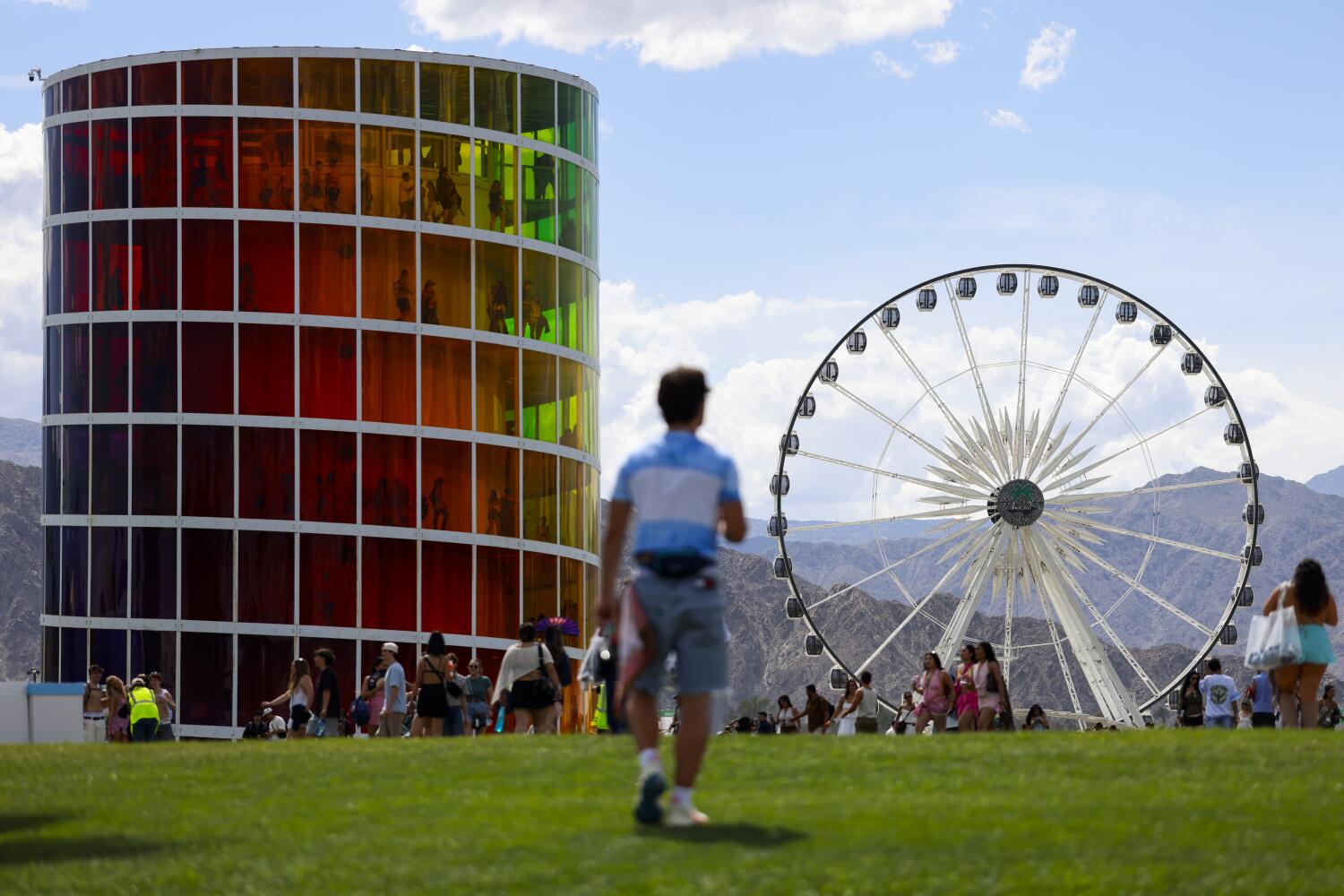
You’ve seen it on every Instagram feed since 2018. That massive, seven-story rainbow cylinder glowing against the Indio desert sky isn’t just a landmark. It’s a masterclass in structural engineering and color theory. While most festival art gets hauled away and forgotten, Spectra stayed. It became permanent. If you’ve ever wondered why a giant spiral of colored glass feels like the heart of the Empire Polo Club, it's because it was designed to manipulate your perception of the desert itself.
Building something this iconic isn't about luck. It’s about surviving 100-degree heat, punishing winds, and the logistical nightmare of a remote valley.
Why the Spectra Tower actually works
Most festival installations are meant to be looked at from the outside. You stand in front of them, snap a photo, and walk away. Spectra flipped the script. Newsome Brown Acoustics and the design team at New Manifest (formerly NEWSUBSTANCE) realized that Coachella attendees needed a sanctuary that didn't feel like a tent.
The tower works because it provides a literal shift in perspective. As you climb the ramp, the world outside changes color. Each window is a specific filter. When you're behind the red panes, the brown desert looks like a Martian landscape. By the time you hit the violets and blues at the top, the heat feels like it’s physically cooled down just because of the visual shift. It’s a psychological trick played on a massive scale.
The engineering behind the rainbow
You can't just stick a glass tower in the dirt and hope for the best. The Coachella Valley is notorious for high-speed wind gusts that can strip paint off a car. Spectra had to be rugged. The structure relies on a central steel core and a winding internal ramp that acts as a structural stabilizer.
The "glass" isn't actually glass in the traditional sense. It’s a specialized acrylic. Real glass would be too heavy and dangerously brittle for a temporary-turned-permanent structure in a seismic zone like California. These panels have to handle intense UV radiation without fading. If those colors lost their punch after one season, the whole illusion would break.
The lighting setup is equally intense. Thousands of LED fixtures are embedded within the structure. They don't just turn on; they breathe. The software controlling the light show is synced to create a sense of movement even when the tower is standing perfectly still. During the day, the sun does the work. At night, the tower becomes a 70-foot-tall lantern.
Why permanent art changed the festival game
Coachella used to be a "leave no trace" kind of event regarding its large-scale art. Everything was ephemeral. When Goldenvoice decided to keep Spectra as a permanent fixture, it signaled a shift in how festivals brand themselves.
Spectra provides a "North Star." If you're lost at 1:00 AM after a headliner set and your phone is dead, you look for the rainbow. It’s a functional piece of wayfinding. This is a lesson for anyone in event space design. If your art doesn't serve a purpose—shade, a meeting point, or a perspective shift—it’s just clutter. Spectra is a tool.
Logistics of the desert build
Building in Indio is a nightmare. I’ve seen crews deal with "dust devils" that knock over equipment and heat that makes steel too hot to touch by noon. The construction of Spectra required a massive footprint.
- Foundations: The tower sits on a heavy concrete pad designed to prevent it from sinking into the sandy desert soil.
- The Ramp: The 31-step spiral isn't just for people. It’s part of the tension system for the outer skin.
- Airflow: If you’ve been inside, you’ll notice it’s surprisingly breezy. That’s not an accident. The gap between the acrylic panels and the floor allows for natural convection, pulling hot air up and out.
Without that airflow, the tower would basically become a giant oven. No one wants to climb a 75-step spiral in a greenhouse when it’s 105 degrees outside.
The cost of an icon
Goldenvoice doesn't release the exact price tags for these commissions, but estimates for a structure of this scale and complexity easily run into the millions. You’re paying for more than materials. You’re paying for the specialized labor of international design firms and the rigorous safety testing required for a public-facing structure in California.
It’s an investment in "Instagrammability." In the current economy of attention, a landmark that generates millions of organic impressions every April is worth more than a traditional ad campaign. People don't share photos of billboards. They share photos of themselves inside a rainbow.
Moving beyond the photo op
If you want to create something that lasts in the cultural memory, stop thinking about the "vibe" and start thinking about the physics. Spectra succeeded because it solved the problem of scale. The desert is huge. Most art looks tiny and pathetic against the backdrop of the San Jacinto Mountains. You need height. You need bold, singular colors.
Don't settle for flimsy materials if you're building for the public. Use high-grade acrylics and powder-coated steel. Think about how the sun moves across your site. Spectra’s designers mapped the sun’s path to ensure the "golden hour" hit the panels at the exact right angle to maximize the glow. That’s the level of detail it takes to build an icon.
Go to the polo grounds during the off-season. You’ll see Spectra standing there alone. It still looks good. That’s the true test of design. It shouldn't need the music or the crowds to have power. It should hold the space all by itself.