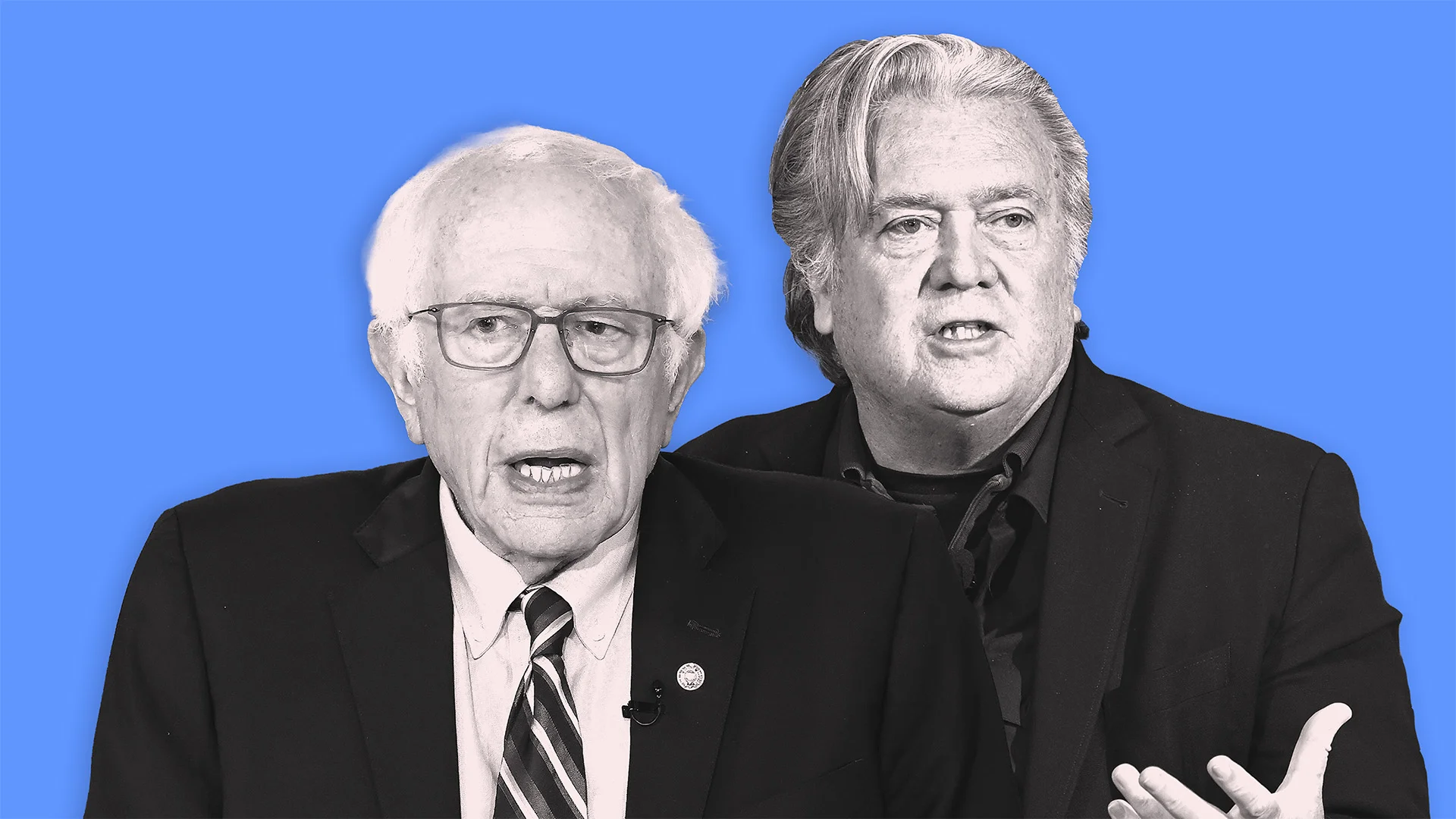
When Steve Bannon and Bernie Sanders end up in the same political foxhole, Washington should stop and check the exits. The former White House chief strategist and the independent senator from Vermont have spent decades firing ideological artillery across the aisle, yet both have zeroed in on a shared target—unregulated artificial intelligence and the Silicon Valley oligarchs building it. Their unlikely alignment in calling for strict AI safety guardrails, aggressive antitrust enforcement, and pauses on unchecked model deployment is not a sudden embrace of bipartisanship. It is a calculated, populist pincer movement against a concentration of corporate power that threatens both their constituencies with economic obsolescence and algorithmic control.
If you look past the cable-news shock value of a far-right nationalist and a democratic socialist reading from the same script, the math is simple. Both men represent working-class voters who have been burned by globalization, deindustrialization, and Wall Street bailouts. Now, they see the exact same playbook being run by tech executives in San Francisco and Seattle, except this time the automation is coming for both the factory floor and the cubicle farm.
The Populist Horseshoe Strikes Silicon Valley
Political pundits love the horseshoe theory—the idea that the far left and the far right bend toward each other at the extremes. Usually, it is a lazy shorthand. Here, it is an operational reality.
For years, Big Tech enjoyed a bipartisan shield in Washington. Democrats loved the progressive workplace aesthetics, the green-energy pledges, and the campaign donations. Republicans loved the free-market evangelism, the deregulation, and the shareholder returns. That consensus is dead.
Sanders approaches the AI safety debate through the lens of labor and class warfare. To him, generative AI and autonomous robotics are the ultimate tools of capital to crush the bargaining power of workers. When a handful of corporations own the foundational models that power everything from healthcare diagnostics to logistics, the wealth generated by those productivity gains does not trickle down. It pools at the top. Sanders has repeatedly warned that without strict legislative intervention—including shorter workweeks, robot taxes, and ironclad union protections—artificial intelligence will trigger the largest upward transfer of wealth in human history.
Bannon sees the exact same technology and smells a different kind of rot. His focus is national sovereignty, cultural preservation, and the destruction of what he calls the "techno-feudal" elite. On his War Room broadcast and in policy circles, Bannon frames unregulated AI as an existential threat to human agency and national security. He argues that unelected tech billionaires are building god-like systems without democratic consent, using data scraped from the public to create tools that will surveil, censor, and ultimately replace the American middle class.
Different diagnoses. Identical prescription. Both want the federal government to slam the brakes on unchecked AI deployment before the major labs achieve a monopoly that no regulator can break.
What "AI Safety" Actually Means When Populists Say It
In Silicon Valley, "AI safety" is a sanitized phrase. When executives at OpenAI, Google, or Anthropic use the term, they are usually talking about alignment—ensuring a superintelligent system does not accidentally wipe out humanity—or content moderation, which often translates to preventing a chatbot from generating offensive text.
Washington lobbyists love this framing because it keeps the conversation abstract and theoretical. If safety is about preventing a sci-fi apocalypse fifty years from now, Congress does not need to pass labor laws or break up monopolies today.
Bannon and Sanders are stripping away that protective jargon. When they talk about AI safety, they are talking about immediate, tangible damage to the social fabric.
- Economic Displacement: The rapid rollout of large language models and automated systems threatens white-collar and blue-collar jobs simultaneously, without any transition plan for displaced workers.
- Data Expropriation: Tech giants trained their commercial models on the copyrighted works, personal data, and creative output of millions of people without paying a dime in royalties.
- Information Control: When three or four companies control the primary engines of information retrieval and synthesis, they hold a quiet veto over public discourse, historical memory, and political narratives.
- Energy and Infrastructure Drain: Massive AI data centers are straining regional power grids and consuming millions of gallons of water, pushing utility costs onto local ratepayers while tech firms claim massive tax subsidies.
By redefining safety around economic security and anti-monopoly principles, this left-right coalition is hitting Silicon Valley where it actually hurts. Tech executives can easily testify before a Senate subcommittee about hypothetical existential risks and promise to self-regulate. They cannot easily explain to a voter in Ohio or Vermont why their electric bill is going up to power a data center built to automate their job.
The Regulatory Capture Trap
There is a massive catch in this push for federal oversight, and anyone who has covered Washington for more than a week can see it coming from a mile away. Regulation is a double-edged sword. In heavily concentrated industries, strict rules rarely hurt the incumbents. They hurt the startups.
When major AI labs ask Congress for licensing regimes, mandatory safety audits, and compute thresholds, they are not acting out of altruism. They are trying to pull the ladder up behind them. Compliance is expensive. A company backed by tens of billions of dollars can easily afford a small army of compliance lawyers and safety researchers to navigate a complex federal bureaucracy. A three-person startup in a garage cannot.
This is where the Sanders-Bannon alignment faces its toughest internal contradiction.
If Congress passes a sweeping AI safety bill modeled on the requests of big tech lobbyists, it will effectively create a government-sanctioned cartel. Open-source developers—who publish their code and model weights publicly so independent researchers can inspect them for flaws—would be regulated out of existence under the guise of "national security" or "public safety." The result would be the exact opposite of what both populists claim to want. Instead of decentralizing power, heavy-handed licensing would lock in the dominance of the very tech giants they despise.
To avoid building a regulatory moat for Silicon Valley, any legislative coalition has to draw a hard line between regulating monopolistic deployment and banning open-source innovation. So far, Washington has shown very little competence in making that distinction.
The Compute Bottleneck and Sovereign Power
To understand why both sides view AI as an urgent national crisis rather than just another software cycle, you have to look at the physical infrastructure underneath it. Unlike the Web 2.0 era, where two kids could build a social network on cheap servers, frontier AI requires staggering amounts of capital, specialized semiconductors, and raw electrical power.
This physical reality changes the political calculus. You cannot hide a gigawatt-scale data center in the cloud. It sits on real land, draws from real rivers, and connects to real municipal power grids.
For Sanders, this infrastructure footprint exposes the corporate welfare model of modern tech. Municipalities routinely hand over massive tax breaks to tech firms promising local jobs, only to discover that an automated server farm requires a tiny fraction of the workforce of a traditional manufacturing plant. For Bannon, the concentration of this compute power in the hands of a few globalist corporations—many with deep supply-chain ties to China—represents a direct subversion of national sovereignty.
When the physical footprint of tech becomes visible, local opposition organizes fast. Farmers fighting over water rights, local ratepayers angry about surging electricity costs, and unions fighting over automation clauses are creating a bottom-up pressure cooker that politicians can no longer ignore.
Why the Tech Lobby Is Suddenly Nervous
For the better part of two decades, Silicon Valley operated under the assumption that Washington was too slow, too divided, and too technologically illiterate to ever mount a serious challenge to its business models. Even during the height of the "techlash" following the 2016 election, partisan gridlock saved Big Tech from meaningful structural reform. Democrats wanted to regulate speech and algorithms; Republicans wanted to stop perceived conservative censorship. Because they could not agree on the problem, they passed zero major laws.
The emergence of a populist cross-aisle consensus on AI safety breaks that stalemate.
Consider a hypothetical scenario playing out in a swing-state congressional district. A local hospital system announces it is laying off hundreds of administrative and diagnostic support staff after signing an enterprise contract with a major AI vendor, while a tech firm simultaneously breaks ground on a tax-subsidized data center twenty miles away. In that district, the ideological divide between a Sanders voter and a Bannon listener evaporates overnight. Both voters are looking at the same local representative and demanding to know who is protecting their community.
Tech lobbyists know how to fight traditional partisan battles. They have armies of former Democratic staffers to whisper to progressives and former Republican staffers to whisper to conservatives. They do not have a playbook for an ideological pincer movement that treats their entire business model as a predatory threat to the working class.
The Limits of an Unholy Alliance
History is littered with strange-bedfellows coalitions in Washington that burned bright for a single news cycle and collapsed the moment someone had to write actual legislative text. Agreeing on the enemy is easy. Agreeing on the remedy is where populist alliances usually fracture.
When the debate moves from broad warnings about AI safety to specific statutory language, the fault lines between Sanders and Bannon become glaringly obvious.
| Policy Area | The Sanders Approach | The Bannon Approach |
|---|---|---|
| Labor & Wages | Mandatory union protections, shorter workweeks, and taxes on automation to fund social safety nets. | Strict immigration limits on tech visas (H-1B), economic nationalism, and reshoring physical supply chains. |
| Corporate Structure | Aggressive antitrust breakups, public ownership models, and strict federal labor boards. | Dismantling globalist conglomerates, stripping Section 230 protections, and decentralizing data ownership. |
| Content & Algorithms | Algorithmic transparency to prevent discrimination, harassment, and misinformation. | Ending corporate content moderation, dismantling trust-and-safety teams, and protecting free speech. |
| Global Strategy | International treaties on AI governance, climate standards, and worker protections. | Unilateral American dominance, decoupling from Chinese tech, and strict export controls. |
Look at the third row of that table. That is the minefield.
To Sanders and the progressive left, an unsafe AI system is one that amplifies racial or gender bias, spreads medical misinformation, or undermines democratic institutions. Fixing that requires human oversight, guardrails, and algorithmic auditing. To Bannon and the nationalist right, those exact guardrails are weapons of ideological censorship designed to enforce corporate orthodoxy and silence populist dissent.
If a bill includes provisions for algorithmic content moderation, Bannon and his allies will torpedo it as a censorship regime. If a bill strips away all content guardrails in the name of free speech, Sanders and the progressive caucus will walk away, arguing it enables mass harassment and fraud.
What Comes Out of the Wreckage
Even if a joint bill never reaches the Oval Office, the political damage to Silicon Valley's untouchable status is already done. In Washington, shifting the Overton window is often more consequential than passing a single piece of legislation.
By lending their combined megaphones to the AI safety critique, Sanders and Bannon have stripped artificial intelligence of its aura of inevitability. For years, tech evangelists successfully sold the public on a deterministic fairy tale: technological progress is a force of nature, resistance is futile, and anyone who questions the pace of deployment is a Luddite standing in the way of human flourishing.
That narrative is dead on arrival outside of venture capital boardrooms.
When two of the most influential populist figures in American politics explicitly frame unregulated AI as an existential threat to working people, they give cover to state attorneys general, local regulators, union leaders, and rank-and-file lawmakers to push back. We are already seeing the downstream effects in state legislatures across the country, where bipartisan coalitions are quietly advancing bills to restrict automated hiring tools, mandate human oversight in healthcare denials, and require explicit consent before companies can use biometric or creative data to train models.
The tech industry spent billions building a political fortress in Washington, assuming the threat would come from one side of the aisle at a time. They never planned for a siege from both gates simultaneously—and no amount of lobbying money can buy back the public trust once both the left and the right decide you are the enemy.