Air conditioning feels like a basic human right until you step into a school built decades ago during a sudden summer spike. When temperatures hit a staggering 33.8°C (98.6°F) in places unaccustomed to that kind of heavy, stifling heat, the traditional classroom setup completely fails.
You can run a dozen plastic desk fans and pass out ice pops, but 30 bodies crammed into a small space will quickly turn a lesson plan into a collective headache. Brains shut down. Kids get sick.
The real question isn't how to fix the building infrastructure overnight, because budgets don't work that way. The real question is how do you stop cognitive decline when the thermometer won't cooperate? Claire Judd, a head teacher at La Houguette Primary School in Guernsey, pointed directly to the problem. Research shows that when kids get too hot, cognitive learning plummets.
So what do you do when the system breaks? You get weird.
The Footbath Method and the Extreme Heat Alternative
Forget the standard advice about loose clothing and hydration for a second. Everyone knows that. When a Year 3 classroom started feeling physically ill from the ambient air, the staff at La Houguette abandoned the rulebook. They turned to two things sitting right on their doorstep: plastic trays and a forgotten World War Two German bunker.
The school island is scattered with hundreds of old wartime fortifications left behind during the military occupation. While a concrete bunker sounds like the last place you'd hold a grammar lesson, it has one massive advantage. It is underground. It stays cold.
Teachers began nipping in and out of the bunker for short cool-off periods, shifting entire blocks of instruction into the damp, historic walls just to drop body temperatures.
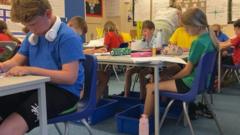
But you don't need a military relic to survive a heatwave. The real MVP of the week was a remarkably low-tech idea cooked up by a Year 5 teacher: the desk footbath.
Kids sat at their normal workspace with their bare feet completely submerged in plastic trays filled with cold water. Nine-year-old Beatrix noted that it made her concentrate more, while ten-year-old Anna admitted it sounded totally strange at first but genuinely rescued her day.
Why Submerging Your Extremities Actually Works
This isn't just a gimmick to keep kids entertained. There is hard physiological data behind why dunking your feet or your forearms works faster than standing in front of a blowing fan.
Your body dumps heat through the skin via blood flow. Your hands and feet are packed with specialized blood vessels called arteriovenous anastomoses. These vessels act as the body's natural radiators. When you submerge them in cold water, you rapidly cool the blood circulating through those extremities, which then travels back to your core.
Military research shows that dunking your forearms or feet in cold water can accelerate core temperature recovery faster than air exposure alone, because water conducts heat away from the body roughly 24 times faster than air.
When a child is sitting in a 33-degree room, their sweat can't evaporate efficiently if the humidity is high. The fan just pushes warm air around. The footbath bypasses the air entirely. It pulls the heat directly out through the soles of their feet.
Giving Up on the Industrial School Model
The schools surviving these micro-heatwaves are the ones willing to break their own schedules. Holding a whole-school assembly in a giant, un-air-conditioned hall during a heatwave is a recipe for heat exhaustion. La Houguette just threw the custom out the window and abandoned assemblies entirely.
They sent staff home the minute the final bell rang instead of keeping them for late meetings. Teachers went for quick swims during their lunch breaks.
If you are trying to manage a room full of people—whether they are third-graders or office workers—during a spike without infrastructure, you have to change your expectations. Expect people to be tired. Expect them to be a little grumpy.
Actionable Steps to Cool a Room Without AC
If you don't have an underground bunker, you have to build a makeshift cooling system with what you have.
- Freeze the water source: Don't just give kids cold water. Pack stainless steel bottles with 90% ice in the morning.
- Target the pulse points: If footbaths are too messy for your carpeted floor, use cold, damp flannels directly on the back of the neck or the forearms.
- Kill the ambient heat contributors: Turn off the big displays, projectors, and overhead lights. They emit more ambient heat than you realize.
- Create an internal wind tunnel: Fans only work if they are moving cooler air. Pointing a fan out an open window can sometimes pull hot air out of a room faster than blowing it directly on hot skin.
Staying functional in extreme weather requires zero ego. If a plastic bucket of water keeps a kid from passing out, you put the bucket under the desk and keep moving.
For more creative ideas on managing spaces during extreme weather spikes, check out this guide on Treating Heat Injuries which explains how rapid cooling techniques keep bodies safe in high-stress environments.