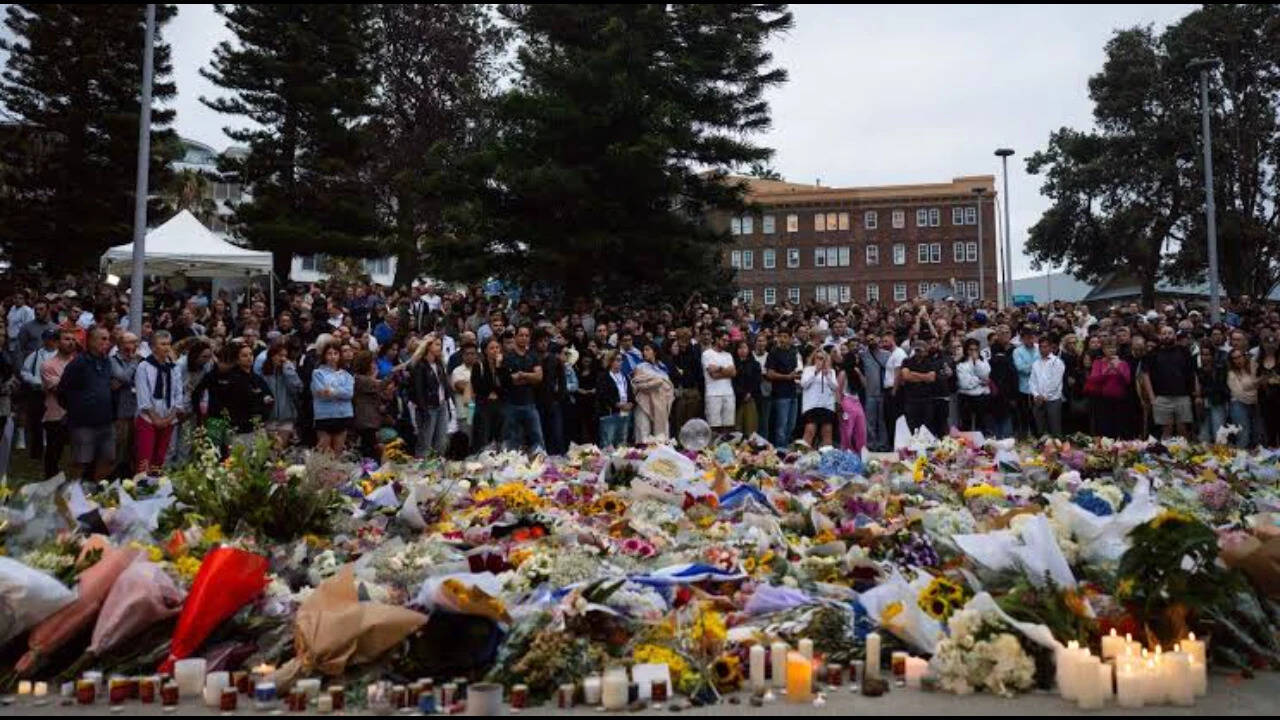
Sirens do not fade when the ambulances leave. They linger in the ribs of the people who heard them first, vibrating long after the yellow tape is rolled up and the street sweepers wash the asphalt clean.
For anyone who has ever stood inside the perimeter of a sudden, violent emergency—or waited frantically by a phone for a loved one to check in—the hours immediately following a terror attack operate on a sacred, unspoken contract. Chaos reigns outside, while inside the cordons, strangers surrender their deepest vulnerabilities to first responders, doctors, and the public trust. Every bandage wrapped, every statement logged, and every dollar set aside for victim compensation rests on a single, fragile assumption.
Nobody would ever lie about being in the blast zone.
Yet, when news broke out of Sydney that an Indian national had allegedly fabricated injuries following a Bondi terror incident—claiming he had been struck by shrapnel when New South Wales Police later determined he had not even been in Bondi at the time—the collective reaction wasn't just anger. It was a quiet, sickening realization. We were witnessing the collision of modern tragedy with an ancient, opportunistic impulse: the theft of someone else's trauma.
The Anatomy of a Phantom Wound
To understand why a man would invent a shrapnel wound out of thin air, you first have to picture the immediate aftermath of a high-profile attack in a place as iconic as Bondi.
Sun. Salt air. The sudden, inexplicable rupture of ordinary life.
When violence strikes a public sanctuary, the emergency response is massive and necessarily porous. Paramedics triage by sight and urgency. Police officers take rapid-fire statements while trying to secure a perimeter and hunt for secondary threats. Hospitals throw open their doors, operating on high-trust protocols designed to save lives first and verify paperwork second.
In that window of institutional grace, a gap opens.
Consider a hypothetical scenario—one that mirrors how fraud investigators across the globe track disaster opportunists. Picture a man sitting miles away from the coast, watching the breaking news banners crawl across a television screen or a smartphone feed. He sees the outpouring of sympathy. He hears officials announce emergency relief funds, visa extensions for affected foreign nationals, or expedited support pathways for victims of violent crime. Maybe he is facing financial ruin, a looming deportation, or simply a crushing, hollow obscurity. Whatever the private desperation, the television screen offers a twisted shortcut. All it requires is a trip to a hardware store, a self-inflicted scrape, a convincingly torn shirt, and a story rehearsed in the bathroom mirror before walking into an emergency room or a police station.
It sounds absurd until you look at the history of mass tragedies.
Following the September 11 attacks, dozens of individuals were prosecuted for claiming to have lost spouses who never existed or to have escaped towers they never entered. After the 2013 Boston Marathon bombing, federal authorities uncovered cases of people submitting doctored medical records to claim payouts from the One Fund, money donated by ordinary citizens to buy prosthetic limbs for amputees. In 2017, a French man was sentenced to prison after fabricating a story about surviving the Bataclan theater massacre in Paris, going so far as to join a victims' association and accept thousands of euros in state compensation before investigators realized his phone records placed him nowhere near the venue.
Tania Head, perhaps the most notorious example in modern memory, rose to become the president of the World Trade Center Survivors' Network, leading tours at Ground Zero and weeping before cameras as she recounted losing her fiancé in the South Tower. Years later, reporters discovered she had been in Barcelona on the morning of the attacks.
The pattern is remarkably consistent. Fraudsters do not target quiet, private misfortunes. They gravitate toward massive, televised catastrophes because the sheer scale of the event acts as camouflage. They bet that in the fog of war, nobody will check the security cameras at the train station three suburbs away.
How the Lie Unravels
They almost always lose that bet.
Modern policing in cities like Sydney does not rely on gut instinct or dramatic courtroom confessions; it relies on the silent, relentless breadcrumb trail we all leave behind every time we move through the world. When detectives from the New South Wales Police Force began piecing together the timeline of the Bondi incident, they weren't just looking for attackers. They were building a three-dimensional map of everyone who claimed to be a victim.
Think of a modern metropolitan investigation like a giant loom. Every witness statement is a single thread. On its own, a thread can be dyed any color the speaker wants. You can claim you were standing near a promenade, heard a deafening bang, felt a sharp sting in your leg, and ran for cover.
Then the detectives start weaving in the other threads.
First comes the digital tether. Every smartphone constantly pings nearby cell towers, creating a passive, timestamped log of physical movement. Even if a person turns off location services, the network still knows which tower handled their device's handshake at 2:14 PM on a Tuesday. Next comes the physical grid—Opal transit card taps at Sydney train gates, highway toll readers, ATM withdrawals, and the dense web of closed-circuit television cameras covering retail strips, beaches, and intersections.
Finally, there is the forensic signature of the injury itself.
Emergency physicians and forensic pathologists spend careers studying how human tissue reacts to high-velocity trauma. Real shrapnel—whether jagged metal fragments, shattered glass, or pulverized concrete—carries immense kinetic energy and heat. It leaves distinct entry profiles, microscopic debris embedded deep within the dermis, and specific patterns of bruising and charring. A superficial cut made with a household blade, or an old scar passed off as fresh trauma, looks entirely different under clinical scrutiny.
When police compared the man's account of being hit by shrapnel at Bondi against the cold, hard geometry of the evidence, the story didn't just fray. It disintegrated. The data showed he wasn't dodging debris by the water. He wasn't even in the suburb.
The Invisible Tax on Real Victims
It is tempting to dismiss a case like this as a bizarre, victimless quirk—a desperate guy telling a stupid lie that got caught before any real harm was done.
That instinct is dead wrong.
The true cost of faked victimhood is paid in full by the people who actually bled on the pavement. Every time a fabricated claim hits the headlines, an invisible tax is levied against genuine survivors. I have watched friends who survived violent crime navigate the bureaucratic labyrinth of victim services, and the hardest part is rarely the paperwork. It is the subtle shift in posture across the desk. It is the narrowing of an official's eyes, the extra request for corroborating affidavits, the agonizing months-long delay in releasing funds needed to pay rent while physical therapy keeps a survivor out of work.
When one person fakes a shrapnel wound, the system reacts by thickening its armor.
Charities tighten their dispersal rules. Government compensation boards introduce more invasive vetting procedures. Immigration authorities scrutinize humanitarian claims with heightened suspicion. The very mechanisms designed to catch people when they are falling apart become stiffer, colder, and slower.
Worse still is the psychological toll on the community. A terror attack is engineered to fracture public trust—to make neighbors look at each other with fear on a crowded bus or a sunny beach. When someone exploits that collective terror for personal gain, whether for money, legal status, or attention, they deliver a second, quieter blow to the exact same wound. They weaponize the public's best instinct—our willingness to rush toward pain with open hands and open wallets—and turn it into a source of cynicism.
Next time sirens wail and a donation link goes viral, a few more people will pause. A few more will wonder if the stories are real. That hesitation is a victory for the people who want us divided and numb.
The Weight of Truth
There is also a distinct, bitter irony in the cross-border dimension of the Bondi case. For millions of immigrants and international visitors living in Australia, trust is currency. Diaspora communities work tirelessly to build reputations as law-abiding, contributing neighbors, often while navigating complex visa rules and cultural misunderstandings. When one individual uses a national security crisis as a backdrop for personal fraud, it casts an unfair, lingering shadow over people who had nothing to do with the deception—people who, in many cases, were among the first to donate blood, offer free rides, or comfort the wounded in the wake of the attack.
Honesty about these incidents requires holding two truths at the same time. We must be unsparing in prosecuting those who exploit mass tragedy, because protecting the integrity of victim support systems is non-negotiable. At the same time, we must refuse to let the cynical actions of one outlier sour our collective empathy or paint an entire community with a single, lazy brush.
What Remains After the Sirens Fade
Think back to the real survivors of violence—the ones who do not give press conferences, who flinch when a car backfires three blocks away, who carry actual pieces of metal or glass beneath skin that will never quite look the same.
For them, trauma is not a story you put on to get into a room or cash a check. It is a heavy, uninvited coat you never get to take off.
When the investigators closed the file on the phantom injury in Sydney, stripping away the false narrative and laying bare the simple truth that the claimant had never set foot near the danger, they did more than clear a police docket. They drew a bright, necessary line between the lived reality of pain and the cheap theater of opportunism. The real scars of Bondi belong solely to the people who stood there when the world broke open, and no amount of borrowed grief will ever make a lie weigh the same as the truth.


