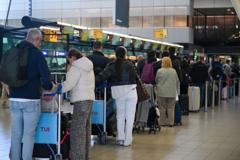
The corporate travel lobby is having a collective meltdown, and they want you to terrified.
If you believe the mainstream travel press, the European Union’s newly implemented Entry/Exit System (EES) is an apocalyptic bureaucratic failure designed to swallow your summer holiday whole. Trade groups like the International Air Transport Association (IATA) and Airports Council International (ACI) Europe are shouting from the rooftops about projected six-hour queues, billions in lost tourism revenue, and airport hubs gridlocked in terminal chaos. Airline executives are wringing their hands, advising passengers to arrive three to four hours before flights, and begging Brussels to suspend biometric data collection.
It is a beautiful, cohesive narrative. It is also a complete deflection.
The lazy consensus treats the EES rollout as an unpredictable regulatory storm that caught the aviation sector off guard. In reality, the hysteria surrounding these holiday delay warnings is smoke and mirrors. Airlines and airport operators are using a necessary, long-delayed digital infrastructure upgrade to mask their own structural incompetence, chronic understaffing, and refusal to invest in modern processing capacity.
The border system isn't broken. The aviation business model is.
The Biometric Scapegoat
Let's dismantle the central premise of the panic: that taking a digital photo and scanning four fingerprints is inherently unmanageable.
The EES, which became fully operational in April 2026 after years of diplomatic haggling and progressive testing, replaces archaic, manual passport stamping with a centralized digital database. It tracks non-EU travelers across the Schengen Area, automatically flagging overstayers and detecting forged identities.
According to the European Commission, the actual physical act of registering biometric data takes roughly 60 seconds per passenger. Yet, airports like Amsterdam Schiphol, Paris Charles de Gaulle, and Frankfurt are reporting bottlenecks that stack queues deep into airport terminals.
Why? Because for a decade, major international hubs chose to treat their physical footprints like high-end shopping malls rather than transit infrastructure. They minimized immigration floor space to maximize duty-free retail footprint. They underinvested in automated pre-registration kiosks, assuming that the EU would continuously delay the rollout or that national border police would simply shoulder the burden.
I have watched airport operators waste millions on automated baggage carousels and sleek terminal lounges while leaving border checkpoint booths unstaffed and technically obsolete. Now that the bill has come due, they are shocked that processing a planeload of 300 non-EU passengers takes longer when you only have two border guards on duty.
The baseline processing time isn't the problem; the deliberate under-allocation of human and technological resources to handle peak traffic flows is.
The Myth of the Automated Border
The travel industry wants you to believe that the pre-EES era was a model of efficient, streamlined movement. This is selective amnesia. Manual passport stamping was always a slow, error-prone administrative bottleneck that belonged in the 19th century.
Imagine a scenario where a border agent has to visually inspect a physical passport, flip through dozens of faded ink marks to manually compute the complex 90-day-in-a-180-day Schengen rule, and manually log anomalies. That process did not scale. It failed during peak summer rushes long before biometrics entered the conversation.
The EES addresses a genuine security and administrative vulnerability. The friction we are experiencing in 2026 is a classic technical debt rebalancing. The travel industry enjoyed decades of artificially fast processing by externalizing the cost of border security. They packed planes tighter, scheduled impossibly short connection windows, and relied on local governments to wave travelers through with minimal scrutiny.
[Legacy Border Model] -> Minimal Scrutiny -> Fast Lines -> High Security Risk
[Modern EES Model]    -> Biometric Verification -> Initial Friction -> Long-Term Security & Automation
Yes, the initial registration requires an extra step. But once a traveler’s biometric profile is securely logged into the centralized system, subsequent border crossings drop to mere seconds. The system is designed to create a smoother flow over a three-year lifecycle. The industry’s demand to "completely rethink or suspend" the process because of temporary summer pressure is short-sighted greed masquerading as passenger advocacy.
The Airlines' Hidden Incentive
There is a cynical economic reality behind why airline bosses are leading the media charge against the EES. If a passenger misses a flight due to general airport congestion, the airline is often legally insulated from paying steep statutory compensation under consumer protection frameworks like EU261. By loudly blaming "EU border system delays," airlines establish an ironclad "extraordinary circumstance" defense.
It is the ultimate get-out-of-jail-free card for carriers that have systematically overscheduled flights relative to their actual operational capacity. They get to pocket your ticket revenue, deny your compensation claim, and blame a faceless bureaucrat in Brussels for the fact that you watched your plane taxi away without you.
Furthermore, consider the hypocrisy of carriers like Wizz Air and Ryanair advising three-hour arrival buffers. These are the same ultra-low-cost business models built on lightning-fast 30-minute aircraft turnarounds. They loathe the EES not because it inconveniences you, but because any systemic delay ripples through their tightly wound schedules, compounding flight delays across their networks and cutting into daily aircraft utilization rates. The outrage isn't about human dignity; it is about asset depreciation.
The Cost of the Contrarian Truth
To be absolutely fair, the EES rollout is not flawless. The implementation across the 29 participating nations has been wildly uneven. While some states deployed dedicated mobile apps and pre-registration kiosks effectively, others dragged their feet. For instance, the temporary suspension of biometric checks at the Port of Dover in May highlighted how quickly a localized lack of physical lanes can cause a gridlock.
But hiding from reality won't fix it. The European Travel Information and Authorization System (ETIAS)—the €20 pre-travel visa waiver system—is launching at the end of 2026. This digital transition is inevitable.
If you want to protect your travel plans this summer, stop reading lazy travel guides that tell you to simply "arrive early" and hope for the best. Survival requires a completely different approach to booking:
- Banish the Tight Connection: If you are booking an itinerary that transitions from an international flight to an internal Schengen flight via a major hub (like Paris or Frankfurt), a 90-minute layover is operational suicide. You need a minimum of three hours to account for the initial biometric registration bottleneck.
- Target Secondary European Gateways: Avoid the massive, retail-bloated mega-hubs that are failing to manage their immigration spaces. Smaller, well-funded regional entry points often process passengers far faster because their base volume doesn't overwhelm their dedicated border staff.
- Register Once, Profit Later: Recognize that the pain is front-loaded. Your digital EES record is valid for three years. Endure the initial registration setup calmly, knowing that your subsequent entries will bypass the legacy administrative mess entirely.
Stop buying into the industry-engineered panic. The long lines at passport control aren't evidence of a failed European system; they are the visible scars of a commercial aviation industry that has refused to evolve alongside modern border realities.