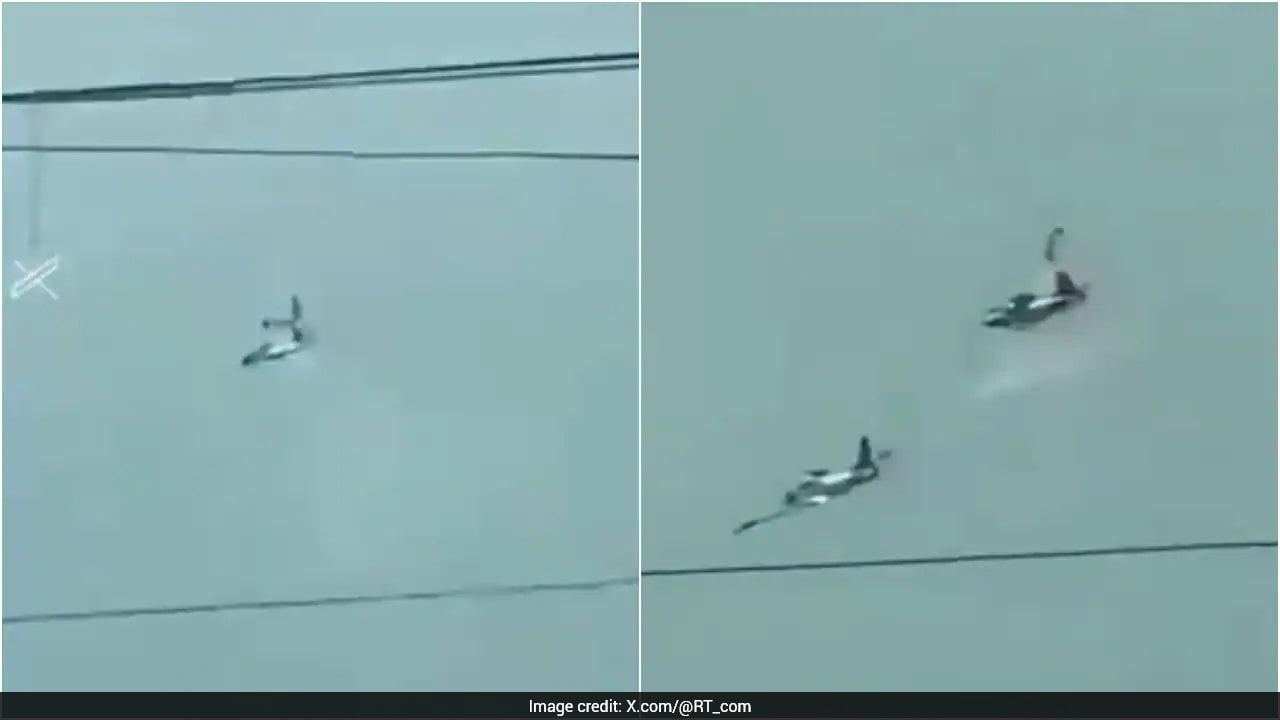
Two light aircraft slam into each other in clear skies over a flight school in the Philippines, killing four pilots, and the aviation press immediately defaults to the laziest trope in journalism. They treat a catastrophic mid-air collision like a freak car wreck. They blame "pilot error," shrug at the tragedy, and move on to the next news cycle.
They are completely missing the point.
When four people die in a routine training exercise, you are not looking at a sudden lapse in judgment by a couple of trainees. You are looking at the predictable, mathematical failure of an archaic aviation doctrine that relies on human eyeballs to prevent two 150-knot aluminum tubes from occupying the exact same airspace.
I have spent years dissecting aviation safety protocols, sitting in accident review boards, and watching flight academies cut corners under the guise of "traditional airmanship." Every time a mid-air collision happens in a training corridor, the public asks the wrong question. They ask, Who wasn't paying attention?
The real question is far more uncomfortable: Why are we still using 1930s visual rules to manage 21st-century flight volume?
The Myth of "See and Avoid"
If you ask a flight instructor how planes avoid hitting each other in uncontrolled airspace, they will recite three words like a religious mantra: See and Avoid.
Under Visual Flight Rules (VFR), pilots are legally responsible for scanning the horizon, spotting conflicting traffic, and maneuvering out of the way. On paper, it sounds reasonable. In the cockpit, it is a biological impossibility masquerading as a safety regulation.
Human eyes are terrible at detecting collision courses. Here is the brutal physics of why:
- Zero Relative Motion: If another aircraft is on an exact collision course with yours, it does not move across your windscreen. It stays pinned to a single, stationary spot on the glass, growing larger at an exponential rate until the final two seconds before impact. Because human peripheral vision is wired to detect movement, a stationary speck is virtually invisible.
- The Saccadic Blindness Trap: Your eyes do not scan smoothly across the horizon. They jump from point to point in rapid movements called saccades. During these micro-movements, your brain literally shuts off visual processing so you don't get motion sickness. When a pilot scans the sky, they are functionally blind for significant fractions of every single second.
- Cockpit Blind Spots: High-wing trainers block your view above and to the sides during turns. Low-wing trainers block everything beneath you. Two planes descending into the same traffic pattern—one high-wing, one low-wing—can fly in absolute blind spots relative to each other until their propellers shred the fuselage.
Authorities like the Federal Aviation Administration (FAA) and the Australian Transport Safety Bureau (ATSB) have published exhaustive studies proving that "See and Avoid" fails far more often than it succeeds. Yet, flight schools worldwide—especially in booming aviation hubs across Southeast Asia—continue to pack dozens of student pilots into narrow practice areas with zero radar coverage and zero mandatory electronic collision avoidance.
Calling a mid-air collision "pilot error" when the system forces pilots to rely on flawed human biology is like blaming a tightrope walker for falling when you refused to give them a net.
The Training Factory Bottleneck
To understand why two planes collided in the Philippines, you have to follow the money and the airspace geometry.
Global airlines are desperate for pilots. To feed that demand, regional flight schools have transformed into high-volume training factories. Dozens of single-engine trainers—Cessna 172s, Piper Archers, Tecnam P2008s—launch from the same regional airports every morning. They all fly to the exact same designated "practice areas" just miles from the runway to perform steep turns, stalls, and simulated engine failures.
Consider what happens in that practice area.
You have a student pilot under the hood—wearing a view-limiting device to simulate flying in clouds—staring intently at six flight instruments. Next to them is a 22-year-old flight instructor who is trying to build enough hours to leave for an airline job. That instructor is simultaneously watching the student's airspeed, coaching them through a maneuver, listening to chaotic radio chatter, and trying to scan 360 degrees of sky.
Meanwhile, two miles away, another instructor and student are practicing emergency descents in the exact same block of airspace.
They are flying on VFR, often without an Air Traffic Control (ATC) flight following service. Why? Because regional airports in developing aviation markets frequently lack primary or secondary surveillance radar down to low altitudes. Even when radar exists, controllers are overwhelmed by commercial traffic and routinely tell VFR training flights to "remain outside controlled airspace" and fend for themselves.
It is an airborne free-for-all.
Why ADS-B Alone Won't Save You
Whenever a crash like this hits the headlines, tech evangelists immediately chime in with a simplistic fix: Just mandate ADS-B!
Automatic Dependent Surveillance-Broadcast (ADS-B) allows aircraft to broadcast their GPS position to ground stations and other equipped planes. It is fantastic technology. It is also dangerously misunderstood by people who don't fly.
First, ADS-B Out only broadcasts your position; it does not mean you can see anyone else unless you also have ADS-B In and a cockpit display. Many budget flight schools install the bare minimum required by law, leaving pilots completely blind to nearby traffic.
Second, even with a full traffic display on an iPad strapped to the pilot's knee, you run into the Head-Down Trap. I have watched hundreds of pilots become so obsessed with staring at their digital traffic screens that they stop looking out the window altogether. If another plane in the area has a malfunctioning transponder, or is an older aircraft exempt from ADS-B mandates, it will not show up on that screen.
The pilot stares at a clean iPad screen, assumes the sky is empty, and flies straight into an invisible aircraft.
True collision avoidance requires TCAS (Traffic Alert and Collision Avoidance System) or FLARM—active systems that interrogate nearby transponders and scream audio commands ("CLIMB, CLIMB NOW") directly into the pilots' headsets. Commercial airliners have had TCAS for decades, and mid-air collisions between commercial jets have practically dropped to zero.
General aviation trainers almost never have active collision avoidance. Why? Because a certified active traffic system costs upwards of $15,000 to $30,000 per aircraft, while a fleet of aging Cessna 152s might only be worth $60,000 a piece. Flight schools do the cold, hard math and decide the hardware is too expensive.
Dismantling the Common Excuses
Whenever I argue that flight training needs radical structural overhaul, the old guard pushes back with the same tired defenses. Let's tear them apart.
"Trainees need to learn how to fly without relying on technology."
This is pure survivorship bias. Yes, pilots must know how to fly basic stick-and-rudder maneuvers without an autopilot. No, they do not need to gamble their lives in congested airspace without electronic traffic alerts to prove their worth. We don't ask student drivers to practice on highways without seatbelts so they "learn to be more careful." Giving a student pilot an audio traffic warning doesn't make them a weak pilot; it keeps them alive long enough to graduate.
"Radio calls keep everyone separated."
In theory, pilots announce their position and altitude on a common frequency (CTAF) so everyone builds a mental picture of the airspace. In reality, radio discipline in busy training areas is a nightmare. Frequencies get stepped on when two people press the mic button at the same time, creating a useless squeal. Non-native English speakers struggle with rapid-fire aviation phraseology under high stress. Worse, pilots routinely misidentify their own location—calling out "five miles north of the airfield" when they are actually five miles northeast. Relying on self-announced radio positions for collision avoidance is like navigating a dark room by shouting.
"Airspace congestion is unavoidable near big cities."
False. Congestion is a scheduling and zoning failure. Flight schools launch waves of aircraft at 7:00 AM, 9:00 AM, and 11:00 AM because it fits a neat corporate timetable. They cram all maneuvers into one massive, unstructured "practice area" instead of dividing the sky into strict altitude blocks and directional corridors. If you put inbound traffic at 2,500 feet, outbound traffic at 3,500 feet, and restrict aerobatic or stall training to specific geofenced quadrants, the probability of two planes meeting head-on plummets.
The Uncomfortable Truth About Flight Instructor Burnout
We cannot talk about four dead pilots without addressing the elephants in the right seats: flight instructors.
In almost every fatal training collision, there is a certified flight instructor (CFI) on board. The media treats them as seasoned veterans. Often, they are barely out of school themselves.
Because airlines require 1,500 flight hours (in the US) or specific multi-crew benchmarks globally before hiring, flight instruction has become a grueling, underpaid stepping stone. Instructors routinely fly six to eight hours a day in sweltering, unairconditioned cockpits, bouncing from one nervous student to the next with ten-minute turnaround times.
Chronic fatigue destroys situational awareness. When an instructor is on their fifth flight of the day, dehydrated and exhausted, their visual scan narrows to a tunnel. They focus entirely on keeping the student from stalling the plane into a spin, and their outside scan dies.
Yet, aviation regulators enforce strict duty-time limits for airline pilots while letting flight instructors fly until they drop. If we treat flight instruction like an entry-level gig rather than a high-risk operational specialty, instructors will continue to miss the speck on the windscreen.
The Downside of My Own Solution
Let's be brutally honest about the trade-offs. If regulators force flight schools to equip every trainer with active traffic alerting systems, mandate strict altitude stratification, and cap instructor daily flight hours, the cost of learning to fly will skyrocket.
Flight training is already prohibitively expensive, locking out working-class talent and worsening the global pilot shortage. Adding $20,000 of avionics to every trainer and restricting airspace capacity will drive hourly rental rates up by 20% to 30%. Smaller, independent flight schools will go bankrupt, leaving pilot training entirely in the hands of massive, corporate aviation academies.
That is a bitter pill to swallow. It will slow down the pipeline of new pilots and make airlines furious.
Good. Let them be furious. An industry that can only maintain its profit margins by subsidizing risk with the lives of 20-year-old trainees is fundamentally broken.
How to Actually Fix Training Airspace
If aviation authorities want to stop scraping wreckage out of fields and coastal waters, they need to abandon the "See and Avoid" fairy tale immediately and enforce four non-negotiable standards:
- Mandate Active Audio Traffic Alerts (FLARM or TAS) for All Primary Trainers: Passive displays are not enough. Every aircraft operating in a designated training zone must have a system that triggers an unmistakable, directional audio warning in the headset when a collision trajectory is detected.
- Enforce Altitude Stratification by Maneuver Type: Stop letting planes do slow-flight at 2,000 feet in the exact same zone where another plane is doing high-speed cruise descents. Divide practice areas into hard 500-foot altitude shelves. If you bust your shelf, your flight school loses its training slot for the week.
- Require Independent Safety Observers in High-Density Zones: Imagine a scenario where a flight school puts three planes in a tight pattern. Putting a third student in the back seat whose sole job is to scan the sky—zero instruments, zero radios, just eyes outside—cuts blind spots in half while giving the observer free immersion time.
- Cap Instructor Flight Hours at Five Per Day: Anything beyond five hours of dual instruction in a single-engine piston aircraft is negligence. You cannot teach airmanship and act as a human radar system when your brain is cooked from heat and vibration.
The next time a news alert flashes across your screen about two training planes colliding in clear weather, do not look at the names of the pilots to figure out who made a mistake. Look at the aviation authority that signed off on the airspace rules, and ask why they let four people fly blind in a crowded sky.


