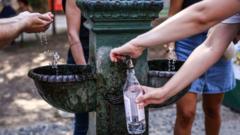
A tourist spends thousands of dollars on a luxury five-star holiday in the Italian Dolomites, sits down for a half-board dinner, and throws a multi-year legal tantrum because the hotel refuses to serve her a free glass of tap water. She takes her outrage all the way to Italy’s Supreme Court of Cassation, demanding thousands of euros for "emotional distress."
The highest court in Italy just handed down its verdict: Case dismissed. There is no law obliging hoteliers or restaurateurs to pour you free water from the plumbing.
Predictably, the internet is in a state of collective meltdown. The lazy consensus has already solidified into a predictable chorus of anti-corporate whine. Outraged travelers are calling it a victory for corporate greed, a violation of basic human rights, and proof that the hospitality industry has succumbed to total enshittification.
They are entirely wrong. The court didn’t just rule on a petty legal dispute; it accidentally defended the fundamental mechanics of business economics against a wave of toxic consumer entitlement.
The Fallacy of the Free Glass
The argument brought forward by the tourist—and echoed by millions of entitled diners worldwide—is rooted in a flawed premise: because water is a natural resource and a human right, it should be provided free of charge at a restaurant table.
This conflates a biological necessity with a commercial transaction.
When you sit down in a restaurant, you are not standing at a public drinking fountain. You are occupying real estate. You are utilizing infrastructure. You are consuming labor.
Let's break down the actual mechanics of what a "free" glass of tap water costs an establishment:
- The Infrastructure Cost: The plumbing, municipal water connection, and filtration systems maintained to meet commercial health codes.
- The Labor Cost: The server who takes the order, the busser who brings the glass, and the dishwasher who cleans it.
- The Capital Investment: The physical glassware, the commercial dishwashing machinery, and the electricity required to run it at sanitizing temperatures.
I have spent years analyzing restaurant profit margins. The average independent restaurant operates on a knife-edge profit margin of roughly 3% to 5%. In luxury hospitality, the overhead costs are astronomical. If a business gives away assets and labor for free simply because the raw material is cheap, it goes out of business.
Restaurants Are Not Public Utilities
The tourist in the Dolomites argued that tap water is an integral part of the service, "much like finding a bed with sheets, a warm room, and soap in the bathroom."
This is a spectacular misunderstanding of how hospitality pricing works. You do not get a warm room and sheets for free; you pay a room rate that explicitly covers the cost of laundering those sheets and heating that space.
When you book a half-board package, the contract covers the food. It explicitly excludes drinks.
By demanding tap water, the customer is attempting to rewrite the contract mid-meal to exploit a loophole. They want the luxury environment, the premium service, and the prime location, but they want to opt out of the financial ecosystem that keeps the lights on.
If you want the absolute lowest cost of hydration, the solution is simple: drink from the sink in your hotel room, or fill a bottle at a public fountain. But the moment you demand that a business serve you at a candlelit table, you are paying for the service, not the liquid.
The Bottled Water Scapegoat
The counter-argument usually pivots to environmental outrage. Critics claim that by refusing tap water, hotels are forcing people to buy imported, single-use plastic or glass bottles, padding their margins under the guise of tradition.
Let's look at the actual reality of Italian dining culture. Italy is one of the largest consumers of bottled water per capita in the world. This is not a conspiracy invented by Big Water or greedy hotel lobbies; it is a deeply ingrained cultural preference. Italians view mineral water as an extension of the meal, curated for its specific mineral profile to complement the food, much like wine.
To walk into a high-end European establishment and demand a pitcher of municipal tap water isn't a brave stance against plastic pollution; it is an aggressive refusal to respect the culinary culture of the country you are visiting.
If your goal is genuinely environmental preservation, the solution is not to bully a local business into changing its operational model. The solution is to decline a beverage entirely and hydrate on your own time.
The Dangerous Entitlement of the Modern Tourist
This legal saga highlights a much deeper, more malignant trend in global tourism: the belief that the customer’s comfort supersedes the host’s sovereignty.
Modern tourists want the charm of old-world European destinations without any of the old-world friction. They want the historic Dolomites, but they want American-style endless free refills, ice water on arrival, and customized service models. When a local business asserts its boundaries, the tourist weaponizes the legal system, claiming "emotional distress" because they were asked to pay €7 for a premium bottle of mineral water at a five-star resort.
The real distress here is the financial burden placed on a business that had to defend itself through three tiers of court systems because a guest couldn't handle the word "no."
Hospitality is a two-way street. It requires a guest to respect the rules, culture, and economic realities of the establishment they choose to patronize. If you cannot afford the €7 bottle of water, or if the policy offends your moral sensibilities, you have a potent weapon at your disposal: vote with your wallet. Dine elsewhere.
Stop expecting private businesses to operate as public charities to subsidize your vacation budget. The Italian Supreme Court didn't fail consumers; it protected common sense.


