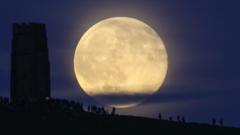
Every June, millions of people get tricked by the same astronomical PR stunt.
Digital publishers blast out identical clickbait guides with titles like "Where to see the Strawberry Moon tonight." They tell you to pack up your car, drive three hours away from light pollution, hike up a freezing hill at midnight, and wait for a cosmic masterpiece.
It is a massive waste of your time.
If you followed that lazy advice, you probably ended up shivering in a dark field, staring at a completely normal, slightly yellowish rock in the sky that looked exactly like the moon did last month. You did not see a vibrant, pink, berry-colored celestial anomaly. You saw the exact same lunar cycle that has occurred for billions of years, packaged by modern media algorithms that need your ad clicks.
The entire premise of the "perfect viewing spot" for a full moon is flawed. Here is the uncomfortable truth about astrotourism, atmospheric optics, and why your backyard—or even your apartment balcony—is actually the best place to watch the June moon rise.
The Pink Myth: It is Not Strawberry-Colored
Let us destroy the biggest misconception immediately. The moon is not turning pink tonight.
The name "Strawberry Moon" has nothing to do with color. It originates from Native American traditions—specifically the Algonquin tribes—who used the full moon of June as a celestial calendar tracking tool to signal that wild strawberries were ripe for gathering. It is a agricultural time stamp, not a literal description.
Yet, every year, lifestyle writers imply you are about to witness a neon pink orb. When people drive out to remote state parks expecting a spectacular color show, they are inherently disappointed.
If you want to see the moon look genuinely orange or deep yellow, you actually need atmospheric interference. When the moon sits low on the horizon, its light travels through a much thicker layer of the Earth's atmosphere than when it is high overhead. This layer scatters shorter wavelengths of light (like blue and violet) and allows longer wavelengths (like red and yellow) to pass through to your eyes.
Where do you get the thickest, most particle-heavy atmosphere to scatter that light and create a deep, dramatic amber hue? Near the horizon, often looking through the heat and dust of developed areas. By driving up a pristine, high-altitude mountain peak to get "closer" to the sky, you are actually stripping away the exact atmospheric density required to give the low moon its rich, golden-orange tint. You are paying for gas to see a standard white rock.
The Illusion of Scale: Why the Wilderness Ruins the View
The most spectacular version of any full moon is not the one high in the pitch-black sky at 1:00 AM. It is the one hovering right next to the horizon during the first twenty minutes of moonrise.
This is due to a psychological phenomenon known as the Moon Illusion. For centuries, scientists and philosophers—from Aristotle to modern cognitive psychologists—have debated exactly why this happens. The prevailing consensus centers on human depth perception. When the moon is high in an empty sky, our brains have no distance cues, so we perceive it as smaller and further away. But when the moon rises right next to trees, distant buildings, or hills, our brains instantly calculate its massive scale relative to those foreground objects.
The moon looks gigantic because your brain is misinterpreting size constancy.
Now, think about the standard advice telling you to head into the deep wilderness or a massive, flat desert for the best view. If you stand in the middle of a vast, featureless plain or on top of a barren mountain peak, you lose those immediate foreground reference points. The moon rises over a distant, flat horizon line with nothing next to it to ground the scale. It looks small, distant, and underwhelming.
If you want a truly jaw-dropping view of the moonrise, you need structures. A city skyline, a suspension bridge, or a row of suburban rooftops provides the ultimate backdrop for the Moon Illusion. Watching a massive, golden-orange orb rise directly behind a skyscraper or a jagged tree line creates a far more dramatic visual impact than watching it rise over an empty ocean or a dark desert.
The Light Pollution Lie
We have been conditioned by dark-sky advocates to believe that light pollution destroys every astronomical event. For meteor showers, the Milky Way, or faint comets, that is absolutely true. City lights easily drown out those delicate, distant photons.
But the full moon is a completely different beast.
The moon is an incredibly bright, highly reflective body lit directly by the sun. It has an apparent magnitude of roughly -12.74 when full. To put that in perspective, it is more than 25,000 times brighter than Vega, one of the brightest stars in the night sky. Light pollution from streetlights or neon signs cannot compete with the sheer luminance of a full moon.
You do not need a pristine dark-sky reserve to view something that bright. In fact, ambient city light or suburban lighting actually balances the high contrast. When you stare at a blazing full moon in total, pitch-black darkness, the contrast can be so intense that it blows out your night vision, turning the moon into a blinding white glare where surface details like craters and maria (the dark plains) get washed out. A little bit of ambient light around you actually makes it easier for your eyes to resolve the distinct physical features on the lunar surface without squinting.
How to Actually Watch the Moonrise Tonight
Stop looking up listicles dictating which state park to drive to. If you want a superior experience tonight, execute this simple, highly effective strategy instead.
1. Check the Exact Moonrise Time
Do not just go outside at 10:00 PM. The magic window lasts only about 30 minutes. Look up the precise moonrise time for your specific zip code using a tool like the US Naval Observatory data or a basic weather app.
2. Find a Clear Eastern Horizon
You do not need to climb an isolated mountain; you just need an unobstructed view toward the east-southeast. A high-floor apartment window, a highway overpass sidewalk, a local park with a clear clearing, or even a supermarket parking lot with a clear view east will work perfectly.
3. Arrive 10 Minutes Early
The moon will appear suddenly. Because it rises at an angle, you want your eyes adjusted to the twilight horizon before it breaks.
4. Look for Foreground Elements
Position yourself so that trees, houses, or architectural elements sit between you and the eastern horizon. Let the Moon Illusion do the heavy lifting for your eyes.
The travel industry wants you to believe that every weekend astronomical event requires a road trip, a hotel booking, and specialized gear. They are selling you an idealized, photoshopped version of nature that does not exist. The sky belongs to everyone, and the best seat in the house is the one you do not have to pay a single cent to reach. Open your window, look east, and enjoy the show.