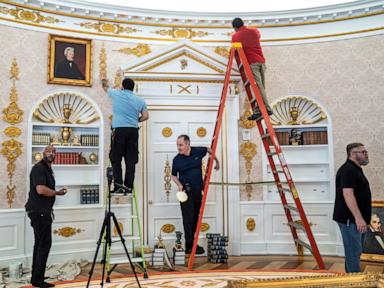
Every coastal design critic and political commentator is currently hyperventilating over a private Oval Office replica near the White House getting a gilded Trump makeover. They are pointing at the gold flourishes, the heavy drapery, and the sheer, unapologetic opulence, and laughing. They call it tacky. They call it gaudy. They call it a cheap parody of American power.
They are completely missing the point.
While the pundit class is busy clutching its pearls over interior design aesthetics, they are ignoring a masterclass in psychological priming, spatial branding, and private-sector influence. That room—located inside the Hay-Adams or a nearby private membership club like Executive Branch or Ned’s Club, depending on which D.C. parlor you’re peeking into—isn't decorated for Architectural Digest. It isn't designed to soothe the sensibilities of minimalist elites who think beige linen is the height of sophistication. It is a calculated, high-stakes stage set built to project absolute authority before a single word of a deal is negotiated.
If you think gold leaf is a joke, you don't understand how power actually operates in Washington.
The Lazy Consensus of "Good Taste"
The mainstream narrative around this makeover relies on a tired, predictable trope: that true American leadership is defined by understated, Federal-style restraint. Critics love to invoke Jacqueline Kennedy’s 1961 White House restoration, where historic authenticity and quiet elegance were treated as moral virtues. In their eyes, adding heavy gold accents to a replica of the Resolute Desk’s surroundings is a violation of sacred civic minimalism.
This is historical amnesia disguised as aesthetic critique.
Power has never been minimalist. From the Palace of Versailles to the gilded ceilings of the U.S. Capitol’s own National Statuary Hall, monumental architecture and metallic excess have always served one primary function: intimidation. When a foreign dignitary, a Fortune 500 CEO, or a reluctant committee chair walks into a room drenched in gold and presidential iconography, their nervous system reacts before their rational brain catches up.
I’ve spent fifteen years advising high-net-worth principals and political operatives on physical staging and brand environments. I’ve watched organizations blow millions of dollars building sterile, glass-walled "innovation hubs" in downtown D.C. that feel like upscale dental offices. You know what happens in those rooms? Nobody feels compelled to make a historic decision. Everyone acts like middle management.
Compare that to a room engineered for sensory dominance. Gold reflects warm light, flatters skin tones under camera flashes, and triggers an immediate, primal association with permanence and wealth. The Trump aesthetic isn't an accident of bad taste; it is an aggressive rejection of bureaucratic grey. It tells the person sitting across the desk that the host plays by different rules—and wins.
The Anatomy of a Shadow Oval Office
To understand why this specific replica matters, you have to understand what it actually is. We aren't talking about a dusty museum exhibit at a presidential library in Texas or California, where tourists pay twenty bucks to snap a selfie behind a velvet rope. We are talking about an operational, high-access replica situated mere blocks from 1600 Pennsylvania Avenue.
In Washington, proximity is currency. Having a functional facsimile of the Oval Office within walking distance of the real thing solves a massive logistical and legal problem for the modern political-industrial complex.
The Legal Firewall of the Replica
Under federal law—specifically the Hatch Act and strict ethics guidelines governing the use of official government property—a president, cabinet member, or senior advisor cannot use the actual Oval Office for partisan fundraising, private business negotiations, or commercial media shoots. Every camera crew entering the West Wing faces a labyrinth of Secret Service clearances, White House Communications Agency restrictions, and press pool demands.
A private replica near the White House obliterates those friction points.
- Zero Press Pool Interference: Principals can host off-the-record strategy sessions, film high-production campaign or commercial content, and conduct private briefings without a single credentialed reporter logging the visitor manifest.
- Total Lighting and Acoustic Control: The real Oval Office is an architectural nightmare for modern production. Its curved walls create bizarre acoustic echoes, and the South Lawn windows cause constant exposure shifts for television cameras. A purpose-built replica near the White House is a broadcast studio disguised as a seat of power.
- The Halo Effect: By replicating the exact dimensions, the curved walls, the presidential seal motif, and the heavy drapery—and then dialing up the gold flourishes—the environment triggers the exact same psychological deference as the West Wing, without the federal oversight.
Why Critics Are Asking the Wrong Question
When people search for details about the Trump Oval Office makeover, they usually ask: "Is it historically accurate?" or "How much did the gold decorations cost?"
Both questions are irrelevant.
Historical accuracy is for historians; perceptual dominance is for operators. As environmental psychologist Robert Gifford has documented extensively in his research on spatial behavior, physical environments dictate social hierarchies. When you place a visitor in a chair slightly lower than the host’s, surrounded by symbols of executive authority and warm, reflective gold trim, you subtly shift the locus of control. The visitor subconsciously adopts the posture of a supplicant.
Think about a scenario where a tech billionaire or a foreign trade representative flies into Washington for a back-channel meeting. If you meet them in a generic hotel suite at the Willard or a bland law firm conference room on K Street, you are equals negotiating on neutral turf. If you bring them into a private, guarded replica of the Oval Office gleaming with gold accents just blocks from the real White House, the psychological framing changes instantly. Even though both parties know it’s a replica, the brain responds to the environmental cues. The stage does half the negotiating before the meeting even starts.
The Aesthetic Misconception: Minimalism vs. Maximalism in Politics
Let’s dismantle the myth that minimalism equals competence.
Over the last two decades, corporate and political branding became obsessed with flat, stripped-down aesthetics. Tech companies ditched serif fonts and 3D icons for sterile sans-serif logos. Political campaigns adopted muted color palettes and sparse, modern stage designs. The underlying assumption was that stripping away ornament signaled transparency, modernity, and efficiency.
It backfired.
When everything looks like a generic airport lounge, nothing feels consequential. Voters and stakeholders grew cynical of the sterile, focus-grouped aesthetic because it felt managerial rather than decisive. Maximalism—specifically the unapologetic, gilded, neoclassical style associated with Donald Trump—works precisely because it violates the unspoken rules of elite conformity.
Design theorist Venturi Scott Brown famously argued in Learning from Las Vegas that vernacular, decorative architecture communicates directly with the public in a way that austere modernism never could. Trump’s use of gold flourishes in a D.C. replica operates on that exact principle. It bypasses the intellectualized critique of architecture professors and speaks straight to the gut: This is big. This is expensive. This is where power lives.
What the Critics Get Right (And Why It Doesn't Matter)
To be completely candid, this hyper-gilded strategy carries real risks. If you push theatricality too far, you cross the line from intimidating to cartoonish.
There is a legitimate downside to building a golden shadow office near the White House: it hands political opponents an effortless visual metaphor. Opponents will inevitably crop photos of the gold trim and frame it as evidence of monarchical ambition, out-of-touch elitism, or vanity. For an audience primed to hate the principal, every gold leaf flourish confirms their worst biases.
Furthermore, maintaining that level of opulent staging requires flawless execution. A single scuffed baseboard, a poorly lit corner, or cheap-looking synthetic fabric under high-definition cameras instantly breaks the illusion. When you play the maximalist game, your production value has to be ten out of ten, because anything less looks like a high school theater set.
Yet, in the attention economy, polarization is not a bug; it is the engine. A tasteful, understated room generates zero headlines, zero social media shares, and zero emotional reaction. A gold-drenched Oval Office replica dominates news cycles for days, forcing even the fiercest critics to broadcast the imagery to millions of viewers. Free media coverage worth tens of millions of dollars, bought with a few gallons of gold paint and some custom upholstery.
How to Apply Spatial Dominance in Your Own Arena
You don't need a multi-million-dollar D.C. real estate budget or a penchant for 24-karat gold leaf to use the mechanics behind this makeover. Whether you are running a B2B sales team, pitching venture capitalists, or leading a corporate division, your physical and virtual environments are either working for you or undermining you.
Stop defaulting to sterile neutrality. Start engineering your environment for authority:
- Control the Focal Point: In the Oval Office, every architectural line draws the eye toward the desk and the fireplace. In your office or video call background, eliminate visual clutter and establish one unmistakable anchor of credibility—whether that’s a curated library, an industry award, or a bold piece of structural art.
- Ditch the "Neutral" Trap: Stop painting every office wall builder-grade grey. Warm lighting, rich textures, and deliberate color contrasts create subconscious gravitas. People trust leaders who make bold aesthetic choices more than leaders who hide behind safe defaults.
- Separate the Stage from the Workspace: Never negotiate high-stakes deals in the same messy environment where you do routine administrative work. Create a dedicated room—or at least a distinct physical setup—reserved exclusively for high-level meetings, media appearances, and closing conversations.
- Design for the Lens: Assume every room you occupy will eventually be photographed or filmed. Test your lighting at different times of day. Ensure that the angles flatters the people in the room and frames the host in a position of natural command.
The pundits mocking the gold flourishes near the White House think they are witnessing a display of vulgar vanity. They aren't. They are watching a ruthless, time-tested psychological play unfold in real time—and they are falling for it hook, line, and sinker. Keep sneering at the gold paint while the people inside that room quietly rewrite the rules of influence.