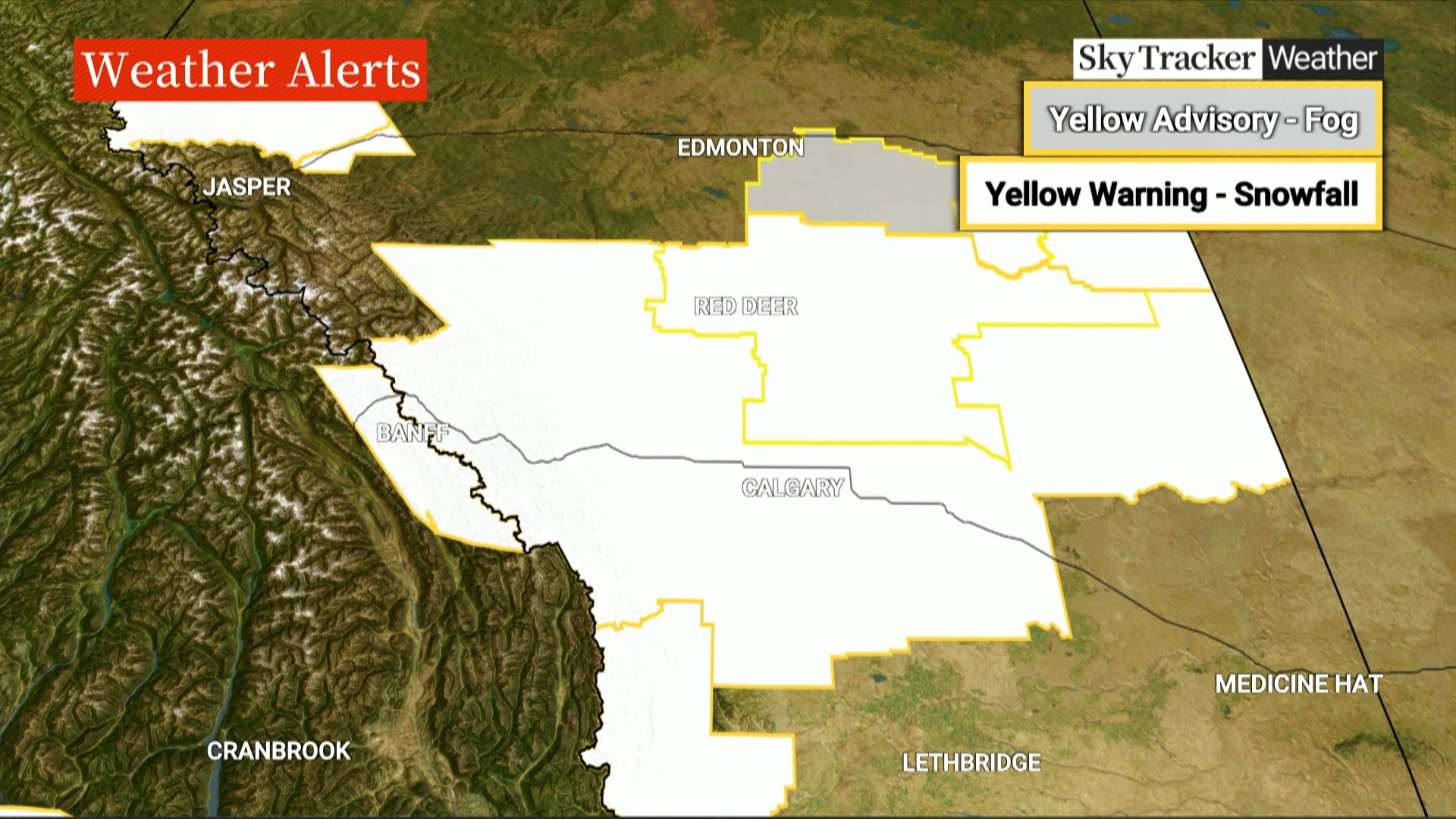
The local news cycle has fallen into its annual, predictable trap. As soon as a low-pressure system crawls over the Rockies, the headlines start screaming about "storm warnings" and "weather alerts." They treat a late-season snowfall in southern Alberta like a localized apocalypse. You see the same stock photos of jackknifed semis on the Highway 2 and hear the same weary sighs from suburbanites clutching their wilting tulips.
They are wrong. They are looking at the sky and seeing a disaster, when they should be seeing a massive, free injection of liquid gold.
The standard narrative suggests that a spring storm is an interruption to "real" life. We have been conditioned to believe that by April, the ground should be dry, the tires should be swapped, and the patio furniture should be out. But if you actually live here—if you understand the brutal reality of the Canadian prairies—you know that a dry spring is a far greater threat than a messy Monday commute.
The Myth of the Ruined Spring
The "lazy consensus" among meteorologists and city dwellers is that snow in April or May is a fluke. It isn't. Statistically, March and April are among the snowiest months for regions like Calgary and Lethbridge. Attempting to frame this as an "unseasonable" event is a rejection of basic geography.
When the media issues a "warning," they frame the snow as the enemy. They focus on the inconvenience of slush. They ignore the fact that southern Alberta is a semi-arid environment currently staring down the barrel of multi-year drought cycles.
Every centimeter of heavy, wet spring snow is a lifeline for the Oldman and Bow River basins. This isn't the light, powdery "champagne" snow of January that blows off the fields and evaporates in a Chinook. This is high-moisture-content "concrete" snow. It stays. It soaks. It saves the topsoil.
Why Your Commute Doesn't Matter
I have watched city councils and provincial departments burn through budgets trying to "mitigate" the impact of these storms. The obsession with dry pavement in April is a massive waste of resources.
We treat 15 centimeters of snow like a logistics failure. In reality, the failure is our lack of adaptability. The "expert" advice is always the same: stay home, drive to conditions, wait for the plows. It’s passive. It treats the population like children who can't handle a change in state from liquid to solid.
The contrarian truth? We should welcome the gridlock. If a storm slows down the city, it forces a momentary pause in a society that is increasingly disconnected from the rhythms of the land it occupies. The economic "loss" of a slow Tuesday is peanuts compared to the billions lost when cattle producers have to cull herds because the dugouts are dry in July.
The Hydrology of the "Inconvenience"
Let's look at the mechanics. Most people see a snowdrift and think of a shovel. A hydrologist sees a snowdrift and thinks of $S$ (Snow Water Equivalent).
The formula is straightforward:
$$SWE = d \times \frac{\rho_s}{\rho_w}$$
Where $d$ is the snow depth, $\rho_s$ is the density of the snow, and $\rho_w$ is the density of water.
In mid-winter, the density of snow might be as low as 5% or 7%. But in a spring storm? We are talking densities of 15% to 20%. That means a spring storm delivers three times the water of a winter blizzard. When the "authorities" warn you about the weight of the snow on your trees, they are accidentally admitting how much water is being delivered to the root systems.
Stop complaining about the heavy lifting. Your lawn is being fed a nutrient-rich, slow-release cocktail that no irrigation system can replicate.
The Cost of the "Early Spring" Fantasy
There is a psychological cost to the way we report on weather. By framing every spring storm as a "hit" or a "strike," we foster a sense of victimhood.
I’ve seen landscapers and "green thumb" influencers encourage people to plant as soon as the first patch of brown grass appears in March. This is peak hubris. When the inevitable April dump happens, they act surprised. They blame the "erratic" weather.
The weather isn't erratic; your expectations are.
Southern Alberta operates on a high-stakes, boom-and-bust moisture cycle. The "status quo" reporting focuses on the immediate—the next 24 hours of traffic. The "insider" view looks at the next 24 weeks of crop yields and wildfire risk.
If we don't get these "disruptive" storms now, we pay for it in August with smoke-filled skies and water rationing. You cannot have the Rocky Mountain lifestyle without the Rocky Mountain weather.
The Arrogance of the Urban Perspective
Most of the noise comes from the Calgary-Edmonton corridor. It’s an urban echo chamber that views the environment as a backdrop for lifestyle, not a functional system.
When a storm hits southern Alberta, the "news" focuses on:
- Flights delayed at YYC.
- Fender benders on the Deerfoot.
- Whether or not the golf courses will open on time.
This is a privileged, narrow-minded way to view a major meteorological event. Go three hours south of the city. Talk to a producer in the Special Areas. They aren't checking the flight board; they are checking the moisture penetration in their fallow fields. To them, a "snowfall warning" is a prayer answered.
The media’s insistence on labeling this as "bad weather" is a slap in the face to the primary industries that actually keep the province solvent.
Redefining the "Warning"
We need to stop using the language of fear. A "warning" implies a threat. A "storm" implies a battle.
Imagine a scenario where the headlines read: "Massive Moisture Injection Projected for Southern Alberta: Agriculture Sector Celebrates." It would change the entire social contract. Instead of people white-knuckling their steering wheels in a blind rage, they might actually realize that the slush on their windshield is the reason they’ll have beef on their table and a forest that isn't on fire by Canada Day.
The Harsh Reality of Adaptation
Of course, there are downsides. The heavy snow breaks branches. It snaps power lines. It kills the early blossoms of people who were too impatient to wait for the May long weekend.
That is the price of entry.
Nature doesn't care about your aesthetic preferences for your backyard. It doesn't care that you already put your winter coat in storage. The "fresh perspective" that nobody wants to hear is that we are the ones who are out of sync, not the clouds.
We have spent decades trying to "engineer" our way out of the climate we live in. We want 20°C weather starting in April, but we also want green parks and flowing rivers. You don't get both.
Stop Checking the Forecast and Start Checking the Reservoirs
The next time you see a "warning" on your phone, don't look for someone to blame. Don't post a grumpy status about "Second Winter."
Look at the data. Check the mountain snowpack levels. Look at the flow rates of the tributaries. If those numbers are low, you should be begging for the sky to fall.
The real disaster isn't the storm. The real disaster is a clear, blue, dry April sky. That is the sight that should actually terrify you.
Put your boots back on. Stop whining. Let it snow.