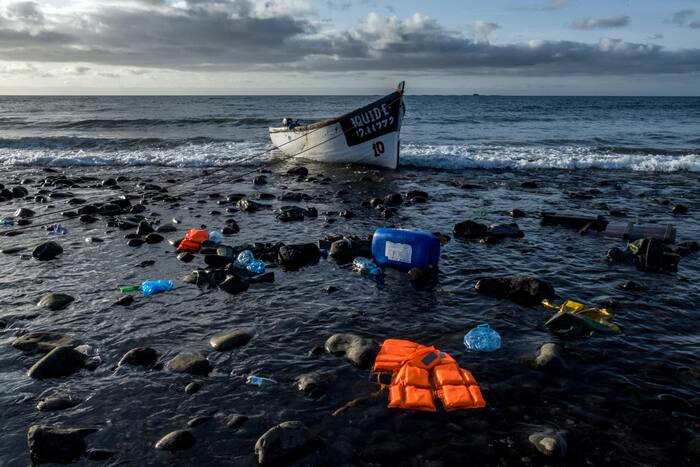
Two thousand two hundred people step off wooden boats onto Canary Islands volcanic rock over forty-eight hours, and every mainstream newsroom hits the exact same panic button.
They print the raw headcount. They quote a regional president begging Madrid for money. They slap a dramatic photo of a Maritime Rescue vessel on the front page and call it journalism.
It is lazy. Worse, it is analytically bankrupt.
When outlets report that nearly 2,200 migrants reached the Canary Islands in two days, they treat irregular migration like an unpredictable Atlantic hurricane—a sudden, inexplicable weather event that simply happens to Spain. By focusing entirely on the shoreline body count, conventional coverage obscures the actual mechanics driving the Atlantic route. You are being fed a symptom disguised as a diagnosis.
If you want to understand what is actually happening off the coast of West Africa, stop counting boats at El Hierro and start looking at diplomatic leverage, demographic math, and the brutal economics of border externalization.
The Shoreline Illusion
Mainstream reporting thrives on the spectacle of the arrival. A sudden spike—hundreds of people disembarking at La Restinga in a single weekend—creates an immediate visual crisis. It feeds a binary narrative that both political extremes love. One side sees an invasion; the other sees a purely humanitarian shipwreck.
Both sides miss the operational reality.
A two-day surge of 2,200 arrivals is not a sudden spike in human desperation. Desperation is a constant across the Sahel and West Africa. What fluctuates wildly—sometimes hour by hour—is maritime friction.
Ocean conditions along the Atlantic route, one of the deadliest migration corridors on earth, dictate departures. Flat seas and favorable winds open temporary departure windows along the 1,500-kilometer coastline stretching from southern Morocco through Western Sahara down to Mauritania, Senegal, and The Gambia. When the swell drops after weeks of rough Atlantic chop, months of pent-up departures launch simultaneously.
Reporting a 48-hour arrival total without explaining maritime windows is like reporting Monday morning rush hour traffic and claiming the city's population doubled overnight.
I have spent years tracking Mediterranean and Atlantic border policy, watching European ministries burn billions of euros reacting to 48-hour news cycles while ignoring the structural levers sitting right in front of them. Every single time a weekend surge hits the headlines, politicians announce emergency transfers to the mainland, deploy a few extra patrol boats, and declare the situation under control once the Atlantic swells return and departures naturally dip. That is not policy. That is meteorological luck masquerading as governance.
Why the Atlantic Route Exists at All
To understand why people risk a thousand-mile open-ocean crossing in an unseaworthy cayuco, you have to look at what Europe closed first.
Migration routes do not vanish when you build a wall; they behave like water under pressure. When Spain and the European Union fortified the land borders at Ceuta and Melilla, and dramatically tightened patrolling across the Strait of Gibraltar and the Alboran Sea through aggressive bilateral deals with Rabat, the shortest crossings became virtually impassable.
The Atlantic route did not explode in volume because smugglers suddenly preferred the open ocean. It exploded because European border enforcement pushed human mobility south toward Mauritania and Senegal, trading manageable short-distance crossings for lethal long-distance voyages.
Look at the real geography of this corridor:
- The Northern Segment: Departures from southern Morocco and the disputed territory of Western Sahara toward Lanzarote and Fuerteventura. Shorter distance, faster interception, heavily dependent on Moroccan gendarmerie enforcement.
- The Southern Segment: Departures from Nouadhibou in Mauritania, or Saint-Louis and Dakar in Senegal, targeting El Hierro, Tenerife, and Gran Canaria. These voyages take up to a week on open water, carrying between 50 and 200 people per vessel with zero margin for engine failure.
When coverage lumps all 2,200 arrivals into a single headline number, it erases the distinction between a 60-mile crossing from Tarfaya and a 900-mile odyssey from Senegal. Those two journeys represent entirely different smuggling networks, different national demographics, and different diplomatic failure points.
The Diplomatic Tap Nobody Mentions
Here is the uncomfortable truth buried beneath the humanitarian press releases: irregular migration flows from West Africa to Spain are heavily modulated by bilateral political transactions.
Border control in North and West Africa is not a neutral administrative function. It is a premier geopolitical bargaining chip. Researchers like Kelly Greenhill, who coined the term coercive engineered migration, have documented for decades how transit and origin states use border enforcement—or the sudden relaxation of it—to extract financial aid, trade concessions, and diplomatic recognition from wealthier neighbors.
Consider the timeline of Spanish-Moroccan relations. Whenever diplomatic friction flares between Madrid and Rabat—whether over Western Sahara or high-profile political asylum disputes—coastal surveillance along the Moroccan and Saharan coasts mysteriously loosens. Boats slip out by the dozens. Once Madrid concedes diplomatic ground or unlocks fresh funding packages, patrols tighten and arrivals plummet within days.
Now apply that exact same dynamic further south. As enforcement tightened in the north, departure hubs migrated down the coast to Mauritania. What followed? High-level European delegations flying to Nouakchott with hundreds of millions of euros in border-management aid, surveillance equipment, and development packages.
When a headline simply states "Spain says nearly 2,200 migrants arrived," it treats the Spanish government as a passive bystander reporting the weather. In reality, Madrid and Brussels are active market participants in a continuous, high-stakes negotiation over where the border actually sits. Today, Spain's functional southern border is not the beach at Maspalomas; it is the port infrastructure of Nouadhibou and the patrol boats operating out of Dakar.
Dismantling the Worst Myths About the Canary Crisis
If you follow public debates around Canary Islands arrivals, you run into the same recycled questions—and the same flawed answers. Let's tear down the three biggest misconceptions dominating the conversation.
Are the Canary Islands actually being overwhelmed by numbers?
Define "overwhelmed." If you mean an archipelago of roughly 2.2 million residents lacks the permanent reception infrastructure to house thousands of sudden arrivals in small towns like Valverde on El Hierro (population around 5,000), yes—local logistics break down immediately. A single boat carrying 180 people represents nearly four percent of that town's entire population arriving before breakfast.
If you mean Europe as a bloc of 450 million people is facing an existential demographic flood, the math laughs at the premise. Even during peak years when Canary Islands arrivals reach forty or fifty thousand people annually, that figure represents less than 0.01 percent of the European Union's population.
The crisis is not one of absolute volume. It is a distribution and governance bottleneck. Spain's regional politics turn routine administrative transfers from the islands to the mainland into bitter partisan warfare between Madrid and autonomous regional governments. Thousands of people sit bottlenecked in temporary camps on the islands not because Europe lacks beds, but because Spanish political parties refuse to share the political optics of housing them on the peninsula.
Does rescuing boats at sea create a pull factor?
This is the loudest talking point in European politics, and empirical data consistently dismantles it.
Academic studies examining search-and-rescue operations across both the Central Mediterranean and the Atlantic route—including work by researchers at the European University Institute and the German Center for Integration and Migration Research—show no causal link between rescue capacity and departure volume. People board cayucos in Senegal because of artisanal fishing collapse caused by foreign industrial trawlers, climate-driven agricultural failure in the Sahel, political instability in Mali and Burkina Faso, and youth unemployment rates that offer zero domestic future.
Nobody in a fishing village outside Saint-Louis checks the weekly shift schedule of Spain's Salvamento Marítimo before deciding whether to flee economic collapse. Removing rescue ships does not stop boats from leaving West Africa; it simply increases the percentage of passengers who die before reaching radar range.
Will more patrol boats and surveillance drones stop the crossings?
Hardware never solves a structural incentive problem. Over the past two decades, Europe has poured billions into Frontex, radar networks, satellite tracking, and bilateral patrol fleets. Every single technological upgrade has achieved the exact same result: temporary displacement followed by adaptation.
Smugglers switch from small fiberglass skiffs to massive wooden cayucos capable of carrying 200 people to maximize per-trip revenue before interception. They launch at night. They push further out into the open Atlantic to bypass coastal radar arcs, drifting west before hooking northeast toward El Hierro—the westernmost island in the archipelago.
More surveillance without legal labor pathways or genuine economic stabilization in origin countries just makes the smuggling business more professionalized, more expensive, and far more lethal.
The Uncomfortable Flaw in the Contrarian View
Intellectual honesty requires admitting where a purely structural critique runs into hard reality.
It is easy to sit back, point out that 40,000 arrivals are a statistical drop in the bucket for the European Union, and criticize local panic. That macro perspective coldly ignores micro-level friction. When 2,200 people land on small islands in 48 hours, local healthcare clinics, police precincts, juvenile guardianship systems, and municipal budgets absorb an immediate, asymmetrical shock.
Specifically, the arrival of unaccompanied minors triggers strict legal obligations under Spanish and international law. Unlike adults, who can be processed and transferred through national reception networks, minors become the legal responsibility of the Canary Islands regional government. You cannot simply put thousands of children on a commercial flight to Madrid without legal transfer agreements from mainland regions—agreements that mainland regional leaders routinely block.
Pretending that local infrastructure strain is purely imaginary is just as dishonest as pretending the arrivals represent an existential invasion. Both truths exist simultaneously: the numbers are tiny at a continental scale, and acutely disruptive at a municipal scale.
How to Actually Read the Next Migration Headline
Stop consuming border news like a sports scoreboard. The next time an alert flashes across your screen announcing a sudden two-day surge in the Canary Islands, run it through four filters before accepting the framing:
- Check the Atlantic swell forecast from 72 hours prior. Nine times out of ten, a sudden arrival spike simply reflects a calm weather window following a storm front off Mauritania or Senegal.
- Look at the port of departure, not the port of arrival. Arrivals in Lanzarote point to Moroccan and Western Saharan dynamics. Arrivals in El Hierro point to Mauritanian, Senegalese, or Malian networks. The policy levers are completely different.
- Track the diplomatic calendar. Check whether Spain or the EU is currently negotiating fisheries agreements, aid packages, or border pacts with Rabat, Nouakchott, or Dakar. Surges frequently precede or follow stalled negotiations.
- Separate reception bottlenecks from arrival volume. Ask whether the chaos on the ground is caused by the number of people arriving, or by political gridlock preventing their transfer off the islands.
A headline telling you that 2,200 people arrived in two days gives you a number, a location, and zero understanding. It turns a complex intersection of climate pressure, West African economic displacement, maritime weather, and European checkbook diplomacy into cheap clickbait.
Stop staring at the beach. Look at the water, look at the treaties, and look at the politics keeping people trapped on the rock once they land.



