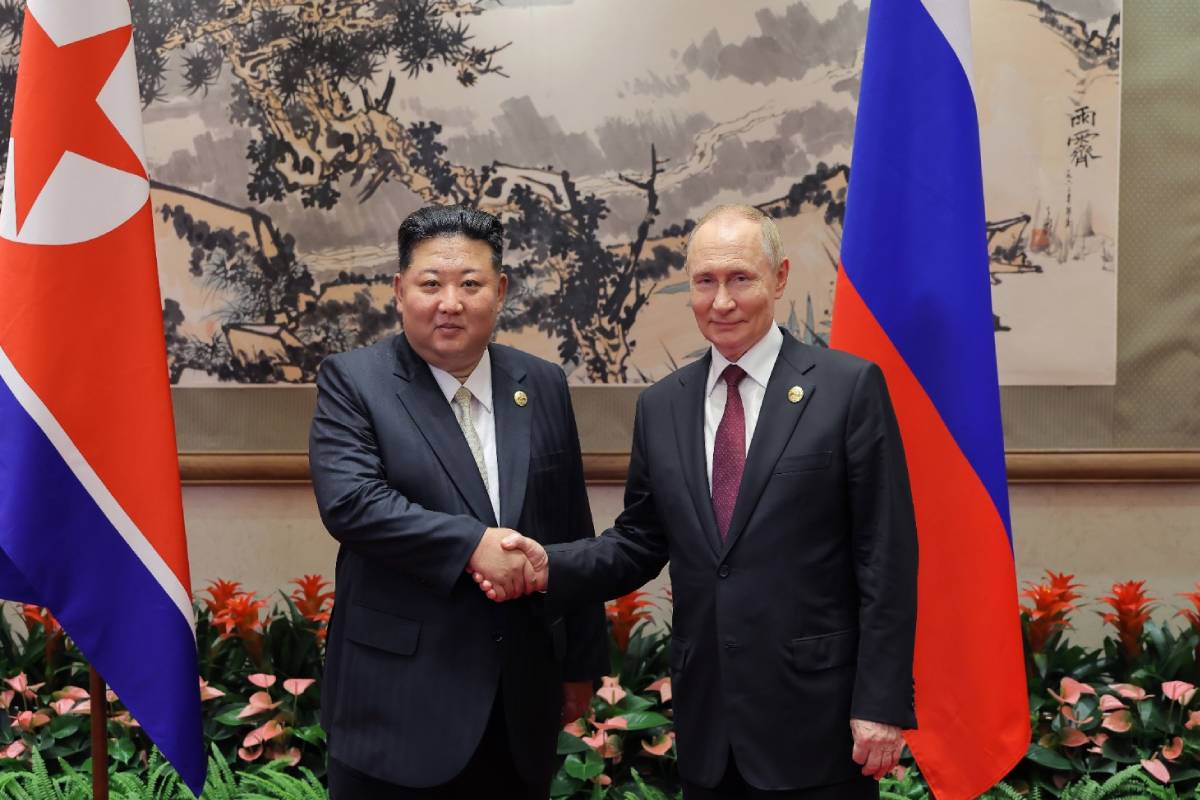
The headlines scream about impending doom every time Pyongyang ships hardware across the Eurasian landmass. Cable news anchors clutch their pearls over North Korean ballistic iron landing in Ukrainian fields, painting a picture of an axis of totalitarian terror scaling up to overturn global security architecture. It is lazy, sensationalist panic porn designed to juice click-through rates.
Let us dismantle the hysteria right now.
I have spent decades watching defense analysts wet themselves over every new shipping manifest coming out of isolated authoritarian states, mistaking basic commercial and logistical desperation for a masterclass in geopolitical strategy. The narrative that North Korean munitions represent some kind of terrifying qualitative upgrade to the Kremlin arsenal is mathematically illiterate and strategically hollow.
Here is the contrarian truth nobody in the mainstream commentariat has the stomach to print: Moscow is not buying North Korean missiles because Pyongyang makes superior gear. Moscow is buying them because Russian defense factories cannot keep up with the sheer, brute-force consumption rates of a grinding artillery war of attrition, and North Korea happened to have warehouses full of cheap, often wildly inaccurate, 1970s-era Soviet-hand-me-down designs sitting around collecting dust.
The Myth of the Quantum Leap in Modern Munitions
Every time a debris field in Kharkiv or Zaporizhzhia yields fragments bearing Hangul characters, the defense blogosphere erupts with apocalyptic speculation. Analysts breathlessly warn that North Korean technicians are gaining invaluable flight telemetry data, modernizing their guidance systems on the fly using real-world combat laboratories.
This sounds sophisticated. It is also fundamentally backward.
Imagine a scenario where a billionaire car collector runs out of spare parts for his modern fleet, so he starts bolting rusted lawnmower engines onto his chassis because he has nothing else left in the garage. Does that make the lawnmower engine a technological breakthrough? No. It means he is out of options.
North Korean short-range ballistic systems—typified by the Hwasong-11 family, often compared to the Russian Iskander—are notoriously plagued by quality control failures. Defect rates are shockingly high. CEP, or circular error probable, measures how close a round gets to its intended target. While an Iskander has a tight precision envelope measured in meters, recovered North Korean hardware frequently drifts wildly off target, turning precision strikes into indiscriminate area bombardment.
When a military power with thousands of indigenous precision-guided munitions starts relying on erratic secondary-market inventory from a sanctioned hermit kingdom, you are not looking at an escalating threat matrix. You are looking at a supply chain scrambling to fill a massive deficit.
"Scarcity dictates desperate procurement, not strategic alignment."
The Logistics Reality Check the Media Ignores
Let us talk about the actual pipeline. Moving heavy ordnance thousands of miles across the Trans-Siberian railway sounds impressive on paper, but logistically, it is an absolute nightmare. Rail networks are congested. Rolling stock is aging. Every ton of foreign munitions hauled across Russia displaces domestic cargo, industrial freight, or consumer goods.
Mainstream journalists love to talk about boundless military cooperation between Moscow and Pyongyang as if it were a seamless, automated conveyor belt of death. Having audited defense supply chains under crisis conditions, I can tell you that inter-state military bartering involving sanctioned economies is bureaucratic quicksand. Nothing moves fast. Nothing is standardized. Every shipment requires high-level political bribes, cumbersome customs workarounds, and massive risk premiums.
The North Koreans are not giving these munitions away out of ideological solidarity. They are extracting maximum leverage: food, fuel, raw materials for their own nuclear program, and perhaps most importantly, hard currency or advanced aerospace technology transfers that actually threaten regional stability in East Asia.
So why is the Western press hyper-ventilating about the missiles themselves rather than the economic desperation underpinning the trade? Because missiles make for better thumbnail images than shipping container manifests and grain shipments.
Dismantling the Escalation Trap
Another favorite talking point of the panic merchants is that the introduction of North Korean hardware into European theater combat marks an irreversible escalation, dragging Asian theater security dynamics directly into the heart of Europe.
This is geopolitical navel-gazing at its finest.
Globalization means that supply chains have been interlocked for decades. Dual-use microchips made in Western factories end up inside Russian cruise missiles via third-party shell companies in Central Asia. Iranian drones strike Ukrainian infrastructure. Commercial components manufactured in allied nations regularly show up in adversary weapon systems.
The idea that war can somehow be quarantined into neat, regional boxes where only locally manufactured items are permitted to kill people is a comforting fantasy belonging to the 19th century. Modern warfare is a global bazaar. If you have cash and a desperate need, you can buy bullets from anyone willing to load a cargo ship, regardless of ideology, sanctions, or human rights records.
North Korea entering the export market for ballistic hardware is not a sign of rising systemic strength. It is the desperate monetization of a bloated, stagnant military-industrial complex that has nothing else of value to sell to the global community. Pyongyang's primary export used to be counterfeit hundred-dollar bills and low-grade methamphetamine. Upgrading to exporting rusty, uncalibrated ballistic missiles is merely a pivot to a more lucrative mafia business model.
What the People Also Ask Queries Get Completely Wrong
If you type inquiries regarding this topic into search engines, the autofill algorithms immediately steer you into a ditch of conventional fallacies. Let us address the most common ones with brutal candor.
Are North Korean missiles more advanced than Russian missiles?
No. This is laughable. Russian domestic manufacturing capabilities, despite being battered by Western sanctions and forced to substitute components, still produce guidance packages, telemetry units, and propulsion systems that are generations ahead of North Korean technology. North Korean systems are cheap, Soviet-derived knockoffs built with primitive machine tools. They are chosen for quantity and availability, not capability.
Does this prove Russia's military industry has collapsed?
No, and this is where casual observers make massive analytical errors. Russia's defense industry has not collapsed; it has bottlenecked. There is a vast difference between a factory stopping production entirely and a factory failing to match the exponential daily burn rate of an active artillery war. Moscow is outproducing many Western estimates in basic armor and standard shells, but high-end tactical missile production requires specialized microelectronics that cannot be ramped up overnight. Buying foreign ordnance is a band-aid to bridge production gaps, not proof of industrial total failure.
Will this change the outcome of the war?
Not by a fraction of a millimeter. A few dozen erratic, low-accuracy ballistic missiles cannot compensate for strategic deficits in air superiority, troop motivation, or command-and-control integrity. They cause tragic civilian casualties and force air defense assets to expend valuable interceptor stocks, but they do not alter the foundational physics of the battlefield.
The Actionable Truth for Observers and Investors
If you are trying to understand where global security and defense markets are heading based on these headlines, stop looking at the debris fields in Eastern Europe.
The real story is the brutal commodification of war. We have entered an era where secondary-market arms trading between rogue states is becoming as frictionless as dark-web commerce. Sanctions compliance is increasingly a polite fiction practiced only by nations with transparent financial systems, while a parallel shadow economy moves heavy weaponry across continents with impunity.
The next time a major news outlet tries to terrify you with a graphic detailing the range of a North Korean missile dropped on European soil, remember what is actually happening behind the curtain. It is not the dawn of a terrifying new super-alliance. It is a clearance sale on discount military surplus, bought by a desperate buyer, sold by a hustler looking for rice and rocket fuel.
Stop trembling at the shadow. Look at the ledger.