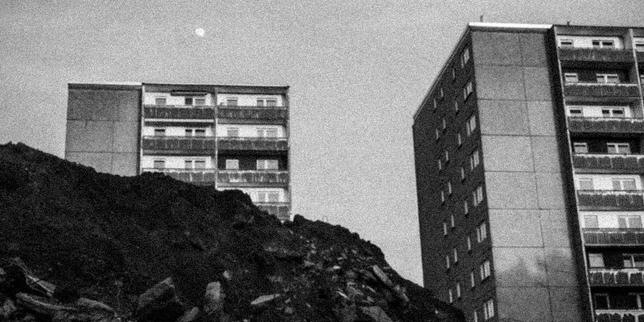
Western photographers have a predictable addiction. Give a Parisian creative a medium-format camera, a plane ticket to Saxony or Brandenburg, and a gray November afternoon, and you will get the exact same photo essay every single time.
Abandoned concrete Plattenbau blocks. Rusting Trabants. Melancholic pensioners staring through fogged glass. The accompanying text will inevitably murmur about "twilight," "fading memory," and the "ghosts of the DDR."
It is visually seductive. It is emotionally manipulative. And it is a complete fabrication of modern German reality.
The prevailing visual narrative surrounding former East Germany—exemplified by the wave of moody, twilight-soaked documentary photography typified by Antoine Lecharny’s visual studies of shrinking eastern towns—relies on a lazy, profitable consensus. It treats thirty-five years of complex post-industrial restructuring as an aesthetic graveyard. By framing the New Federal States (Neue Bundesländer) exclusively through the lens of decay, Western media flattens living, breathing communities into props for Ostalgie—a romanticized nostalgia for a defunct dictatorship that almost nobody who actually lived through it wants back.
If you look at the actual economic, demographic, and architectural trajectory of eastern Germany, the "twilight" metaphor falls apart. What Western lenses mistake for a funeral is actually the messy, brutal, and largely successful second act of Europe's largest industrial conversion.
The Lie of the "Dying" Eastern City
Walk into any photo gallery in Berlin, Paris, or London showcasing the former GDR, and you will be fed a single premise: these cities are emptying out and waiting to die.
This is a half-truth masquerading as journalism. Yes, immediately following the 1990 reunification, the Treuhandanstalt privatization agency liquidated thousands of state-owned enterprises. Millions lost their jobs. Between 1990 and 2010, roughly two million people—disproportionately young and female—moved west. Towns like Hoyerswerda, Schwedt, and Eisenhüttenstadt lost up to half their populations.
That happened. Nobody denies the trauma of the Wende.
What the twilight photographers conveniently crop out of the frame is what happened next. While rural peripheries in Mecklenburg-Vorpommern or southern Brandenburg continue to age and shrink—a demographic phenomenon identical to rural France, the American Rust Belt, or northern England—the urban centers of the east have undergone one of the most aggressive renaissances in European history.
- Leipzig isn't dying; it has been Germany’s fastest-growing major city for over a decade, outpacing Munich and Hamburg in percentage growth.
- Dresden anchors "Silicon Saxony," producing roughly one-third of all microchips manufactured in Europe.
- Jena transformed from a hollowed-out optical manufacturing town into a global powerhouse for photonics and medical technology.
- Erfurt and Rostock boast renovated historic cores that make dilapidated western industrial cities like Duisburg or Gelsenkirchen look like actual war zones.
When a photographer travels to an eastern town in 2026 and points a lens exclusively at peeling wallpaper and empty concrete plazas, they are not documenting reality. They are curating a fetish. I have spent years analyzing regional European development, and I have watched cultural institutions pour millions into funding "ruin porn" exhibitions while completely ignoring the massive capital inflows, renewable energy grids, and semiconductor fabs reshaping the exact same regions.
How Documentary Photography Became Ruin Porn
To understand why the "twilight of East Germany" trope refuses to die, you have to understand the economics of the art and editorial markets.
Nuance does not sell prints. A photograph of a newly insulated, pastel-painted 1970s apartment block with solar panels on the roof and a fiber-optic connection in the basement is boring. It looks like suburban Denmark. Nobody puts that on the cover of a monograph.
A photograph of a crumbling Soviet-era barracks shrouded in mist, however, triggers immediate, visceral recognition. It taps into Cold War mythology. Urban theorist Camilo José Vergara and critic John Patrick Leary coined the term "ruin porn" to describe this exact phenomenon in Detroit: outside observers aestheticizing poverty and structural collapse while erasing the agency, resilience, and daily realities of the people who live there.
In the context of former East Germany, this visual bias carries a specific political sting. It reinforces the Western gaze—the subtle, condescending assumption that West Germany represents "normalcy" and "progress," while the East remains a permanently damaged, slightly exotic museum of socialist failure.
The Architecture of Deception
Let’s look at the favorite prop of the melancholic eastern photo essay: the Plattenbau (prefabricated concrete panel building).
In Western photography, the Plattenbau is always shot in flat, overcast light. It is framed as a monument to totalitarian conformity and bleakness.
Here is the architectural reality that the camera hides:
- Structural Quality: When built in the 1970s and 1980s, these apartments were viewed by East Germans as luxury upgrades. They had indoor plumbing, central heating, and hot water—amenities missing from many crumbling pre-war Altbau tenements in East Berlin or Leipzig at the time.
- The Stadtumbau Ost Transformation: Beginning in 2002, the German federal government launched Stadtumbau Ost (Urban Redevelopment East), a multi-billion-euro program that demolished over 350,000 surplus apartments and completely modernized the rest.
- Modern Livability: Today, a renovated Plattenbau in Dresden or Magdeburg has better thermal insulation, cheaper district heating, and more green space between buildings than a cramped, overpriced apartment in Paris's 11th arrondissement.
The ruined buildings that remain—and are endlessly photographed by visiting artists—are almost always victims of unresolved restitution claims from the 1990s, speculative land banking by West German investors, or deliberate deconstruction zones awaiting park conversion. Framing them as the "soul" of the city is like visiting a construction site in Manhattan and declaring that New York is collapsing.
Answering the Questions You Should Actually Be Asking
When people search for photography or articles about former East Germany, they are usually driven by a specific curiosity: What is left of the GDR, and why does the East still feel so different?
If you rely on atmospheric photo essays to answer that, you get a poetic lie. Here is the unvarnished truth behind the questions most people ask—and the ones they miss entirely.
Why do parts of former East Germany still look abandoned?
They don't look abandoned because of communism; they look abandoned because of capitalism and demography.
After 1990, West German tax incentives triggered a massive, speculative building boom in the East. Developers built sprawling shopping malls and suburban housing tracts on greenfield sites outside towns, sucking the economic life out of historic city centers. Simultaneously, the birth rate in the East plummeted by nearly 60% between 1989 and 1994—the steepest demographic drop ever recorded in peacetime.
When your population drops by a third in ten years and new malls pull shoppers out of the center, storefronts go empty. Those empty buildings are monuments to 1990s free-market shock therapy, not Erich Honecker.
Is "Ostalgie" real, or is it a media invention?
It is both, and the distinction matters.
For older East Germans, Ostalgie is rarely a desire to return to Stasi surveillance, travel bans, or standing in line for bananas. As sociologist Wolfgang Engler noted in his foundational work Die Ostdeutschen, it is a defense mechanism against the total erasure of their biographies. After 1990, everything East Germans had built, studied, or achieved was declared worthless overnight. Holding onto GDR consumer brands, design aesthetics, or community traditions was a way of saying, "Our lives had meaning before you arrived."
For Western photographers and tourists, however, Ostalgie is pure aesthetic consumption. It turns a complex psychological defense mechanism into retro kitsch.
What is the biggest misconception about life in small eastern towns today?
The misconception is that they are stagnant.
In reality, smaller eastern towns are ground zero for some of the most radical economic shifts in Europe. Take the Lusatia (Lausitz) region straddling Brandenburg and Saxony—a favorite hunting ground for photographers obsessed with industrial twilight.
Yes, the massive open-pit lignite coal mines are closing. Yes, the old power plants look like rusting sci-fi sets. Yet Lusatia is currently absorbing over 17 billion euros in structural transformation funds. New rail maintenance hubs for Deutsche Bahn, battery recycling plants, hydrogen research centers, and artificial lake districts are actively replacing the coal economy. The town isn't dying; its industrial operating system is being wiped and reinstalled in real time.
The Dark Side of the Contrarian View
To argue that former East Germany is vibrant and mischaracterized is not to claim that reunification was a seamless triumph. Ignoring the real scars is just as dishonest as fetishizing them.
If you reject the "twilight" narrative and look at the hard data, you still run straight into uncomfortable structural realities that explain the political volatility—and the rise of the far-right AfD—across the region:
- The Ownership Gap: Over thirty-five years after reunification, less than 2% of Germany’s largest companies are headquartered in the East. Most factories, media outlets, and prime real estate in the New Federal States are owned by West Germans or international corporations. The East functions largely as an extended workbench (verlängerte Werkbank) where goods are assembled, while profits and executive salaries flow west.
- The Wealth Chasm: Because East Germans had no opportunity to accumulate private capital or inherit property during forty years of socialism, median household wealth in the East remains roughly half that of the West.
- The Elite Exodus: In the 1990s, West Germans replaced almost the entire upper tier of the East's judiciary, university faculty, military, and senior civil service. Even today, East Germans remain drastically underrepresented in top leadership positions across unified Germany.
These are real, infuriating systemic inequities. Notice, however, that none of them can be captured by taking a moody black-and-white photo of a broken window in Chemnitz. In fact, focusing on physical decay actively distracts from the structural economic imbalances that actually hold the region back.
How to Actually See Former East Germany
If you are a traveler, a journalist, or a photographer who wants to engage with the former GDR without falling into the trap of visual tourism, you need to change how you look at the place.
Stop hunting for ghosts. Start looking at the friction between the old and the new.
- Ditch the November Fog: Western photo editors love shooting the East in winter because gray skies hide the massive infrastructure upgrades. Visit in June. Look at how post-industrial spaces—like the Ferropolis "City of Iron" near Dessau or the flooded mining pits of the Leipzig Neuseenland—have been repurposed into cultural venues and nature reserves.
- Look at the Infrastructure, Not Just the Facades: Pay attention to the rail lines, the autobahns, and the energy grids. Eastern Germany actually has newer, higher-capacity infrastructure in many sectors than West Germany, which is currently choking on decades of deferred maintenance on its bridges and railways.
- Talk to the Rückkehrer (Returnees): Instead of only interviewing retired factory workers sitting on park benches, talk to the thousands of thirty-somethings who left for Frankfurt or London in the 2000s and are now moving back to Saxony and Thuringia to buy cheap land, launch remote tech startups, and rebuild local communities.
- Read the Urban Planning, Not the Nostalgia: If you want to understand an eastern city, skip the Cold War museum. Walk into the municipal urban planning office (Stadtplanungsamt) and look at the zoning maps for 2030. That is where the real drama is happening.
The Camera Never Lies, Except When It Does
A photograph is an act of exclusion. Every time a photographer frames an empty street corner in an eastern German town, they are making a deliberate choice to leave the newly built vocational school, the automated logistics hub, and the crowded local café just outside the edge of the negative.
The "twilight" of former East Germany ended twenty years ago. What we are looking at now is a harsh, bright, complicated morning—one filled with economic friction, political anger, and genuine reinvention.
Stop clapping for photographers who treat living cities like antique shops. Put down the nostalgia filter, step outside the ruins, and look at what is actually being built.


