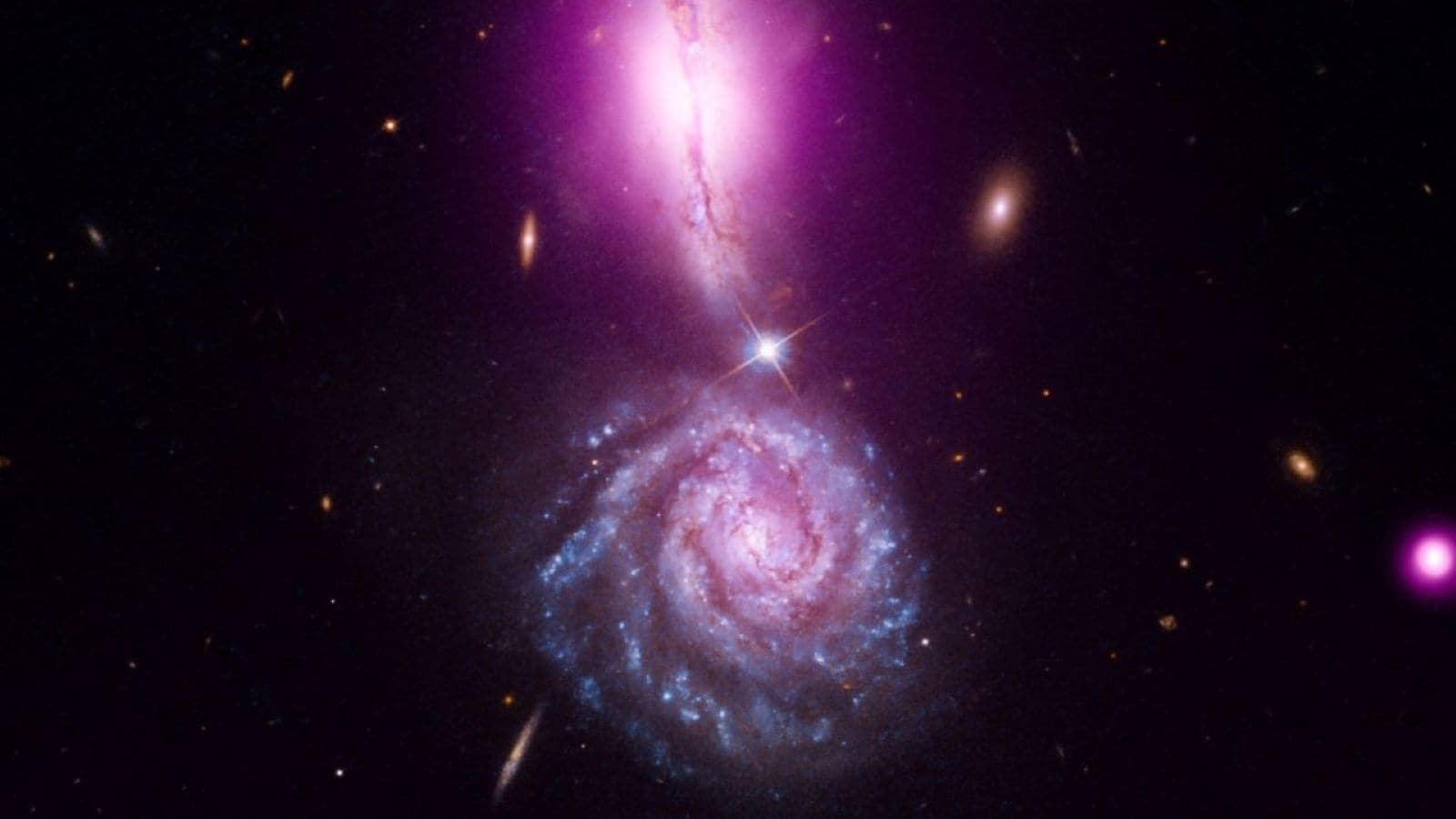
Every time NASA points a mirror at the dark, the internet treats it like a cosmic horoscope. The latest routine capture of a distant galaxy merger gets slapped with a cutesy headline about punctuation marks, and millions of adults lose their minds over a celestial exclamation point. Netizens call it enchanting. They call it a sign. They project their tiny, terrestrial need for poetic validation onto a dead vacuum burning millions of light-years away.
It is garbage science communication. And it needs to stop. For another look, consider: this related article.
We are looking at violent, thermodynamic devastation across millions of parsecs, and the cultural consensus reduces it to an emoji. We prefer our astrophysics wrapped in whimsical folklore because actual physics is terrifying, vast, and completely indifferent to human syntax.
The Punctuation Fallacy
The lazy narrative goes like this: Hubble or Webb snaps a distorted gravitational lens or a colliding dust lane, it vaguely resembles a punctuation mark, and social media feeds light up with wonder. The hidden assumption is that the universe is trying to communicate with us. It is a modern form of ancient augury, reading chicken entrails in the constellation Cetus. Further analysis on the subject has been provided by TIME.
Nature does not write in English. It does not write in Cyrillic, Arabic, or ASCII.
When you look at an image labeled as an exclamation point or a question mark, you are looking at gravitational lensing, tidal tails, and chaotic starbursts shaped by mass distribution governed by general relativity. The dot at the bottom of the shape is a massive elliptical galaxy acting as a lens. The line is a background galaxy smeared out by spacetime curvature.
There is no grammar out there. There is only mass warping spacetime according to Einstein field equations:
$$G_{\mu\nu} + \Lambda g_{\mu\nu} = \frac{8\pi G}{c^4} T_{\mu\nu}$$
There is no emotional punctuation in a tensor equation.
Why We Anthropomorphize the Void
Human brains are pattern-matching engines built in the African savanna to spot predators in high grass. We see faces in toast, animals in clouds, and grammatical symbols in galactic collisions. This is pareidolia. It is an evolutionary glitch that kept our ancestors from getting eaten by leopards, but it makes us terrible astronomers.
When science journalism panders to this glitch, it robs the public of real awe. Real awe does not come from pretending the cosmos made a typo that looks like punctuation. Real awe comes from understanding that the light hitting our sensors left those galaxies when multicellular life on Earth was barely figuring out how to multicellular.
The comforting lie is that the universe is a friendly gallery curated for our amusement. The dangerous truth is that the universe is an indifferent machine operating on physical laws that would vaporize our entire solar system without blinking an eye.
The Cost of Cute Science
Dumbing down astronomy into viral optical illusions creates a profound epistemic failure. People stop asking how gravity bends light and start asking what it means. They treat data from the James Webb Space Telescope like a Magic 8-Ball.
When you ask the wrong questions, you get useless answers.
People ask: "Is the universe trying to tell us something?"
The correct question is: "What is the mass-to-light ratio of the lensing cluster, and how does it constrain our models of dark matter distribution?"
When we sanitize the cosmos into a series of cute internet memes, we foster scientific illiteracy under the guise of wonder. We create a populace that can click a heart icon on an Instagram post of a dying star system, but cannot explain why the sky is dark at night.
The Reality of Galactic Collisions
Let us strip away the whimsy and look at the actual mechanics of what people call an exclamation point.
Imagine a scenario where two massive galaxies, each containing hundreds of billions of stars, slam into each other at a thousand kilometers per second. This is not a gentle brush of celestial brushstrokes. It is a gravitational blender.
Stars almost never collide because the distances between them are too vast. Instead, they pass right through each other like ghosts. But their interstellar gas clouds smash together violently. Shocks compress the gas, triggering massive waves of star formation. Giant molecular clouds collapse. Newborn stars burn hot, live fast, and die young in supernova explosions that enrich the surrounding medium with heavy elements like iron, gold, and uranium.
Meanwhile, the supermassive black holes at the cores of both galaxies spiral inward, locked in a decaying orbit driven by gravitational wave emission. Eventually, they merge into an even more gargantuan black hole, kicking out a blast of gravitational radiation that ripples across the observable universe.
That is not an exclamation point. That is a cosmic slaughterhouse. It is violent, magnificent, and entirely mathematical.
Dismantling the Astrological Urge
We need to talk about why society clings so desperately to this cosmic infantilization.
We live in an era of hyper-specialization and existential dread. Climate anxiety, political instability, and economic precarity leave people feeling powerless. Looking up at the night sky and pretending it is writing love letters or exclamation points to us is a coping mechanism. It is a desperate bid to feel seen by the infinite.
It is astrology for people who own smartphones.
We must reject this impulse. True intellectual maturity means confronting a universe that does not care about us, does not know we are here, and operates on cold, elegant, unfeeling equations.
How to Read Space Images Like a Professional
If you want to look at deep-space imagery like an astrophysicist instead of a TikTok consumer, change your baseline assumptions immediately.
- Never trust the colors. Webb and Hubble images are composite false-color representations. Ultraviolet and infrared wavelengths are mapped into the visible spectrum so human eyes can see them. That gorgeous magenta and gold gas cloud? In reality, it would look pitch black or blindingly infrared to your naked biological eyes.
- Look for the physics, not the shape. When you see a weird arc, ring, or line, look for the massive foreground object causing it. Calculate the scale. Realize that the light you are viewing has traveled billions of years, distorted by intervening dark matter halos that outmass the visible stars by a factor of ten.
- Embrace the cold data. Read the calibration papers. Look at the spectral lines. Understand that every pixel on your screen is not a brushstroke from an artistic deity, but a precise count of photons hitting a cryogenic cadmium telluride or silicon sensor.
The Uncomfortable Bottom Line
Stop looking for validation in the dark.
The universe is not winking at you. It is not sending you signs, punctuation, or aesthetic inspiration. It is an immense, ancient, thermodynamic engine slowly winding down from a hot, dense singularity into a cold, dark heat death.
That is not depressing. That is liberating. It means the only meaning the universe contains is the meaning we construct right here, on this fragile blue speck, through hard work, rigorous logic, and the refusal to let comforting fairy tales replace hard-won facts.
Put down the astrology app. Turn off the whimsical narration. Look at the raw data and face the terrifying, beautiful machine for what it actually is.


