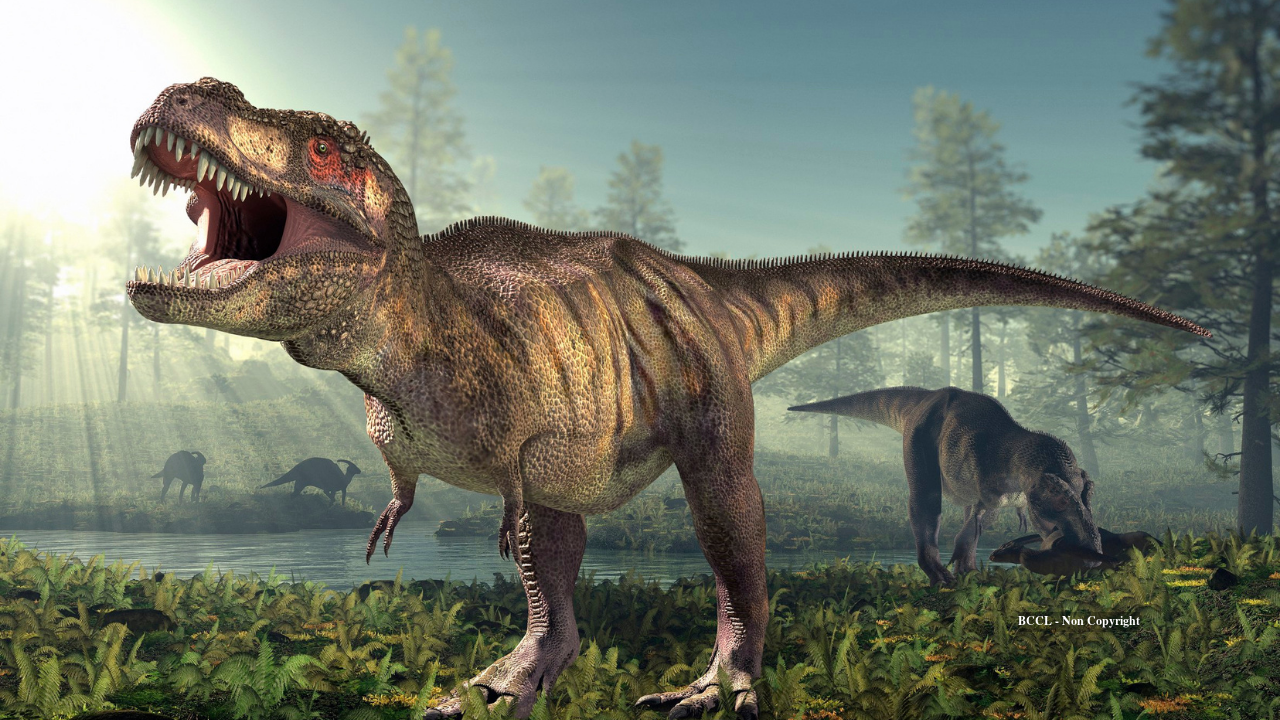
Paleontologists cannot stop projecting mammalian fantasies onto dead reptiles. The latest media cycle treats us to breathless headlines about fossil teeth revealing that Tyrannosaurus rex maintained a warm, human-like body temperature. The lazy consensus loves this narrative. It paints the apex predator of the Cretaceous not as a cold-blooded behemoth, but as a high-octane, revved-up athlete running hot on internal combustion.
It is a comforting illusion. We crave monsters we can understand through our own biology. We want our terror warm-blooded, familiar, and metabolically expensive. Discover more on a similar subject: this related article.
The problem is that the physics do not care about your mammalian bias.
Clumped isotope paleothermometry on fossil tooth enamel measures the bonding of carbon-13 and oxygen-18 isotopes, which form at specific temperatures during mineral formation. When researchers apply this technique to ancient teeth, they find numbers hovering around 36 to 38 degrees Celsius. Match that to modern body temperatures, and paleontology departments pop champagne. They declare the king of the tyrant lizards a warm-blooded beast. More reporting by TIME explores comparable perspectives on the subject.
They are confusing the symptom with the engine.
The Physics of Being Massive
Gigantothermy is the dirty little secret the warm-blooded lobby refuses to address. When an animal hits six to nine metric tons, thermodynamics changes the rules of engagement.
Imagine a massive boulder left out in the summer sun. It absorbs heat efficiently and radiates it back with agonizing slowness. Scale up a biological organism to the proportions of a T. rex, and surface-area-to-volume ratios become an absolute tyrant. A creature of that magnitude traps internal metabolic heat simply by existing. It possesses a massive thermal inertia.
You do not need a mammalian metabolic furnace to stay hot when you are the size of a municipal bus. You just need mass.
Researchers waving isotope data around like a smoking gun are measuring the thermal inertia of a biological mountain, not the metabolic rate of a cheetah. The teeth recorded a high temperature because a body that massive physically cannot cool down fast enough in a Cretaceous greenhouse world. It is a passive consequence of geometry, not an active physiological choice.
To claim T. rex was warm-blooded based on core temperature alone ignores how scale distorts biology. It is the equivalent of touching the engine block of a parked semi-truck hours after it stopped running and concluding the engine must be running on nuclear fusion because it is still hot.
The Metabolic Mirage
Let us look at the actual mechanics of avian and mammalian endothermy. True warm-bloodedness requires a ceaseless, hyper-efficient burn of calories. Mammals and birds maintain constant internal temperatures by stoking metabolic fires twenty-four hours a day, fueled by massive amounts of food and oxygen.
Now look at the skeletal structure and growth curves of large theropods.
Bone histology tells a different story. Unlike mammals, which show continuous, rapid growth arrested only by adulthood, large dinosaurs display cyclical growth rings. These lines of arrested growth are the biological equivalent of tree rings. They prove that growth slowed down significantly during seasonal food shortages or environmental stress.
Warm-blooded animals do not hit pause on their metabolism when times get tough. They starve, burn through fat stores at a catastrophic rate, or die. The existence of growth rings points directly to a metabolic strategy that could throttle down when resources grew scarce. That is not mammalian endothermy. That is regional heterothermy or gigantothermy on an industrial scale.
Furthermore, look at the respiratory turbinates in the nasal cavities of animals. Birds and mammals possess complex, scroll-like bones inside their noses lined with moist tissue to capture moisture and heat during exhalation. This adaptation prevents high-metabolism endotherms from desiccating their lungs with every breath.
T. rex skulls lack these structures.
If you run a mammalian-level metabolism through a respiratory tract lacking proper heat-and-moisture exchangers, you dry out and crash. The plumbing does not match the hypothesis.
Why Science Loves a Good Story
Why do researchers keep forcing dinosaurs into mammalian boxes? Because nuance does not sell grants or get picked up by evening news anchors.
The public wants a cinematic predator. We want an animal that acts like a scaled-down lion with teeth the size of bananas. We want the active hunter that sprints across floodplains with boundless aerobic capacity.
The reality is far stranger and far more alien. T. rex was an inertial homeotherm. It inhabited a middle ground that modern biology has largely abandoned because mammals and birds pushed evolution into two distinct, high-energy corners. Dinosaurs operated on a different operating system entirely. They leveraged sheer size to stabilize their internal environment while keeping their baseline cellular metabolism lower than a mammal of equivalent mass.
This meant a T. rex did not need to hunt every single day to feed a runaway furnace. It could afford to lie low, conserve energy, and let its sheer mass buffer it against thermal fluctuations.
When we look at those fossil teeth and see high temperatures, we are not looking at a warm-blooded engine. We are looking at the thermal footprint of an organism so massive it defied the cold simply by refusing to lose heat. Stop trying to make dinosaurs into mammals. They were something much more terrifying: an entirely different design of living engine that conquered the world by rewriting the rules of thermodynamics.