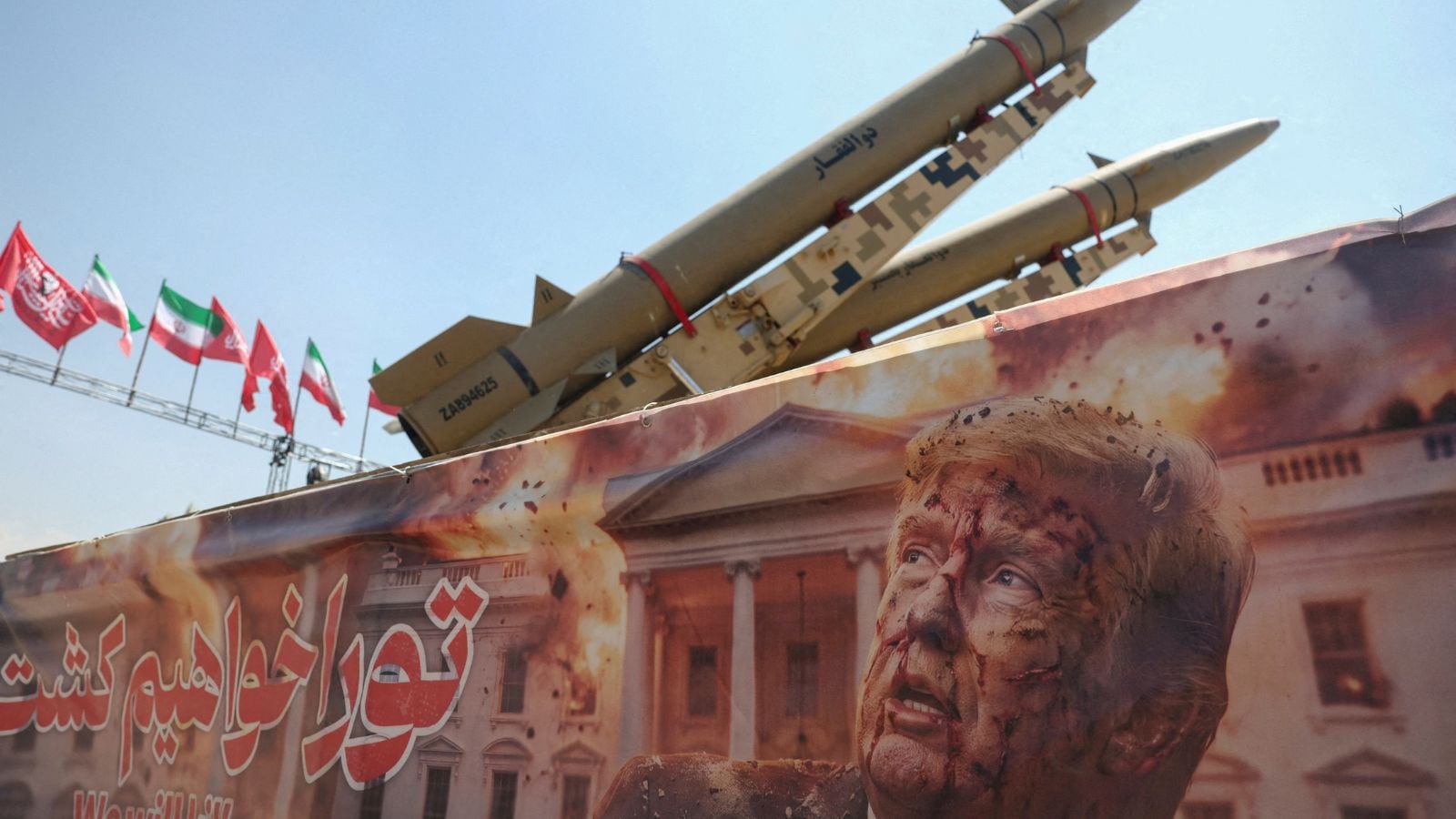
Control over global maritime chokepoints is governed less by permanent territorial dominance than by the continuous cost function imposed on adversary transit. When United States Central Command forces struck two Islamic Revolutionary Guard Corps rocket launchers on Larak Island, the action shattered a month-long operational lull characterized by Washington's pivot toward economic isolation strategies. The tactical trigger was straightforward: observation of Iranian forces preparing to deploy sea-mine-carrying rockets into the northern channels of the Strait of Hormuz. Yet, interpreting this engagement as a mere localized skirmish obscures the broader structural mechanics governing the theater. The confrontation exposes the inherent fragility of maintaining open commercial shipping lanes against an adversary optimized for asymmetrical denial-of-service operations.
The Chokepoint Cost Function
The Strait of Hormuz operates as a high-density, low-margin bottleneck through which a significant share of global energy supplies historically flows. Strategic positioning on islands like Larak grants the Islamic Revolutionary Guard Corps a geographic asymmetry. Launchers positioned here do not need to permanently close the strait to achieve strategic utility; they only need to drive the risk premium for commercial transit past the threshold of profitability.
When insurance rates, hull risk assessments, and crew hazard pay spike, shipping volumes contract independently of actual physical blockades.
[IRGC Asymmetric Threat] ---> [Spike in Risk Premium] ---> [Commercial Traffic Contraction] ---> [Global Price Volatility]
The month preceding the Larak Island strike demonstrated Washington's attempt to alter this equation through economic warfare, specifically via financial isolation campaigns intended to starve Tehran of state revenues. However, economic coercion operates on a delayed feedback loop. For the Islamic Revolutionary Guard Corps, kinetic signaling via minelaying preparations serves as a direct counter-mechanism to immediate economic pressure. By threatening the physical integrity of maritime transit, Tehran forces a re-allocation of American military attention from financial enforcement back to tactical force protection.
The Escalation Ladder and Retaliatory Kinetics
Military engagements in constrained geographic corridors follow a strict escalatory architecture. A targeted preventative strike against imminent minelaying capabilities is designed to degrade adversary operational capacity without triggering systemic escalation.
- Preventative Suppression: Striking active launchers before ordnance enters the water or shipping lanes.
- Proportional Deterrence: Signaling resolve to protect international navigation corridors while capping the geographic scope of the operation.
- Asymmetrical Rebuttal: Adversary utilization of secondary vectors, such as ballistic missile salvos directed at regional logistics hubs.
The immediate aftermath of the Larak Island engagement validated this predictable chain of reactions. Tehran executed a retaliatory missile salvo targeting regional installations, including air facilities in Jordan, which air defense networks successfully intercepted. This sequence highlights the primary operational constraint facing the coalition: tactical defensive precision against launchers does not neutralize the adversary's theater-wide missile inventory. Each localized exchange embeds a persistent structural risk premium into regional energy markets, driving crude benchmarks upward regardless of official assertions regarding the nominal openness of the shipping lane.
The Information Domain and Deterrence Signaling
Modern state conflict relies as heavily on narrative manipulation through digital channels as it does on kinetic exchange. Hours after the tactical engagement on Larak Island, digital communications from political leadership introduced synthetic media artifacts depicting widespread destruction at Iran's primary oil export terminal on Kharg Island. Independent verification confirmed the imagery lacked physical grounding, functioning instead as a psychological deterrence mechanism.
This divergence between kinetic reality and digital signaling underscores a fundamental reality of contemporary deterrence theory. When physical assets are constrained by rules of engagement designed to prevent regional escalation, digital and rhetorical escalation substitutes for kinetic expansion. The objective shifts from physical destruction to cognitive overload, attempting to convince adversary leadership of a disproportionate cost structure that does not yet exist on the ground.
Strategic Execution
Sustaining maritime commerce through the Strait of Hormuz requires transitioning from reactive tactical strikes against exposed launchers to an integrated denial architecture. Coalition planners must couple persistent airborne surveillance with autonomous sweep-and-clear mechanisms that neutralize mine deployment capabilities before assembly phases reach completion on island outposts. Intelligence-led preemption of logistical supply chains servicing Larak and adjacent tactical islands will dictate whether maritime chokepoints remain open through sustained force or continuous crisis management.