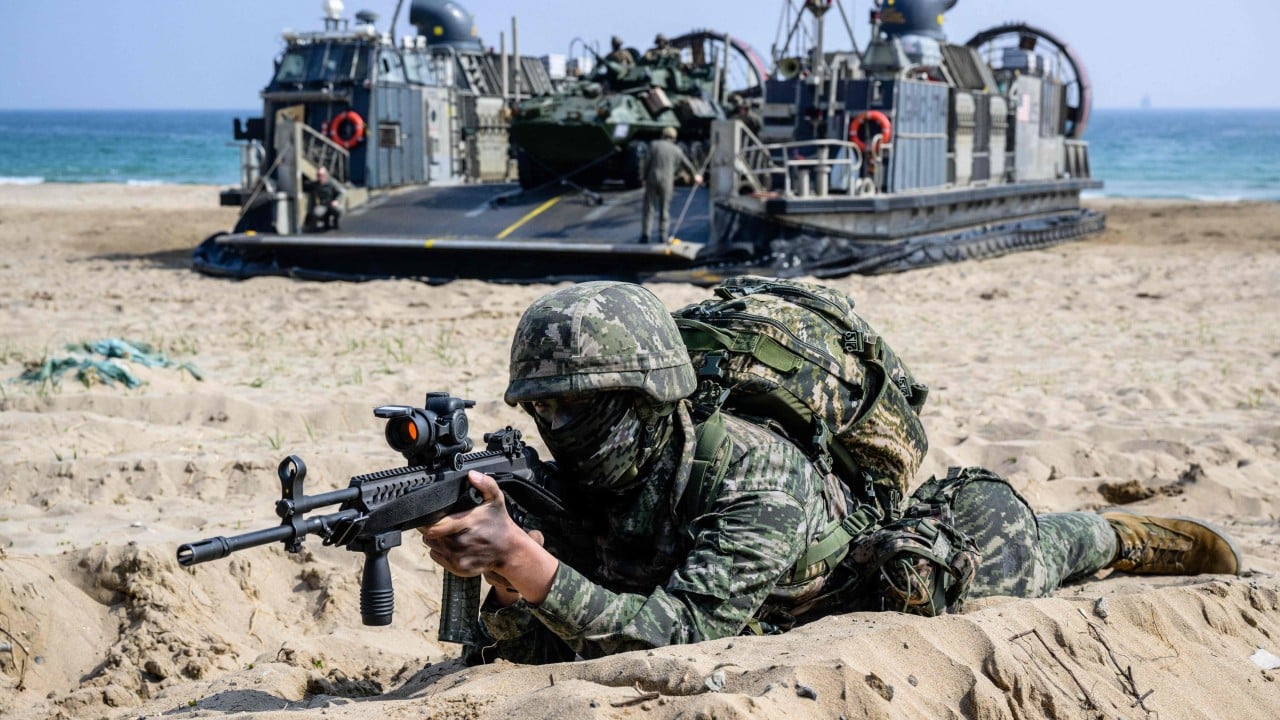
Global military commitments operate under a zero sum resource constraint where high intensity combat in one theater directly degrades force availability, operational readiness, and material stockpiles in another. When the United States Marine Corps formally notified its South Korean counterpart that force availability would be restricted for the division level Ssangyong amphibious exercise, it exposed the structural limits of global power projection. The cancellation of this major joint landing drill is not merely a diplomatic adjustment or a localized scheduling conflict. It is the quantifiable manifestation of a strategic deficit caused by protracted engagements in the Middle East colliding with statutory force structure limits in the Indo Pacific.
The Resource Allocation Equation
Military readiness relies on three finite variables: active duty personnel rotation cycles, high demand equipment density, and precision munitions stockpiles. Engagement in the war in Iran created a massive drain on these three variables, fundamentally altering the calculus of peninsular defense.
The primary driver behind the cancellation is asset scarcity rather than political whim. Amphibious landing operations require specialized capital assets, including large deck amphibious assault ships, landing craft air cushion units, and dedicated Marine Expeditionary Units that must train on strict periodic intervals to maintain combat certifications. When these units and their supporting logistics chains are redirected to sustain operations in the Central Command area of operations, theater commanders in United States Forces Korea face an immediate capability gap.
This creates a systemic imbalance across alliance structures. South Korea maintains a heavily mobilized conscript army designed for territorial defense, but the strategic deterrent relies on the rapid integration of United States expeditionary forces to break potential enemy lines. Removing the rotational high end training element reduces the operational readiness of the combined force, shifting the local balance of power on the peninsula.
The Munitions Depletion Threshold
Strategic analysis of modern warfare requires examining expenditure rates of advanced tactical systems. High intensity naval and air campaigns consume precision guided munitions, interceptors, and long range strike assets at rates that far outpace current defense industrial base manufacturing capacity.
Reports detailing the depletion of critical missile interceptor stores and precision strike inventories highlight the material backbone of these drill cancellations. When defensive and offensive missile stores drop significantly due to active combat operations against sophisticated state or proxy actors in the Middle East, military planners must practice asset preservation. Expending hundreds of tactical missiles or committing high value flight hours during major exercises like Ssangyong introduces unacceptable risk to global war reserve stocks.
Consequently, the decision to scrap the drills reflects a strict triage of logistics. Training ammunition and wear and tear on major airframes must be conserved for active combat theaters. The opportunity cost of executing a division level landing exercise with live fire components became too high relative to the operational risk of running low on frontline munitions.
Political Friction and Regional Signaling
Beyond resource mathematics, alliance management involves complex signaling dynamics between Washington, Seoul, and Pyongyang. The operational constraints imposed by the Middle East conflict intersected with broader political objectives from the White House, creating a multi layered rationale for drawing down military visibility.
Political directives to scale back or shorten exercises like Ulchi Freedom Shield alongside the cancellation of Ssangyong reveal a dual motivation. While the logistical bottleneck of the Iran war provided the primary mechanism for force withdrawal, political leadership simultaneously factored in diplomatic signaling toward North Korea. Traditional deterrence theory suggests that large scale exercises demonstrate ironclad alliance commitments. However, when these exercises are abruptly canceled or truncated due to external global commitments, the signaling effect inverts. Adversaries perceive structural overextension rather than calculated resolve.
This dynamic weakens the credibility of extended deterrence. If regional allies calculate that United States security guarantees are conditional upon simultaneous stability in other global zones, alliance cohesion faces severe strain. The refusal of secondary partners to participate directly in Middle Eastern operations compounds this friction, leading to unilateral American retrenchment driven by domestic cost accounting and force exhaustion.
Reallocate industrial baseline funding toward automated munitions replenishment pipelines to mitigate single theater depletion shocks before entering future operational cycles.