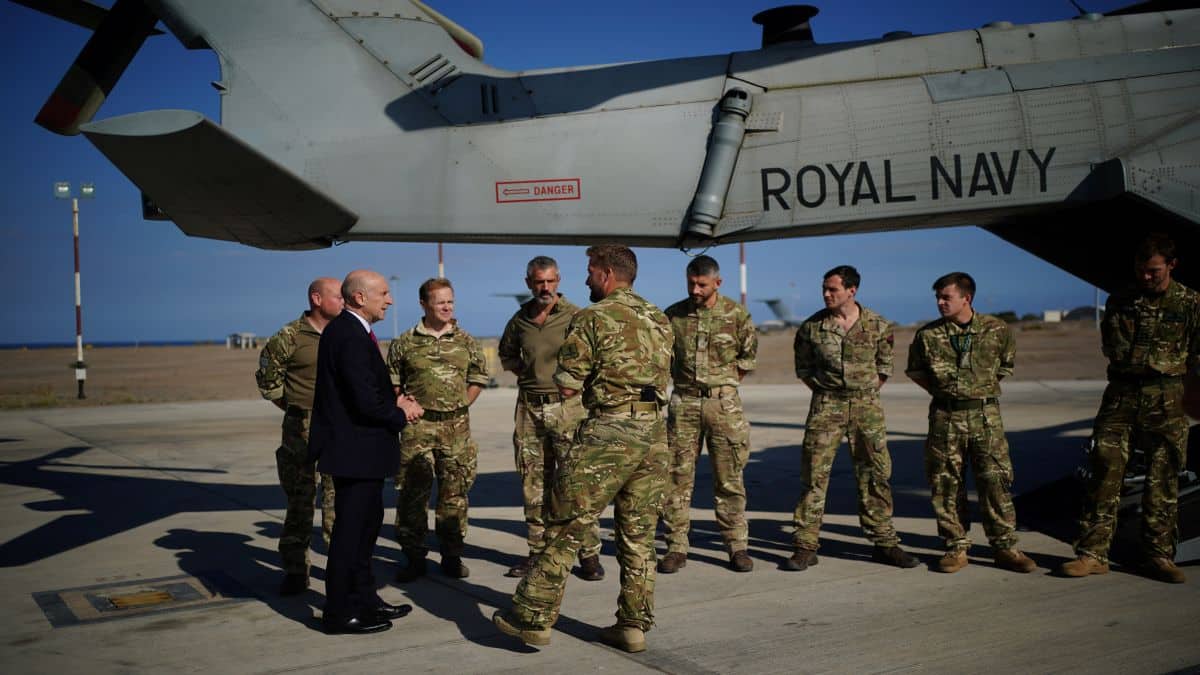
The security architecture of the Eastern Mediterranean rests on the assumption that British Sovereign Base Areas (SBAs) in Cyprus—Akrotiri and Dhekelia—function as unsinkable aircraft carriers, insulated from Middle Eastern kinetic shifts by distance and diplomatic status. This assumption is failing. As Iranian ballistic missile and Unmanned Aerial Vehicle (UAV) ranges expand, these bases have transitioned from rear-echelon logistics hubs to front-line targets. Assessing the actual risk requires moving beyond alarmist headlines and into the hard physics of missile envelopes, the geometry of regional air defense, and the political thresholds for escalation.
The Triad of Threat Vectors
To quantify the risk to UK bases, the threat must be disaggregated into three distinct technical categories. Each carries a different probability of success and a different requirement for defensive saturation.
1. The Ballistic Trajectory
Iran’s liquid-fueled and solid-fueled medium-range ballistic missiles (MRBMs), such as the Shahab-3 variants or the Kheibar Shekan, possess the theoretical range to strike Cyprus from Western Iran (approximately 1,500km to 2,500km). The primary constraint here is not distance, but Circular Error Probable (CEP).
Historically, Iranian missiles were considered "area denial" weapons—too inaccurate to hit a specific hangar or command center. However, the integration of Terminal Guidance and Maneuverable Re-entry Vehicles (MaRVs) has reduced the CEP of newer iterations to under 50 meters. In a saturated strike scenario, the objective is not a "hole in one" but the destruction of runways through multiple impacts, rendering the base non-operational for 24 to 48-hour windows.
2. The Low-Altitude Cruise
The Soumar and Hoveyzeh cruise missile families present a different problem for the SBAs’ air defense. Unlike ballistic missiles, which follow a predictable parabolic arc, cruise missiles utilize low-altitude terrain-masking and waypoint navigation to bypass conventional early-warning radar.
The primary danger for Akrotiri lies in the "blind spot" created by Cyprus’s Troodos Mountains. A cruise missile launched from a sea-based platform or a proxy-controlled territory could, in theory, approach from the south or west, significantly compressing the engagement window for the base’s Surface-to-Air Missile (SAM) batteries.
3. The Loitering Munition
The Shahed-136 and its descendants are the "attrition" wing of a potential strike. These systems are slow and relatively easy to intercept with kinetic or electronic warfare means. Their threat is derived from cost-asymmetry.
Intercepting a $20,000 drone with a $2 million Aster 30 or CAMM (Common Anti-Air Modular Missile) creates a sustainability crisis for the defender. In a coordinated multi-domain strike, loitering munitions are deployed as "defensive sponges," intended to force the depletion of the base’s limited missile interceptors before the high-value ballistic or cruise missiles arrive.
Defensive Calculus: The Sky Shield of the Eastern Mediterranean
The UK’s ability to protect its Cypriot assets is not a binary—it is a function of "Interception Probability" ($P_i$) and "Saturation Threshold" ($S_t$). The Royal Air Force (RAF) utilizes a layered defense system, centered on the Sky Sabre and its integration into the wider NATO Integrated Air and Missile Defence (IAMD) network.
Detection Latency and Reaction Windows
The initial layer of defense is not located on Cyprus itself but on the peak of Mount Olympus. The RAF’s Type 101 long-range radar provides a persistent 360-degree view, but its effectiveness is limited by the curvature of the earth and the high-speed descent of MRBMs.
A ballistic missile from Western Iran has a flight time of approximately 10 to 12 minutes. The reaction window for a successful intercept is roughly 120 to 180 seconds from the moment of detection to the launch of an interceptor. This leaves zero margin for human-in-the-loop deliberation, requiring highly automated engagement cycles.
The Interceptor Economics
The Sky Sabre system, using the CAMM, is optimized for short to medium-range defense. While highly effective against aircraft and cruise missiles, its capability against high-velocity ballistic re-entry vehicles is less certain. To address this, the UK relies on the presence of Type 45 Destroyers in the Eastern Mediterranean. These vessels, equipped with the Sampson radar and Sea Viper (Aster 15 and 30) missiles, are the primary "outer shield" for Akrotiri.
The strategic vulnerability here is quantity. A single Type 45 carries 48 missiles. In a massed Iranian strike involving dozens of drones and several waves of missiles, the ship’s magazine could be exhausted within minutes. Without a rapid reload capability—which currently requires returning to port—the defense of the bases transitions from a technical challenge to a logistical one.
The Escalation Ladder and Proxy Entanglement
To understand if Iranian missiles will actually fly toward Cyprus, one must analyze the geopolitical cost function. Iran rarely engages in direct kinetic action against a Tier-1 power unless its core interests are threatened.
Cyprus as a Western Node
The primary risk to the SBAs is not their British sovereignty, but their utility as a staging ground for Israeli or US operations. If Iran perceives that Akrotiri is being used as a refueling hub for IAF F-35s or as a launchpad for US strikes against Iranian interests in Syria or Lebanon, the base moves up the target list.
Under the "Logic of Proportionality," Iran might calculate that a strike on a British base on Cyprus is "safer" than a direct strike on Israel or a US base in the Gulf. The intent would be to signal capability and resolve while banking on the UK's desire to avoid a full-scale regional war. This is a high-stakes gamble on Western risk-aversion.
The Lebanon Variable
Hezbollah’s arsenal includes thousands of short-range rockets and an increasing number of precision-guided munitions. While Hezbollah has historically focused on northern Israel, its leaders have explicitly named Cyprus as a potential target if the island’s infrastructure is used to support Israeli military actions.
From a tactical perspective, a strike from Lebanon is far more dangerous than one from Iran. The distance is less than 250km, meaning flight times are measured in seconds rather than minutes. This eliminates the early-warning advantage and places the bases under an almost constant threat of "pop-up" attacks.
Hard Constraints and Operational Realities
No military system is infallible, and the defense of Cyprus is constrained by several factors that are often ignored in generalist reporting.
- Geography of Vulnerability: Dhekelia, being located in the eastern part of the island, is significantly more exposed to Lebanese-based threats. Akrotiri, though further west, is the primary operational hub and therefore the higher-value target.
- Shared Airspace: The proximity of civilian air traffic at Larnaca and Paphos airports complicates the "Identification Friend or Foe" (IFF) process. In a high-tension scenario, the risk of a "blue-on-blue" or collateral damage event against civilian airliners is significant, potentially causing the defense to hesitate.
- Electronic Warfare (EW) Saturation: The Eastern Mediterranean is one of the most EW-congested environments in the world. Russian assets in Tartus and Khmeimim, along with Iranian and Israeli platforms, constantly monitor and jam frequencies. This environment can degrade the precision of GPS-guided munitions but also interferes with the radar-link accuracy of defensive systems.
Tactical Reconfiguration: The Survival Playbook
The current defensive posture for the Sovereign Base Areas is reactive. To mitigate the rising threat profile, the UK must shift toward a proactive resilience model. This does not necessarily mean more missiles, but rather a more sophisticated management of the base’s "Signature."
Dispersal and Hardening
The reliance on a single main runway at Akrotiri is a strategic bottleneck. Investing in "Rapid Runway Repair" (RRR) capabilities and hardened aircraft shelters (HAS) is the most cost-effective way to neutralize the impact of an Iranian strike. If the base can demonstrate that it can recover operational status within 12 hours of a strike, the strategic value of an Iranian attack is halved.
Integration of Non-Kinetic Defense
High-energy laser systems (such as the DragonFire currently in testing) represent the long-term solution to the drone swarming problem. By eliminating the cost-per-intercept issue, these systems allow kinetic interceptors to be reserved for the high-velocity ballistic threats that lasers cannot yet stop. Deploying a prototype laser capability to Akrotiri would signal a technological shift that complicates Iranian strike planning.
Diplomatic Decoupling
The most potent defense for the SBAs is political. The UK must clearly define the parameters of its cooperation with regional allies. By maintaining a distinction between "sovereign UK operations" and "support for third-party kinetic actions," London can reduce the likelihood of being drawn into the direct targeting loop of Tehran or its proxies.
The threat is real, measurable, and increasing. While a direct Iranian missile strike on Cyprus remains a low-probability event in the immediate term, the technical capability exists, and the geopolitical barriers to such an action are eroding. The security of the Sovereign Base Areas will increasingly depend on their ability to survive the first wave of a conflict they did not start.