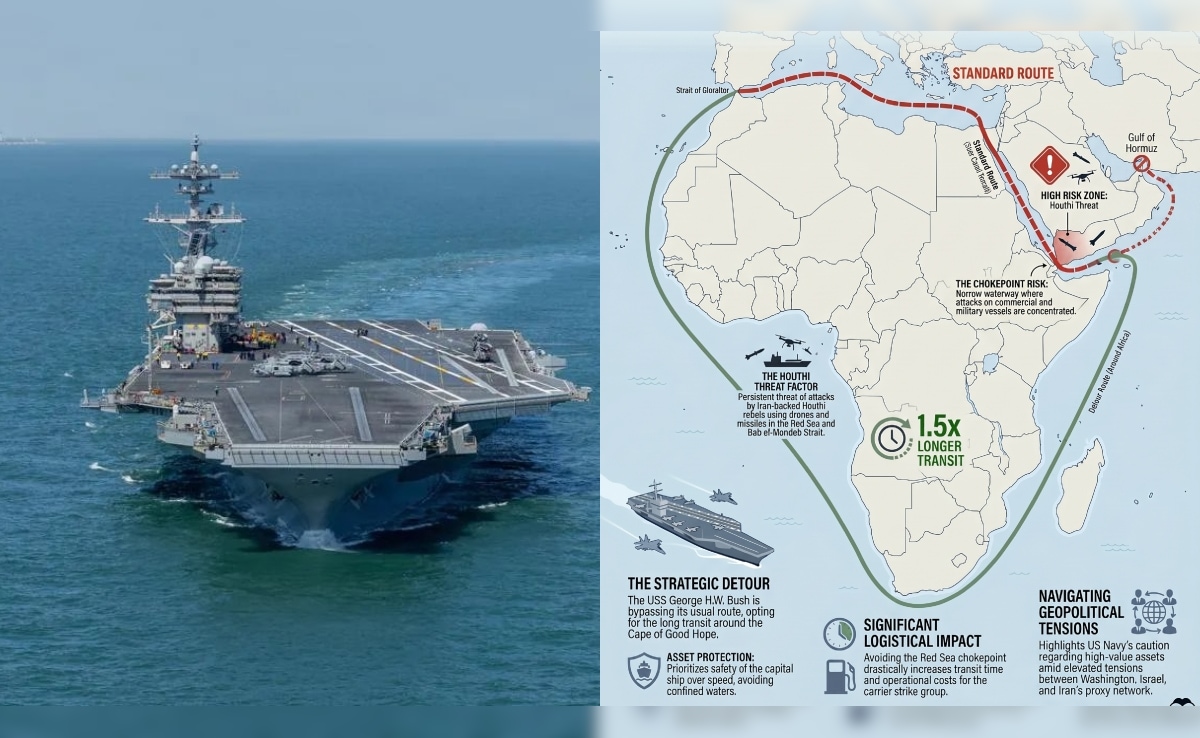
The transit of a Nimitz-class aircraft carrier like the USS George H.W. Bush around the Cape of Good Hope rather than through the Suez Canal is not a mere detour; it is a calculated prioritization of platform survivability over operational velocity. While the Red Sea offers the shortest maritime link between the Mediterranean and the Indian Ocean, the emergence of an asymmetrical threat profile from Houthi-controlled territories has altered the cost-benefit calculus for high-value naval assets. This displacement represents a shift from "expedited transit" to "force preservation," driven by the proliferation of low-cost precision munitions and the inherent geographic constraints of the Bab el-Mandeb Strait.
The Geopolitical Funnel and Asymmetric Vulnerability
The decision to add approximately 3,500 nautical miles and 10 to 14 days of transit time to a carrier strike group’s schedule is rooted in the physics of "choke point" naval warfare. The Suez Canal and the Bab el-Mandeb Strait function as strategic funnels where the maneuvering room of a 100,000-ton vessel is severely restricted.
In open ocean environments, a carrier strike group (CSG) utilizes its speed and sensory perimeter to maintain a "bubble" of protection. Within the confines of the Red Sea, this bubble is compressed. The proximity to the Yemeni coastline places the CSG within the engagement envelope of several specific weapon systems:
- Anti-Ship Cruise Missiles (ASCMs): Low-flying, high-speed projectiles that provide minimal radar warning when launched from coastal batteries.
- Anti-Ship Ballistic Missiles (ASBMs): High-velocity weapons that challenge traditional Aegis Combat System intercept profiles by attacking from high-angle trajectories.
- One-Way Attack (OWA) Unmanned Aerial Vehicles (UAVs): Saturation tactics designed to overwhelm point-defense systems through sheer volume rather than individual lethality.
- Unmanned Surface Vessels (USVs): Remote-controlled, explosive-laden boats that target the waterline, exploiting the difficulty of detecting small targets in cluttered littoral environments.
The Houthi arsenal, significantly bolstered by Iranian technology transfers, has transformed the Red Sea from a permissive environment into a contested littoral zone. For a theater commander, the risk of a "lucky shot" damaging a multi-billion-dollar asset outweighs the tactical advantage of arriving in the Gulf ten days earlier.
The Cost Function of Maritime Rerouting
Naval logistics are governed by a trade-off between time, fuel consumption, and crew endurance. Rerouting around Africa is a massive logistical undertaking that involves more than just a change in heading.
Fuel and Propulsion Economics
A Nimitz-class carrier is nuclear-powered, meaning its primary propulsion is not limited by fuel range. However, its escort ships—destroyers and cruisers—rely on conventional gas turbine engines. The extended route increases the frequency and complexity of Underway Replenishment (UNREP) operations. Every additional mile traveled by the strike group requires a corresponding increase in the support of the Combat Logistics Force (CLF), specifically oilers and supply ships that must also navigate these extended lines of communication.
The Maintenance Debt
Naval platforms are managed via a rigorous cycle of deployment and maintenance. Forcing a strike group to spend an extra two weeks at sea at high transit speeds (typically 20+ knots for such moves) accelerates the wear on mechanical systems and shortens the window for required pier-side maintenance. This creates a "maintenance debt" that must be repaid later in the ship’s lifecycle, potentially delaying future deployments and reducing overall fleet readiness.
Tactical Justification for the 1.5x Route Factor
The "1.5 times longer" metric is a simplified representation of the Cape of Good Hope route versus the Suez route. In reality, the distance from the Eastern Mediterranean to the Persian Gulf via Suez is roughly 6,000 nautical miles. The circumnavigation of Africa pushes this to nearly 11,000 nautical miles.
The decision-making framework for this detour includes three primary pillars:
1. The Detection-to-Engagement Window
In the Red Sea, the distance from the shoreline to the shipping lane can be as narrow as 15 to 30 miles. A missile traveling at Mach 2 covers 20 miles in approximately 47 seconds. This provides the ship’s defensive systems a razor-thin window to detect, track, and intercept. In the open waters of the Atlantic or the Indian Ocean, the threat of land-based coastal batteries is eliminated, restoring the CSG’s defensive depth.
2. Signal Intelligence and Electronic Warfare
The littoral environment is electromagnetically "noisy." Terrestrial radio, civilian radar, and coastal cellular networks can interfere with the sensitivity of naval sensors. By operating in the deep ocean, the CSG can better utilize its AN/SPY-6 or SPY-1 radar arrays to identify and categorize threats at their maximum theoretical range without the clutter of land-mass interference.
3. Political and Diplomatic De-risking
A kinetic engagement in the Suez Canal or the Bab el-Mandeb has massive economic externalities. If a carrier were to be disabled or even forced to engage in a high-intensity defensive battle within the canal approaches, the resulting disruption to global trade (which accounts for roughly 12% of global maritime traffic) would be catastrophic. Moving the carrier around the Cape removes the vessel from being a potential "plug" in the world’s most vital artery.
Quantifying the Threat of "Saturation"
The primary concern for naval planners is not the lethality of a single Houthi missile, but the mathematical reality of a saturation attack. Every defensive system, from the RIM-162 Evolved SeaSparrow Missile (ESSM) to the Phalanx CIWS (Close-In Weapon System), has a finite number of simultaneous engagements it can handle.
If an adversary launches twenty drones and five missiles simultaneously, the defensive system must achieve a 100% success rate. A single failure results in a "mission kill"—where the ship remains afloat but its sensors, flight deck, or weapon systems are rendered inoperable. For a symbol of American power like the USS George H.W. Bush, a mission kill is a strategic defeat on the global stage.
Strategic Realignment of Naval Presence
The shift in routing signals a broader change in how the U.S. Navy views "Freedom of Navigation" operations. Historically, the presence of a carrier was enough to deter regional actors. However, the democratization of precision-strike technology means that even non-state or semi-state actors like the Houthis can now impose significant costs on superpower navies.
The Navy is now forced to adopt a "disaggregated" posture. Instead of sailing through the heart of the threat, the carrier operates from "stand-off" distances. It uses its air wing (F/A-18E/F Super Hornets) to project power into the Red Sea from the safety of the North Arabian Sea or the Indian Ocean. This extends the reach of the carrier while keeping the hull itself outside the highest-risk zones.
The Logistic Constraint of the Combat Logistics Force
A critical bottleneck in the Cape of Good Hope strategy is the availability of replenishment ships. The U.S. Navy’s logistics fleet is optimized for established hubs. Rerouting an entire CSG requires redirecting oilers and dry cargo ships to mid-ocean points where they have less land-based support. This stretches the "logistics tail" to its limit. If multiple strike groups were forced to take the long route simultaneously, the Navy’s ability to sustain them would be severely tested, highlighting a systemic vulnerability in long-range power projection.
This maneuver demonstrates that the era of uncontested maritime transit in the Middle East has ended. The "1.5x route" is a permanent addition to the strategic playbook as long as shore-based precision density remains high. Future naval architecture will likely prioritize increased magazine depth for defensive missiles and enhanced electronic warfare suites to counter the low-cost drone threat that has made the Suez route a liability for capital ships.
Naval commanders must now integrate "threat-avoidance routing" as a standard operational procedure rather than an anomaly. This requires an immediate increase in the procurement of long-range logistics vessels and a re-evaluation of the "all-in-one" carrier strike group model in favor of more distributed, modular sea power.


