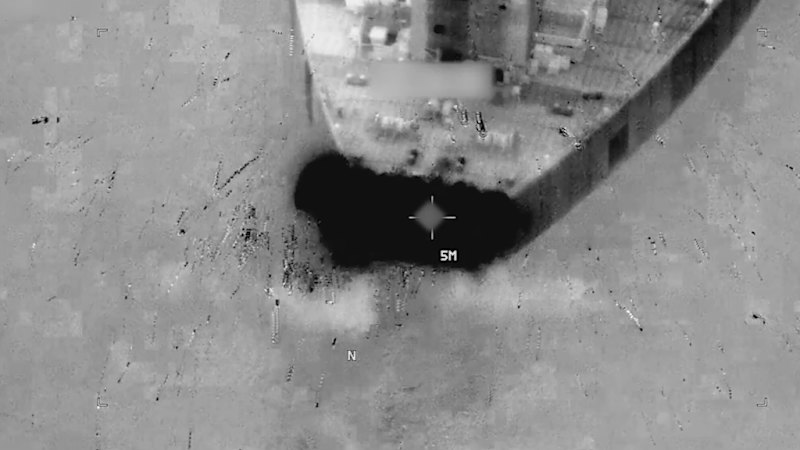
When military authorities publish high-contrast, monochromatic targeting footage of aerial bombardments, the primary objective transcends routine public affairs reporting. The release of visual records documenting operations against strategic infrastructure functions as a calculated vector of deterrence, information operations, and alliance management. Deconstructing the distribution mechanics of modern combat documentation reveals a rigorous framework designed to achieve distinct geopolitical and tactical outcomes without exposing proprietary sensing capabilities.
The operational utility of releasing engagement media operates across three distinct vectors. First, visual evidence shortens the verification cycle for state actors attempting to assess combat damage indicators independently. Second, public dissemination establishes an immediate narrative dominance, preempting competing information campaigns from adversary apparatuses. Third, the media artifacts serve internal bureaucratic functions, validating expenditure metrics to oversight bodies through tangible proof of weapon system performance.
Combat disclosure strategy relies heavily on selective transparency. Military commands withhold high-resolution optical feeds that could compromise sensor frequencies, aperture sizes, or thermal signature libraries. Instead, consumers receive compressed, heavily scrubbed monochrome footage featuring standardized targeting reticles. This structural sanitization protects classified technical parameters while maximizing psychological impact on adversary command structures. The visual grammar of a precision strike—characterized by static overhead tracking terminated by sudden thermal dispersion—communicates absolute spatial dominance regardless of temporal delay between recording and release.
Information warfare dynamics in modern theater operations dictate that visual artifacts act as proxies for broader military capacity. When defensive command centers broadcast imagery of missile cells launching or aircraft departing flight decks, they signal readiness states to regional partners and potential secondary belligerents. This proactive disclosure shifts the adversary's defensive posture from offensive planning to asset preservation, forcing a redistribution of radar assets and mobile launchers to mitigate anticipated follow-on packages.
Assessing the downstream utility of these releases requires tracking changes in adversary communication channels rather than immediate battlefield concessions. Strategic analysts monitor changes in state-run media framing, electronic emissions density, and command-and-control redundancy measures to gauge whether the public display achieved its intended deterrent effect. When the targeted state responds through asymmetric proxies or calibrated retaliatory strikes, the initial disclosure has successfully mapped the opponent's remaining response thresholds, feeding directly into the targeting cycle for subsequent operational phases.
Prioritize continuous monitoring of secondary electronic signatures and proxy network activation patterns to evaluate the true deterrence quotient of public combat disclosures, as optical media serves primarily to anchor the narrative while kinetic outcomes are validated through telemetry and signals intelligence.
US Department of Defense releases videos showing strikes on Iran
This video is relevant because it features official Department of Defense footage documenting the precision strikes on Iranian infrastructure.
http://googleusercontent.com/youtube_content/1



