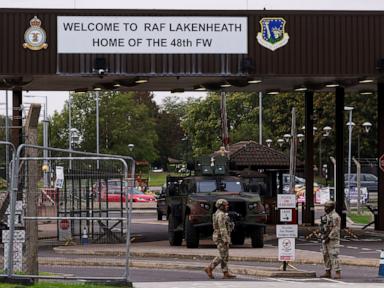
Modern counterterrorism operations operate under a continuous tension between intelligence extraction and preventative detention. The operational architecture surrounding the investigation of RAF Fairford—marked by multiple arrests under Section 5 of the Terrorism Act 2006 and subsequent releases on police bail—exposes the complex mechanics of how state security apparatuses manage threat vectors involving proxy networks. Analyzing this incident requires examining the systemic framework of statutory detention limits, evidentiary thresholds, and the operational calculus behind conditional bail releases.
The Statutory Constraint Matrix
When counterterrorism units intercept individuals suspected of preparing hostile acts, their legal authority is strictly bounded by statutory timeframes. In the United Kingdom, suspects detained under terrorism legislation can initially be held without charge for a limited window before investigators must either charge them, release them, or apply for judicial extensions.
The decision to release suspects on police bail is rarely indicative of a collapsing case. Instead, it functions as a controlled tactical maneuver dictated by three operational variables:
- Evidentiary Gaps: Investigators often intercept cells during the nascent or planning phases before material execution occurs. While suspicious indicators such as reconnaissance markers or accelerants like petrol may be recovered, raw physical evidence must legally connect to a specific, provable conspiracy to cross the threshold for a formal criminal charge.
- Intelligence Harvesting vs. Prosecution: Immediate arrest halts an active plot but often blinds intelligence services to broader networks, handlers, and funding channels. Bailing suspects under stringent monitoring conditions can force communications between operatives and overseas handlers, generating actionable signals intelligence.
- Resource Allocation: Holding suspects in custody triggers strict clock mechanics for interrogation and evidence processing. Releasing individuals under intense electronic and physical surveillance allows law enforcement to redirect finite investigative assets toward newly uncovered nodes, such as secondary coordinators or recruiters.
The Transnational Proxy Economic Model
The evolution of security threats targeting military infrastructure, such as the strategic installations utilized by United States and allied forces, reflects a shift toward decentralized, asynchronous operations. Rather than deploying state-uniformed personnel, modern state-backed interference relies on localized proxies and compartmentalized cells.
This operational model minimizes attribution risk for the sponsoring state while maximizing disruption potential for the host nation. The economic and logistical cost function for the host nation escalates rapidly:
$$\text{Total Security Burden} = \text{Direct Interception Cost} + \text{Infrastructure Hardening} + \text{Strategic Redeployment Cost}$$
When threats materialize near vital military nodes, the secondary effects extend beyond immediate policing. Force protection postures must shift dynamically. As observed in the wake of the Fairford investigations, the strategic calculus can force the physical redeployment of high-value assets, such as bomber aircraft, to mitigate exposure while investigations unfold. This achieves an asymmetric disruption effect for the threat actors even in the absence of a successful kinetic attack.
The Surveillance-Intervention Tradeoff
A fundamental dilemma in managing terror suspects released on bail is the risk-mitigation curve. Law enforcement agencies must weigh the public safety hazard of conditional release against the intelligence yield of observing an unconstrained suspect.
- Active Monitoring Costs: Maintaining 24/7 surveillance on multiple suspects requires immense manpower, specialized technical units, and cross-jurisdictional coordination between local constabularies and national counterterrorism commands.
- The Communications Catalyst: Suspects under suspicion frequently attempt to verify the status of their network post-arrest. Monitoring these communications provides the evidentiary linkages required for international indictments, as demonstrated when cross-border coordination uncovers financial flows or directives originating from foreign detention facilities or handlers.
- The Threshold of Prosecution: Transitioning from suspicion to a formal indictment under frameworks like the National Security Act requires dismantling plausible deniability. Investigators must systematically eliminate alternative explanations for the suspects' movements, digital footprints, and material acquisitions.
Strategic Operational Forecast
The structural handling of state-backed proxy threats points toward an era of protracted legal and intelligence friction. As jurisdictional lines blur between domestic criminal acts and international state-sponsored sabotage, counterterrorism agencies will increasingly rely on prolonged pre-charge bails coupled with severe travel restrictions and asset freezes. The primary objective shifts from rapid local prosecution to the systematic mapping of transnational command chains, accepting short-term tactical release risks to dismantle the broader underlying architecture of the threat network.