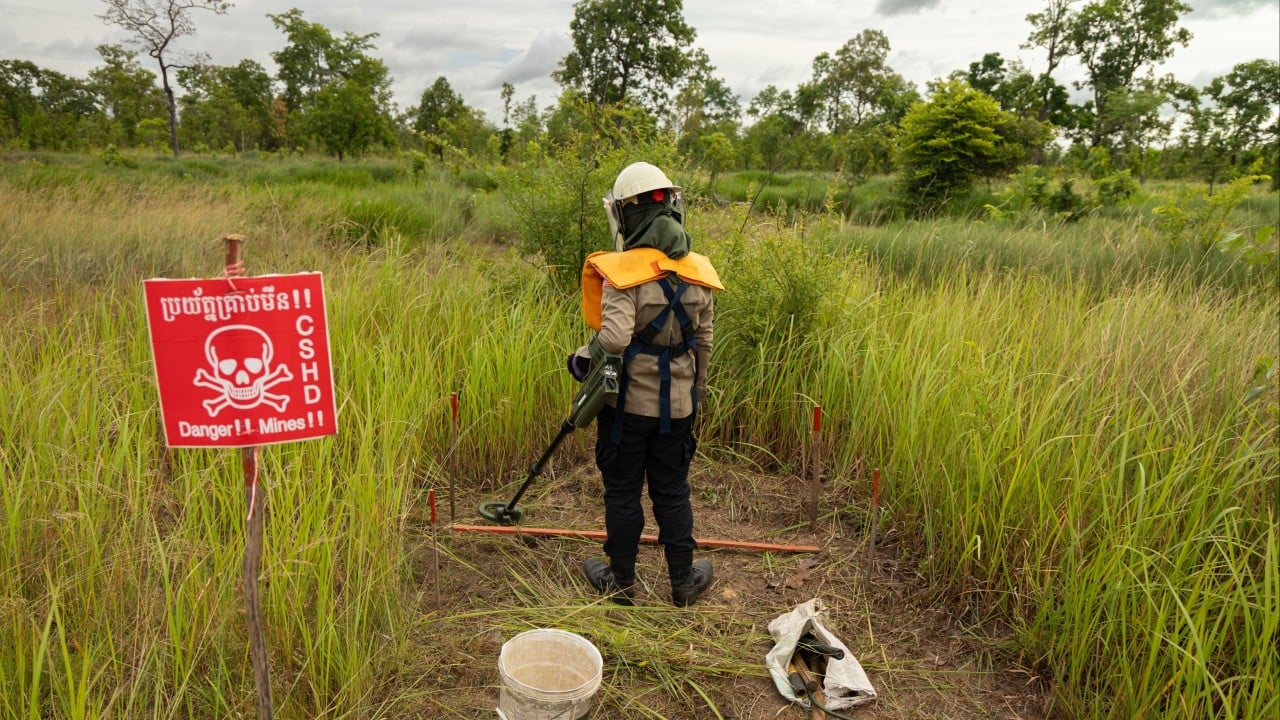
Capital allocation shifts toward emergent European and Middle Eastern conflicts are producing an operational insolvency crisis for humanitarian demining organizations across Southeast Asia. When donor liquidity leaves a theater, legacy clearance operations do not gradually wind down; they experience sudden structural failure. This dynamic reveals a core fragility in how post-conflict remediation is financed: reliance on shifting geopolitical attention rather than amortized capital schedules or multi-year underwriting guarantees.
Understanding this crisis requires examining the economic mechanics of international aid dependency. Demining operations in nations like Cambodia, Laos, and Vietnam operate almost exclusively on foreign public sector grants and multilateral development bank appropriations. When the primary donor states reallocate treasury priorities to active high-intensity warzones, recipient clearance agencies face an immediate liquidity shortage.
The Donor Displacement Mechanism
The substitution effect in international aid operates through direct budget cannibalization. Major state donors maintain finite foreign assistance envelopes. When a high-profile crisis erupts, ministries of foreign affairs rarely expand their total expenditure caps proportionally. Instead, they exercise zero-sum reallocation. Funds slated for multi-year hazard reduction programs in Southeast Asia are redirected toward emergency military procurement, refugee housing, and immediate infrastructure reconstruction in newer conflict theatres.
This capital flight triggers three distinct operational bottlenecks for clearance agencies:
- Fixed Overhead Rigidities: Demining requires specialized mechanical assets, trained field operatives, and rigorous quality assurance management. These costs are fixed in the short term, meaning sudden funding drops cannot be matched by proportional cost reductions without dismantling core technical capacity.
- Accreditation and Retention Decay: Field personnel undergo years of specialized training in metal detection, animal-assisted search, and explosive ordnance disposal. When funding lapses force layoffs, this human capital disperses permanently into other sectors, destroying organizational muscle memory.
- Survey-to-Clearance Pipeline Fracture: Systematic clearance relies on a continuous pipeline: non-technical survey, technical survey, and physical clearance. Stopping mid-stream invalidates prior survey data because shifting land use can re-contaminate cleared grids or alter hazard footprints.
The Economic Burden of Unfinished Remediation
To understand why funding withdrawal carries catastrophic long-term costs, one must evaluate the opportunity cost of uncleared agricultural land. In rural Cambodia and central Laos, unexploded ordnance directly suppresses gross domestic product by locking up arable acreage.
The economic equation governing demining investment relies on land productivity recovery versus clearance cost per square meter. When international donors cut budgets, clearance agencies are forced to triage operations. They abandon low-density, high-area agricultural zones in favor of high-density immediate infrastructure corridors.
[Donor Budget Reduction]
       │
       ▼
[Operational Triage: Abandonment of Agricultural Grids]
       │
       ▼
[Suppression of Local Agricultural Yields & Subsistence Farming]
       │
       ▼
[Macroeconomic Compression & Increased Rural Dependency]
This triage logic shifts the economic burden from the international community onto local populations. Rural communities must choose between leaving productive land fallow or accepting lethal risks to farm. The resulting injury rates generate immediate healthcare expenditures that exceed the per-capita savings achieved by cutting demining grants.
Structural Alternatives to Aid Dependency
The structural vulnerability exposed by shifting global aid streams points to a fundamental flaw in the funding architecture of humanitarian demining. Relying on discretionary annual grants exposes critical human security infrastructure to the whims of foreign electoral cycles and shifting media cycles.
Transitioning away from this vulnerability requires a pivot toward performance-linked development finance and blended capital models. Host governments in Southeast Asia lack the domestic tax bases to fully subsidize legacy clearance, but they can restructure how international capital enters the sector.
One viable alternative is integrating demining directly into national infrastructure financing packages. When a multilateral bank funds a highway or irrigation grid in an affected region, clearance must be costed as an inescapable preliminary engineering expense rather than a separate charity project. Under this model, capital is secured through project finance debt rather than donor goodwill.
Another structural reform involves instituting endowment-backed trust funds managed through sovereign wealth mechanisms. By capitalizing funds during periods of high donor interest and investing the principal in yield-bearing instruments, agencies can smooth out the volatility of annual aid cycles.
The ongoing funding crisis in Southeast Asia is not merely a temporary shortfall driven by competing global emergencies. It is a structural stress test that proves traditional humanitarian aid models are obsolete for long-tail post-conflict environments. Clearance agencies must abandon the assumption of perpetual donor benevolence and re-engineer their operational units around self-sustaining economic frameworks or face permanent retrenchment.
Strategic Capital Reallocation Protocol
- Audit Fixed Cost Baselines: Strip administrative overhead to align strictly with guaranteed multi-year commitments rather than projected annual grants.
- Bundle Clearance with Infrastructure Debt: Mandate that all commercial and public development loans include a non-negotiable, fully funded demining allocation prior to ground-breaking.
- Monetize Land Recovery Valuations: Partner with agricultural ministries to issue green bonds tied directly to the future economic yield of newly cleared acreage, tapping private capital markets to replace volatile state aid.


.jpg)
