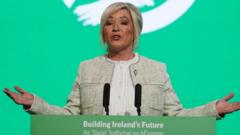
The United Kingdom is currently undergoing a process of institutional thinning where the constitutional glue—historically dependent on economic convergence and shared administrative logic—is losing its adhesive strength. Michelle O’Neill’s assertion that the union is "cracking at the seams" serves as a qualitative observation of a quantitative reality: the divergent fiscal trajectories and regulatory misalignments between Westminster and its devolved administrations. To analyze the stability of the UK union, one must move beyond political rhetoric and evaluate the three primary stressors currently acting upon the state: regulatory divergence, fiscal imbalance, and the erosion of the "Internal Market" logic.
The Tri-Node Stress Framework
The integrity of any multi-nation union depends on a stable equilibrium between three nodes: economic integration, political legitimacy, and cultural cohesion. When one node weakens, the others must compensate. In the current British context, all three are experiencing simultaneous friction.
1. Regulatory Divergence and the Irish Sea Border
The implementation of the Windsor Framework and the preceding Northern Ireland Protocol introduced a fundamental anomaly into the UK’s internal market. For the first time in the modern era, a constituent part of the UK (Northern Ireland) remains aligned with a foreign regulatory orbit (the EU Single Market for goods) while the mainland (Great Britain) pursues a path of deregulation or independent standards.
This creates a "regulatory wedge." Over time, the cost of doing business between Belfast and London increases relative to the cost of doing business between Belfast and Dublin. We can model this as a friction coefficient: as GB regulations drift further from EU norms, the administrative burden on internal UK trade rises. This mechanical separation precedes political separation. If a business in Antrim finds it easier to source components from Louth than from Lancashire due to paperwork overhead, the economic union has already functionally ceased to exist for that firm.
2. The Fiscal Transfer Paradox
The UK operates on a system of massive fiscal transfers, primarily moving capital from the Southeast of England to Scotland, Wales, and Northern Ireland via the Barnett Formula. Theoretically, this should act as the ultimate stabilizer. However, we are witnessing a diminishing marginal return on these transfers.
Political actors in devolved regions increasingly frame these transfers not as a benefit of union, but as a symptom of a "dependency trap" created by Westminster’s failure to decentralize economic growth. When the recipient of a subsidy begins to view the provider not as a benefactor but as a structural inhibitor to independent growth, the fiscal link turns from an anchor into a source of resentment.
3. The Erosion of Unified Administrative Logic
For centuries, the British civil service and legal systems provided a unified backbone. Post-Brexit, the "Common Frameworks" intended to manage devolved powers have become sites of constant litigation and disagreement. The UK Internal Market Act 2020, designed to prevent internal trade barriers, has been viewed by Edinburgh and Cardiff as a "power grab" that overrides their legislative competence. This creates a recursive loop of constitutional friction:
- Westminster passes a law to ensure market uniformity.
- Devolved parliaments view this as an infringement on their autonomy.
- The resulting legal challenge undermines the perceived legitimacy of the central government.
- Voters perceive the system as "broken," fueling separatist sentiment.
Quantifying the "Cracking" Phenomenon
To measure the actual degradation of the union, we must look at the decoupling of public sentiment from institutional performance. In Northern Ireland, the "cracking" mentioned by O'Neill is visible in the demographic shift and the normalization of Sinn Féin as a primary party of government. This is not merely a change in personnel; it is a shift in the state's teleology.
The political gravity is shifting toward a "United Ireland" not because of a sudden surge in romantic nationalism, but because of a cold-eyed assessment of economic outcomes. The Republic of Ireland’s GDP per capita—even when adjusted for the distortions of multinational accounting (GNI*)—presents a stark contrast to the relative stagnation of the UK regions outside of London.
The Scottish Variance
In Scotland, the stress is manifest in the disconnect between the desire for EU reintegration and the reality of the UK border. The Scottish Government’s economic papers often fail to account for the "Border Friction Multiplier." If Scotland were to leave the UK to join the EU, it would trade its largest market (the UK) for a distant one. However, the political success of the SNP and the persistent ~45-50% support for independence suggest that a significant portion of the electorate is willing to accept an "adjustment cost" in exchange for regulatory sovereignty.
This indicates that the economic deterrent—once the strongest argument for the union—is losing its potency. When the status quo no longer guarantees stability or growth, the perceived risk of radical change decreases.
The Cost Function of Constitutional Uncertainty
Constitutional ambiguity is not free; it carries a measurable economic cost. This is often referred to as the "Constitutional Risk Premium."
- Investment Dampening: Multinationals are hesitant to commit long-term capital to regions where the basic legal and tax framework could be overhauled within a decade.
- Brain Drain: High-skill workers in devolved nations may relocate to London or abroad if they perceive their local economy as being trapped in a permanent state of political limbo.
- Infrastructure Paralysis: Major projects (like rail or energy grids) require cross-border cooperation. If Westminster and the devolved governments cannot agree on basic standards, these projects stall or balloon in cost.
The "cracking" O'Neill refers to is the sound of these institutional gears grinding against one another without lubrication.
The Decentralization Trap
The UK government’s current strategy is a defensive one: "Muscular Unionism." This involves bypassing devolved governments to fund local projects directly and emphasizing the visibility of the British state through branding and direct intervention.
This strategy frequently backfires. By ignoring the established devolved channels, Westminster reinforces the narrative that the current constitutional settlement is being bypassed. This does not "foster" unity; it creates a parallel administration that increases complexity and reduces efficiency. A more sophisticated approach would involve a shift toward a "Federalist Equilibrium," but the UK's uncodified constitution makes such a transition legally and politically fraught.
The Endgame of Asymmetric Devolution
The UK is unique in its asymmetry. England, comprising 84% of the population, has no devolved parliament, while the smaller nations do. This creates an inherent instability where the "center" is also the "whole" for the vast majority of the population.
This asymmetry leads to "English resentment," where the largest voting bloc perceives itself as subsidizing nations that are constantly threatening to leave. If the English electorate begins to view the union as a net drain rather than a source of global power, the pressure to dissolve the union may eventually come from the center rather than the periphery.
The Role of International Re-Alignment
The UK’s position in the global trade hierarchy has fundamentally shifted. Previously, the union was the gateway to Europe. Now, it is a standalone entity navigating a world of giant trade blocs (US, China, EU). In this environment, the "Sovereignty Dividend" promised by Brexit has been unevenly distributed. For London’s financial sector, it offers some agility; for the manufacturing and agricultural bases of Wales and Northern Ireland, it offers primarily friction.
Strategic Forecast: Managing the Breakup or the Rebuild
The British state is at a crossroads where the current "muddle through" approach is reaching its logical limit. The friction between the NI Executive, the Scottish Parliament, and Westminster is not a temporary political spat; it is a structural misalignment of interests.
If the UK is to survive as a unified entity, it requires a complete overhaul of its fiscal and regulatory architecture. This would involve:
- Formalizing the Internal Market: Replacing ad-hoc legal challenges with a transparent, shared regulatory body that includes devolved representation.
- Fiscal Reform: Moving away from the Barnett Formula toward a system based on "Needs-Based Allocation" that incentivizes regional growth rather than just subsidizing decline.
- Constitutional Codification: Defining the limits of Westminster’s "parliamentary sovereignty" to provide the devolved nations with the security that their powers cannot be unilaterally retracted.
Without these interventions, the process of "cracking" will accelerate into a "fragmentation event." This would likely begin with a de-facto economic unification of the island of Ireland, followed by a renewed and more economically grounded push for Scottish independence. The UK union is no longer a given; it is a high-maintenance system currently suffering from chronic under-investment in its institutional hardware.
The primary strategic move for any observer or stakeholder is to hedge against a "loose union" future. Expect increased divergence in tax rates, environmental standards, and labor laws across the UK. The era of a monolithic British market is over; the era of a fragmented, competitive, and highly unstable archipelago has begun. Organizations must move from a "UK-wide" strategy to a "Regional Hub" model, treating each constituent nation as a distinct regulatory and political risk environment. This is the only way to navigate a state that is actively unravelling its own internal logic.