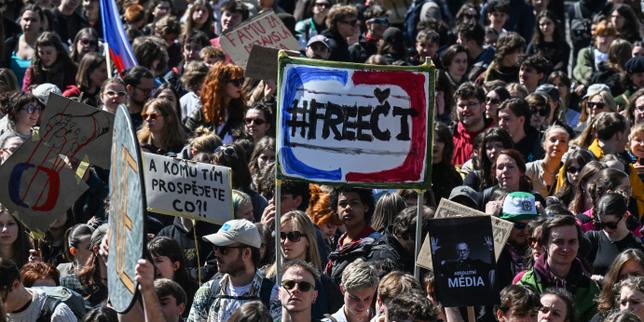
The independence of the Czech Republic’s public broadcasters, Česká televize (ČT) and Český rozhlas (ČRo), is currently undergoing a stress test dictated by a specific legislative and economic bottleneck. While political rhetoric often frames this as a battle over editorial bias, the actual vulnerability lies in the Dependency Triangle: the intersection of executive control over funding levels, the appointment mechanism of oversight councils, and the technological transition of media consumption.
To understand the fragility of the Czech media ecosystem, one must analyze the mechanisms that allow state actors to exert pressure without direct censorship. This is not a "takeover" in the traditional sense; it is a gradual tightening of the operational environment that forces self-censorship or structural decay.
The Dual-Oversight Chokepoint
The primary mechanism of influence is the Broadcasting Council Model. In the Czech Republic, the councils for ČT and ČRo serve as the buffers between the public and the broadcasters. However, their composition is determined by the Chamber of Deputies, creating a direct feedback loop between the legislative majority and the media’s executive leadership.
This structure creates three distinct operational risks:
- Director-General Vulnerability: The council possesses the power to appoint and dismiss the Director-General. When the council’s makeup shifts toward a specific political bloc, the Director-General faces a choice: adapt the editorial tone to match the council’s perceived preferences or face dismissal based on technicalities, such as "management failure" or "budgetary mismanagement."
- Budgetary Stagnation as Control: The television license fee, the primary revenue stream for ČT, remained frozen at 135 CZK for fifteen years. Inflation over this period effectively halved the broadcaster's purchasing power. By refusing to index the fee to inflation, the government uses economic attrition to limit the broadcaster’s ability to produce high-quality investigative journalism or expensive historical dramas, which are the hallmarks of public service value.
- Council Politicization: The process of selecting council members often prioritizes political loyalty over media expertise. This leads to a council that acts as a political proxy, scrutinizing specific investigative programs under the guise of "objectivity" while ignoring systemic operational improvements.
The Economic Asymmetry of Public Funding
The Czech public media model relies on a flat-rate fee system. This system is structurally superior to direct state budget funding, as it theoretically isolates the broadcaster from the annual whims of the finance ministry. However, the isolation is illusory because the nominal value of the fee is a political decision.
The Inflationary Trap
When the cost of content production—driven by global streaming competition and technical infrastructure upgrades—rises while the revenue remains flat, a "quality gap" emerges.
- Production Costs: Rights for sports, international cinema, and high-end equipment have seen an annualized increase of 4% to 7% in the European market.
- Labor Market Pressure: Retaining top-tier journalistic and technical talent requires salaries that compete with private conglomerates like CME (TV Nova) or Seznam.
- Infrastructure Debt: The transition to DVB-T2 and 4K broadcasting requires significant capital expenditure (CapEx).
Without an automatic indexation mechanism, the broadcaster is forced to petition the government for fee increases every few years. This petitioning process turns a statutory right into a negotiation. The government can demand "efficiency reforms" or "content restructuring" in exchange for the financial survival of the institution. This is the definition of soft censorship through fiscal constraint.
Digital Transformation and Regulatory Lag
The shift from linear broadcasting to Video on Demand (VOD) and digital platforms (iVysílání) has outpaced the Czech legislative framework. The current law defines public service largely through the lens of traditional television and radio signals.
This creates a Regulatory Void in three areas:
- Platform Neutrality: Public media is mandated to be accessible, but private distribution networks (ISPs and cable providers) do not always have the same mandate to carry public digital services without friction.
- Data Sovereignty: Unlike private entities, public broadcasters are often restricted in how they use viewer data for personalization, putting them at a disadvantage against global platforms like Netflix or YouTube.
- Revenue Diversification: Strict regulations on advertising for public broadcasters mean they cannot easily pivot to digital ad revenue to offset the stagnation of license fees.
The Mechanism of "Objective" Harassment
A recurring strategy used by political actors in the Czech Republic involves the weaponization of "objectivity" complaints. By flooding the council with complaints regarding specific segments—often those investigating corruption or government mismanagement—politicians create a paper trail of "controversy."
This creates an Atmospheric Chill. Editors and producers, knowing that a specific investigative angle will result in hours of council testimony and potential disciplinary action, may subconsciously gravitate toward "safer" topics. This is not a direct order to stop a story; it is the creation of a high-friction environment for difficult journalism.
The logic follows a predictable sequence:
- An investigative report is aired.
- Public officials denounce the report as "biased" or "unprofessional."
- The Council is pressured to launch an inquiry.
- The inquiry, regardless of the outcome, consumes administrative resources and signals to the staff that certain topics carry a high professional cost.
The Cost of Institutional Capture
If the current trend of legislative and fiscal pressure continues, the Czech Republic faces the "Slovak Scenario"—the complete restructuring of public media into a state-controlled mouthpiece. The transition from public service to state media is marked by the replacement of independent management with political appointees and the alignment of the news agenda with the executive branch's narrative.
The primary defense against this is the Institutional Shielding provided by the Senate. Recent legislative changes aimed to involve the Senate in council appointments to diversify the political influence. However, this is a procedural fix for a cultural problem. If the underlying funding mechanism remains tied to the immediate approval of the lower house, the broadcaster remains on a short leash.
Strategic Realignment Requirements
To stabilize the Czech public media ecosystem, the focus must move beyond "protecting" the status quo and toward structural insulation.
First, the funding model must be decoupled from parliamentary votes. An automatic indexation linked to the Consumer Price Index (CPI) would remove the broadcaster’s need to beg for resources, effectively closing the fiscal chokepoint.
Second, the definition of "public service" must be expanded to include digital-first content, ensuring that the mission remains relevant as linear audiences decline. This includes granting the broadcasters the legal right to compete in the digital space without being hampered by legacy regulations designed for the 1990s.
Third, the oversight councils must transition from political representation to professional competence. This involves a selection process based on a "Matrix of Expertise," requiring a mandatory balance of legal, financial, and media production specialists, rather than a reflection of the current parliamentary seat count.
The survival of independent media in the Czech Republic is not a matter of journalistic courage alone; it is a matter of fixing the broken machinery that currently allows political actors to starve or bully the institutions into submission. The next legislative cycle must prioritize the Mechanical Independence of the media, or the erosion will become irreversible. Managers must prepare for a landscape where "efficiency" is no longer a buzzword, but a survival tactic used to maintain investigative units in the face of dwindling real-world budgets. The only viable path forward is a radical transparency of the Council’s internal logic and a relentless push for a self-adjusting financial model.