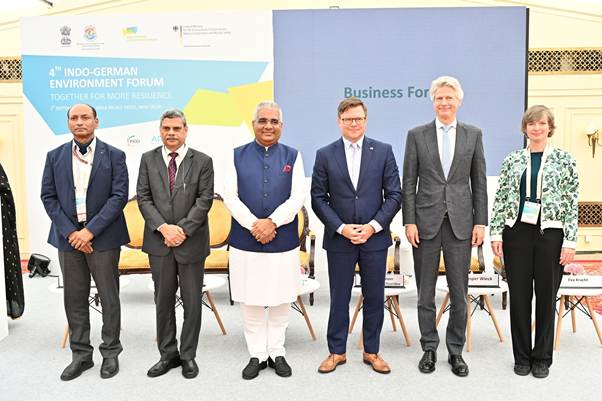
Bilateral environmental agreements frequently suffer from diplomatic performativity, translating broad political intentions into ambiguous mandates without operational metrics. The formalization of the Joint Declaration of Intent on wetland conservation between India and Germany at the fourth Indo-German Environment Forum attempts to bypass this critique by tethering ecological preservation directly to structural decarbonization metrics and financial commitments under the Green and Sustainable Development Partnership. Evaluating the efficacy of this mechanism requires deconstructing the economic and ecological interdependencies that bind industrial output in northern Europe with hydrological management in South Asia.
The Economic Rationality of Ecological Preservation
Wetlands operate as high-efficiency carbon sinks and hydrological buffers, yet traditional market mechanisms fail to price their ecological yield accurately. The market failure stems from externalized benefits: the flood-mitigation and carbon-sequestration capacities of a Ramsar-designated wetland accrue to regional and global actors, while the opportunity cost of land conversion falls exclusively on local economic agents.
To correct this pricing distortion, international frameworks must introduce structured capital transfers. Germany's overarching commitment to mobilize ten billion Euros in new commitments by 2030 through financial and technical cooperation provides the capital architecture required to fund these public goods. Approximately ninety percent of these allocations manifest as loan instruments rather than direct grants, establishing a fiscal model where developing economies leverage external liquidity to underwrite long-term ecological assets.
This creates a specific economic equation:
$$\text{Net Ecological Value} = \sum \left(C_{\text{seq}} + H_{\text{mit}}\right) - \left(O_{\text{cost}} + D_{\text{serv}}\right)$$
Where sequestered carbon ($C_{\text{seq}}$) and hydrological mitigation ($H_{\text{mit}}$) must outpace the opportunity cost of alternative land use ($O_{\text{cost}}$) plus the debt servicing obligations ($D_{\text{serv}}$) of the concessional loans. If loan conditions outstrip the localized economic yield of the restored ecosystem, policy failure occurs through premature fiscal strain.
Decarbonization Bottlenecks in Heavy Industry
While ecological corridors and wetlands handle carbon absorption, industrial production matrices dictate total emissions generation. Both negotiating blocks face structural barriers when attempting to decarbonize energy-intensive sectors such as steel, cement, and basic chemicals. These sectors share a common thermodynamic constraint: high-heat requirements that cannot easily be electrified with current grid capacities without risking severe supply-chain contraction.
India's industrial transition involves managing an expanding domestic demand baseline while simultaneously migrating power generation capacity away from fossil fuel inputs. Having already crossed significant non-fossil capacity integration thresholds ahead of schedule, the operational bottleneck shifts from power generation to industrial process heat. Green hydrogen and scalable energy storage represent the primary technological variables capable of resolving this bottleneck, yet their unit economics remain uncompetitive without substantial capital expenditure and technology transfer.
German industrial conglomerates face an analogous cost function, driven by strict regulatory timelines under the European Union emissions trading framework and the phase-out of baseline fossil fuel imports. The bilateral forum acts as a regulatory bridge, allowing European technology providers access to large-scale deployment environments in South Asia, while granting Indian manufacturers access to climate-mitigation capital.
Institutional Capacity and Implementation Velocity
The primary point of friction in bilateral environmental compacts is not policy design, but implementation velocity. Institutional capacity at the sub-national level often lags behind federal declarations. When municipal or state bodies are tasked with executing wetland restoration strategies, they encounter three distinct structural hurdles:
- Data Deficits: Baseline hydrological mapping and real-time carbon flux measurements are missing for secondary and tertiary wetland networks.
- Resource Misalignment: Technical expertise is centralized in national capitals, leaving localized administrative units underequipped to manage complex bio-remediation projects.
- Stakeholder Fragmentation: Conflicting incentives between agricultural expansion, urban real estate development, and conservation mandates routinely stall project execution.
Overcoming these barriers requires standardized frameworks for data sharing and institutional training, moving beyond political sign-offs into operational protocols. The inclusion of three bilateral working groups focusing explicitly on climate change, biodiversity, and circular economy business models attempts to address this operational lag. By institutionalizing regular technical reviews, the framework attempts to transform high-level political intent into auditable benchmarks.
Deploy capital reserves toward sub-national technical integration units immediately. Link upcoming tranches of the ten billion Euro financial commitment directly to verified milestone completions in hydrological mapping and industrial process-heat retrofitting rather than general policy enactments.