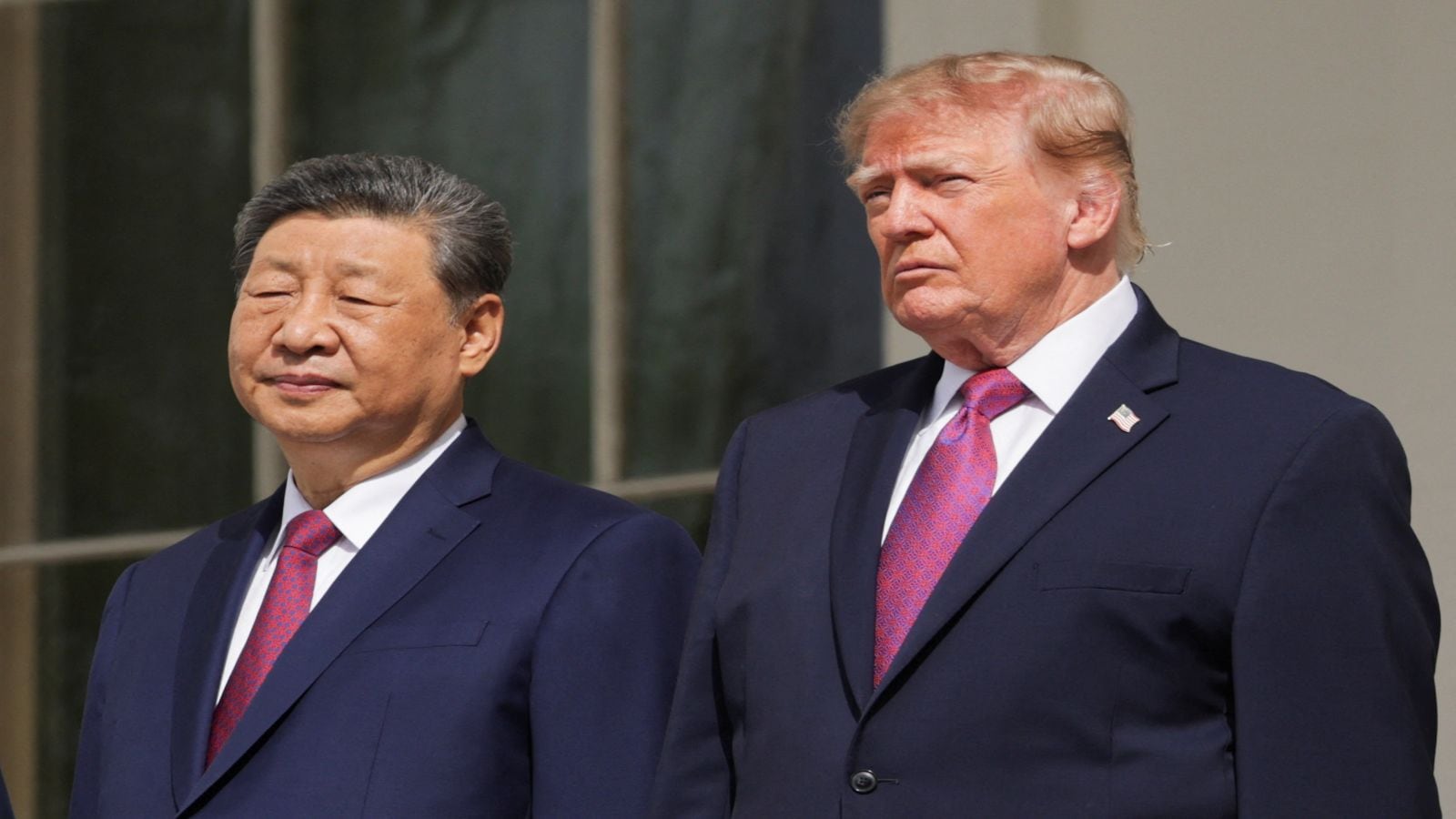
Diplomatic engagements at the highest executive level operate less as interpersonal communications and more as high-stakes calibration exercises between sovereign entities. When a visiting head of state enters the executive residence, the visible pageantry serves to anchor a complex machinery of trade policy, security posture, and industrial signaling. Analyzing these events requires moving past diplomatic normalization and examining the underlying incentive structures, systemic constraints, and game-theoretic constraints governing state-to-state friction.
The Architecture of Executive Signaling
Every diplomatic reception functions through calculated friction and alignment. State visits carry an asymmetric weight because they signal domestic legitimacy while establishing international boundaries. The core mechanism is not the exchange of rhetoric, but the reduction of uncertainty between rival power blocs.
When structural imbalances exist within bilateral trade or technological supply chains, a formal summit acts as an information-revealing protocol. Both administrations test the resolve of the other regarding red lines in industrial subsidies, capital controls, and geopolitical alignments. The mechanics of these negotiations rely on credible commitments rather than verbal assurances. Because neither state can afford public capitulation, agreements are filtered through a complex web of incremental concessions and bureaucratic deferrals.
+---------------------------+     Signals Intent      +---------------------------+
|                           | ----------------------> |                           |
|   Visiting State Actor    |                         |     Host State Actor      |
|                           | <---------------------- |                           |
+---------------------------+    Enforces Constraint  +---------------------------+
The Industrial Policy Cost Function
Beneath the diplomatic protocol lies a rigid economic cost function. Both superpowers operate under heavy internal industrial pressures. For export-oriented manufacturing economies, maintaining industrial capacity requires sustained external demand, even as trade deficits provoke protectionist domestic policies in importing nations.
The trade-off manifests in distinct optimization problems:
- Domestic political survival depends on protecting legacy manufacturing sectors from external shocks.
- Global technological dominance requires open access to advanced semiconductor design, rare earth elements, and software supply chains.
- Capital allocation must balance short-term consumer price stability against long-term national security self-reliance.
When executive leadership meets, the discussion centers on redefining this cost function. Tariffs and export controls are deployed as marginal costs designed to shift the competitor's production curve. If the marginal cost of compliance exceeds the expected return of defiance, policy adjustments follow. However, because both economies are deeply intertwined, unilateral decoupling remains structurally inefficient, forcing a return to managed competition.
Information Asymmetries and Strategic Ambiguity
Strategic ambiguity is a primary tool for maintaining negotiating leverage. By refusing to explicitly detail retaliatory responses to specific industrial policies, a state preserves its design space.
- Information Extraction: Summits provide a controlled environment to test executive resolve on intellectual property enforcement, market access, and regional security postures.
- Commitment Devices: Joint communiques and press statements serve as costly signals. Violating these public positions incurs domestic and international reputational costs.
- Regulatory Arbitrage: Both nations continuously adjust domestic administrative hurdles to favor national champions while formally adhering to international trade frameworks.
The interaction resembles a repeated game with incomplete information. Each administration attempts to deduce the opponent's domestic political threshold—the exact point at which economic pain outweighs ideological stance. Consequently, breakthroughs are rare during public sessions; substantive alignment occurs months prior within working groups, leaving the summit to ratify pre-negotiated parameters.
Systemic Bottlenecks in Bilateral Integration
The friction between major powers is sustained by structural bottlenecks that cannot be resolved through executive fiat. These include legal divergences in property rights, incompatible state-capitalist models versus market-driven capital allocation, and divergent national security definitions applied to commercial technology.
Fixing these imbalances requires mutual recognition of systemic limits. As long as economic interdependence remains a vector for geopolitical leverage, bilateral engagements will oscillate between managed cooperation and structural containment.
Execute long-term capital allocation strategies by assuming persistent friction in cross-border technology transfers, treating regulatory divergence as a permanent operating cost rather than a temporary disruption.