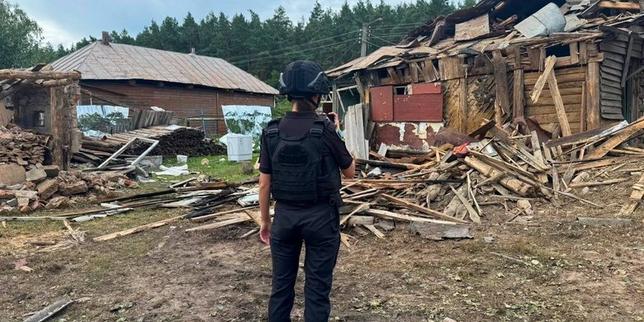
Strategic friction in protracted interstate conflict operates through predictable vectors of material exhaustion and demographic depletion. When operational updates report cumulative casualties across multiple municipal jurisdictions without a corresponding shift in territorial control, the underlying dynamic is not tactical stagnation. Rather, it represents a calculated war of attrition where each operational node functions as a pressure valve designed to test adversary sustainment thresholds. Deconstructing the mechanics of cross-border strikes and urban casualties requires abandoning sensationalized reporting in favor of structural metrics: force generation rates, air defense saturation limits, and logistical supply chain elasticity.
The Dual-Targeting Cost Function
Modern operational doctrine relies heavily on distributed strikes that force an adversary into defensive resource allocation dilemmas. When strikes hit urban centers simultaneously in distinct territorial zones, the strategic objective extends beyond immediate physical destruction.
[Incoming Threat Vectors] ---> [Shared Air Defense Network] ---> [Resource Allocation Bottleneck] ---> [Terminal Vulnerability]
This dual-targeting approach imposes a severe cost function on defending command structures:
- Resource Diversion: High-value interceptor missiles are consumed to neutralize asymmetric, low-cost delivery systems.
- Command Fatigue: Decentralized regional command posts must process simultaneous threat rings, increasing decision latency.
- Infrastructure Degradation: Civilian nodes absorb kinetic impact, forcing state apparatuses to divert financial and logistical capital from front-line logistics toward domestic triage and structural reconstruction.
The casualty figures reported by regional authorities serve as lagging indicators of this broader fiscal and material burn rate. Every life lost in these exchanges marks a permanent reduction in human capital reserves, while the expenditure of long-range munitions depletes stockpiles that require months of industrial manufacturing to replace.
Logistics and the Industrial Baseline
A protracted campaign cannot outlast the industrial capacity feeding it. The current operational tempo functions as a continuous drain on legacy equipment stores inherited from past decades. To evaluate the sustainability of ongoing operations, analysts must examine three primary operational bottlenecks:
- Barrel Wear and Artillery Lifespans: High-intensity artillery exchanges degrade rifled barrels after thousands of rounds, necessitating specialized manufacturing inputs that face global supply constraints.
- Spare Parts Deficit: Mechanized infantry units rely on continuous maintenance loops. A shortage of specific electronic components or hydraulic assemblies converts mobile combat power into static defense assets.
- Fuel Distribution Networks: Pipeline vulnerabilities and mobile tanker targeting force logistics planners into complex, high-friction distribution patterns that consume a significant percentage of the fuel they are attempting to deliver.
When these industrial realities collide with political directives, front-line commanders must ration ammunition and prioritize specific defensive sectors. This rationing manifests publicly as shifting frontlines or fluctuating casualty counts, mirroring the ebb and flow of manufacturing output rather than pure tactical brilliance.
Demographic Attrition and Force Generation
Territorial acquisition is ultimately a byproduct of infantry occupation, making human capital the most constrained resource in prolonged engagements. Mobilization structures face severe diminishing returns over time. The initial waves of volunteers are replaced by conscription models that require extensive training pipelines before units achieve operational readiness.
Casualty accumulation among experienced junior officers and non-commissioned officers erodes unit cohesion at the tactical level. Without seasoned leadership, large formations experience a drop in synchronization efficiency. This manifests as higher casualty ratios during offensive maneuvers and reduced responsiveness during defensive retreats. State actors attempt to counter this through technological substitution, deploying uncrewed systems and automated reconnaissance networks to preserve frontline personnel. However, remote platforms cannot hold ground or clear urban terrain, ensuring that the human cost remains an unavoidable variable in the overall equation of state survival.
Intelligence Integration and Targeting Loops
The speed of modern reconnaissance-strike complexes has compressed decision cycles from hours to minutes. Commercial satellite imagery, signals intelligence, and localized spotters feed information directly into automated fire-direction systems. This transparency makes massed concentrations of personnel or equipment extremely vulnerable to precision counter-battery fire.
To mitigate this transparency, forces on both sides have adopted disaggregated deployment patterns. Squad-sized elements operate independently across wide frontages, relying on secure, decentralized communication nodes. While this dispersion reduces vulnerability to area-effect munitions, it complicates logistics and command oversight. Senior leadership trades control for survivability, accepting the risk of tactical fragmentation in exchange for strategic persistence.
The Strategic Horizon
The trajectory of the conflict points toward a sustained equilibrium of mutual exhaustion, where operational pauses are dictated strictly by inventory replenishment cycles rather than diplomatic breakthroughs. As industrial bases are forced to transition from rapid-drawdown models to sustainable wartime production baselines, the intensity of engagements will calibrate directly to factory output. The state that successfully preserves its industrial infrastructure, secures uninterrupted raw material supply chains, and manages demographic degradation with maximum efficiency will dictate the eventual terms of termination. All other metrics remain secondary noise in the calculus of endurance.


/i.s3.glbimg.com/v1/AUTH_1f551ea7087a47f39ead75f64041559a/internal_photos/bs/2025/P/p/LLF10DRp2WoUISXryrUQ/whatsapp-image-2025-12-02-at-20.06.57.jpeg)