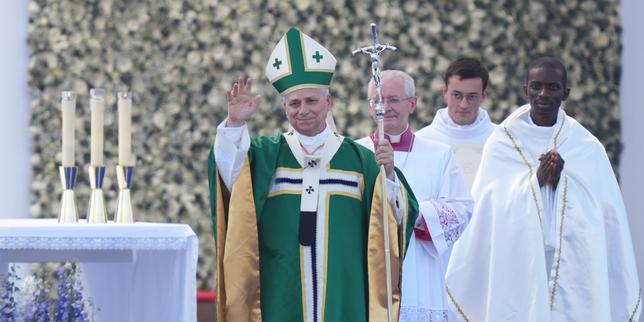
Mass public gatherings orchestrated by institutional hierarchies operate on precise logistical, symbolic, and operational frameworks. When a high-profile figure like a pope holds a major liturgical event—such as a mass in Lourdes—the undertaking functions as an exercise in complex event architecture, crowd dynamics management, and institutional signaling. Analyzing such events requires moving past surface-level descriptions of crowds and imagery to examine the underlying mechanisms driving media framing, spatial organization, and state-church coordination.
The Logistics Matrix of Mass Liturgical Assemblies
Hosting hundreds of thousands of attendees in a localized pilgrimage center like Lourdes demands a strict operational blueprint that integrates municipal infrastructure, security protocols, and liturgical pacing.
The primary constraint in any large-scale outdoor assembly is throughput capacity. Ingress and egress corridors must be calculated using spatial coefficients that account for maximum density thresholds to prevent compression incidents. Security perimeters function as multi-tiered filtering systems, separating vehicular traffic from pedestrian zones while maintaining emergency access vectors.
- Zone Segmentation: Separation of the venue into concentric rings based on accreditation, mobility requirements, and general admission.
- Medical Infrastructure: Decentralized triage stations positioned along natural drainage and exit paths, staffed to handle dehydration, minor trauma, and acute medical emergencies typical of elderly or vulnerable pilgrim demographics.
- Communication Redundancy: Establishing closed-loop radio networks and localized cellular boosters to maintain command-and-control continuity during network congestion.
These operational constraints reveal that the apparent spontaneity of a mass religious gathering is actually a highly engineered administrative output. The cost function of such an event involves balancing public safety expenditure against the projected symbolic and economic yield for both the host region and the sponsoring institution.
Symbolic Architecture and Visual Signalling
Media coverage of papal events heavily relies on visual semiotics. Images of open-air altars, vast congregations, and ritual gestures serve distinct institutional signaling functions. From a strategic communications perspective, these visuals project institutional continuity, global reach, and emotional resonance.
The deployment of iconography follows a deliberate grammar. The altar configuration, vestments, and spatial orientation are standardized to reinforce historical continuity while adapting to modern broadcast requirements. Television and digital media capture mechanisms are integrated directly into the spatial design, ensuring that camera sightlines align with the focal points intended by the organizers.
[Institutional Intent]
       │
       ▼
[Spatial Choreography & Altar Design]
       │
       ▼
[Broadcast Optimization & Framing]
       │
       ▼
[Global Audience Reception & Institutional Legitimization]
This causal chain explains why specific angles and moments—such as quiet prayer amid a massive crowd—are prioritized in media output. They synthesize individual piety with collective scale, reinforcing the perceived relevance and authority of the institution.
Economic and Municipal Externalities
A papal visit functions as a massive, compressed shock to local economic systems. Host cities experience extreme volatility in service demand, straining hospitality, transportation, and sanitation sectors.
- Demand Surges: Immediate, short-term spikes in lodging and food service pricing, followed by post-event capacity contraction.
- Infrastructure Utilization: Temporary stress on public transit networks, requiring schedule optimization and subsidized shuttle integration.
- Fiscal Impact: Direct municipal expenditures on security and sanitation offset by long-term destination branding value and increased tourism baseline metrics.
Evaluating the success of these events requires analyzing the ratio of public infrastructure investment to the sustained increase in regional visibility. Unlike recurring athletic tournaments, papal visits rely on unique spiritual and cultural motivations that drive repeat pilgrimage behaviors over decades rather than immediate seasonal returns.
Institutional Adaptation and Modern State Relations
The interaction between the Vatican and secular state apparatuses during these visits illustrates modern diplomatic protocols. The state provides security, airspace management, and diplomatic immunities, while the religious authority provides cultural cohesion and international visitor influxes.
This relationship operates through institutional bargaining. The state secures domestic political alignment with Catholic constituencies and international prestige, while the religious body secures freedom of movement and operational support for its global leadership.
To optimize future large-scale papal deployments, organizers must transition from reactive crowd control models to predictive data-driven density simulations, integrating real-time telemetry from mobile networks and public transit turnstiles to dynamically reroute pedestrian flows before bottlenecks form.