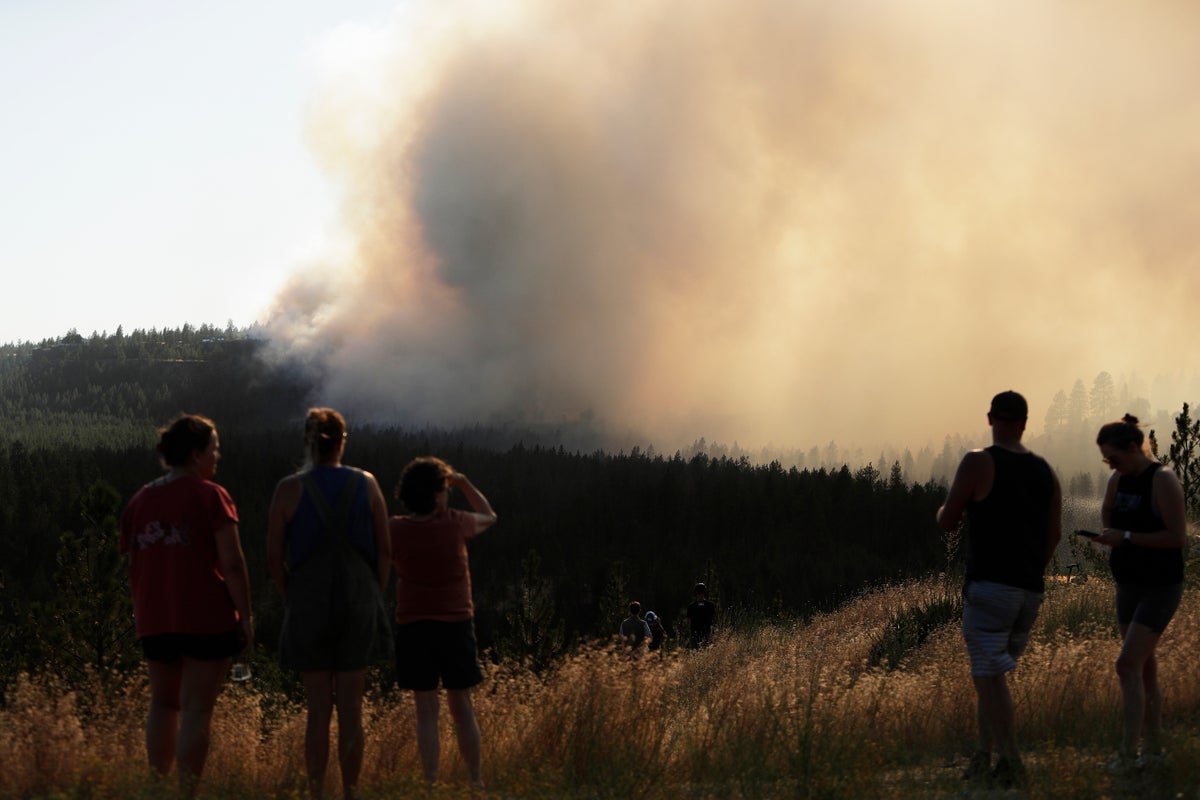
Disaster response in the American West has shifted from a crisis management problem to a structural capacity failure. When rapid-onset fire events bypass traditional rural perimeters and breach municipal boundaries, standard containment models collapse. Analyzing the Spokane complex fire requires examining the mechanics of urban-wildland interfaces, the velocity of wind-driven ignition vectors, and the economic toll of high-density structural loss.
The Vector Dynamics of Urban Intrusion
Urban wildfires do not spread through uniform diffusion. They operate on a directional velocity model determined by three primary physical constraints: thermal draft, fuel continuity, and topographical channelling.
When sustained winds range between twenty and forty miles per hour over desiccated timber and grass beds, fire propagation transitions from surface spread to ember casting. In the case of the Spokane event, the Old Trails fire and associated complexes utilized local canyon topography as natural draft tubes. Steep slopes flanking the Spokane River accelerated convective heat transfer, pushing active flame fronts across natural water barriers and directly into residential zones.
This dynamic breaks standard municipal defense parameters. Urban fire departments are engineered for point-source structural fires, not area-wide contiguous ignition. When hundreds of structures catch fire simultaneously within a dense neighborhood like Indian Trail, suppression resources experience immediate saturation. Every structure converted to fuel generates its own micro-climate of radiant heat, accelerating the destruction of adjacent properties independently of the primary front.
The Economic and Infrastructural Cost Function
The magnitude of a natural disaster is measured by the ratio of structural replacement costs to municipal capital reserves. The destruction of over six hundred structures—spanning homes, commercial enterprises, and vital utility nodes—creates an immediate liquidity crisis for local government.
Utility vulnerabilities compound this loss. When mass power shutoffs and grid damage leave tens of thousands of residents without electricity, municipal pumping stations, wastewater facilities, and communication networks operate on emergency redundancy. The economic impact extends beyond direct property write-offs into business interruption losses, temporary housing deficits, and the cost of regional evacuation logistics for roughly sixty thousand displaced individuals.
Federal emergency declarations function as external capital injections, but the velocity of aid deployment rarely matches the velocity of asset destruction. State-level resource pooling, which currently involves thousands of personnel across multiple concurrent fires statewide, stretches mutual aid agreements to their operational limit.
The Policy and Preparedness Deficit
The recurring nature of extreme fire seasons across the Pacific Northwest indicates a permanent alteration in baseline environmental conditions, driven by multi-year drought cycles and elevated baseline temperatures. Zoning laws and building codes in the urban-wildland interface have historically treated wildfire risk as an externality rather than an internal design parameter.
Traditional zoning permits high-density residential development immediately adjacent to unmanaged wildland fuel beds. Without mandated defensible space buffers, class-A fire-rated roofing materials, and underground electrical distribution, municipal expansion acts as an amplifier for wildfire propagation. The absence of these structural safeguards transforms routine seasonal dryness into catastrophic urban loss.
Strategic recovery requires a shift from reactive suppression to structural hardening. Municipalities facing similar topological risks must decouple urban growth policies from wildland vulnerability by enforcing retroactive building envelope upgrades and investing in localized, off-grid water suppression infrastructure capable of operating independently of regional power grids.
WATCH: Washington Wildfire EXPLODES | 600 Buildings Burn As 5,000 Homes Evacuated Near Spokane
This video provides an on-the-ground visual record of the rapid-onset fire dynamics and structural devastation that overwhelmed emergency responders in eastern Washington.
http://googleusercontent.com/youtube_content/1